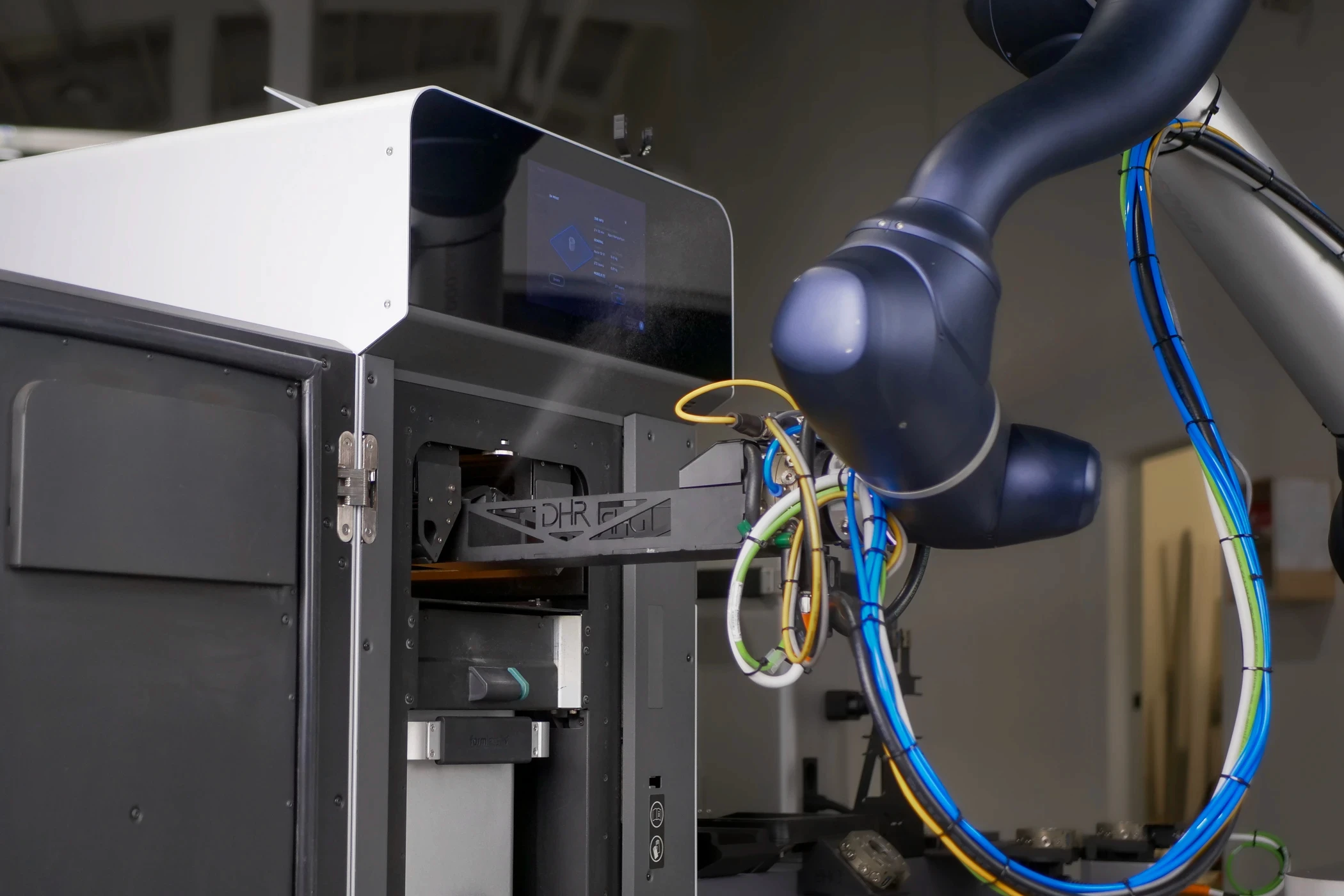
2026
Learn how DHR Engineering’s automation for LuxCreo’s dental manufacturing equipment handles harvesting, washing, curing, and storage with zero manual intervention.
Dental Manufacturing
Automation
INTRO
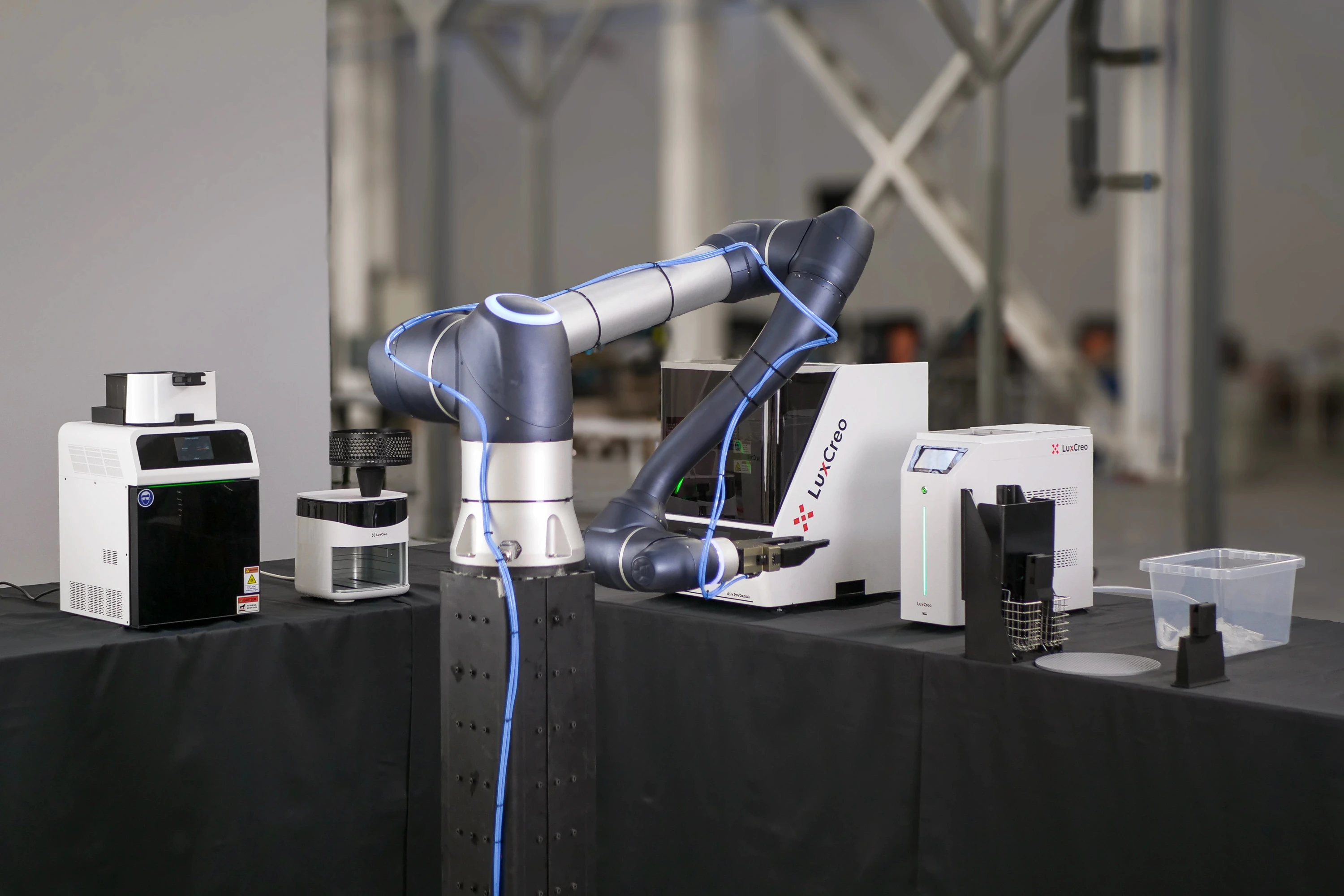
From manual processes to automated dental production
Dental labs producing orthodontic and prosthetic appliances such as clear aligners, denture molds, surgical guides, and occlusal splints increasingly face the same challenge: demand grows faster than manual workflows can scale.
While 3D printing technology has advanced rapidly, downstream manual operations continue to limit throughput and prevent true lights-out manufacturing in orthodontic production. To explore how these constraints can be addressed at industrial scale, DHR Engineering developed an autonomous production cell for clear aligners using LuxCreo’s direct-print dental platform.
The goal is to demonstrate how direct-print dental workflows can be structured, automated, and ultimately scaled into multi-cell production lines. For this specific project, we focused on clear aligners as the example application.
Model printing & thermofolding vs. Direct Printing for Clear Aligners
Traditional clear aligner production relies on a multi-step thermoforming process: printing a physical model with resin, vacuum-forming a plastic sheet over it, and manually trimming the excess. If not automated, this method can be labor-intensive and prone to cumulative errors.
LuxCreo’s direct-print technology fabricates the final aligner directly from a biocompatible photopolymer resin, completely eliminating the need for physical models and the intermediate thermoforming step. For labs focused on speed and high volume, this reduction in process complexity can significantly improve margins and throughput, especially when combined with robotics.
Same-day dentistry and predictable production
One of the most important outcomes of this automation is time compression. By removing thermoforming and manual finishing, the LuxCreo workflow enables a complete scan-to-part cycle within hours rather than days.
For orthodontic clinics, this opens the door to same-day dentistry. For dental labs, it means faster order fulfillment, lower work-in-progress inventory, and the ability to respond quickly to demand spikes.
Automation also improves predictability. Every aligner follows the same validated process, reducing rework and variability. This is particularly important for labs serving multiple clinics or operating as centralized production hubs.
WHAT WE DID
Automation Design for Scalable Dental Manufacturing
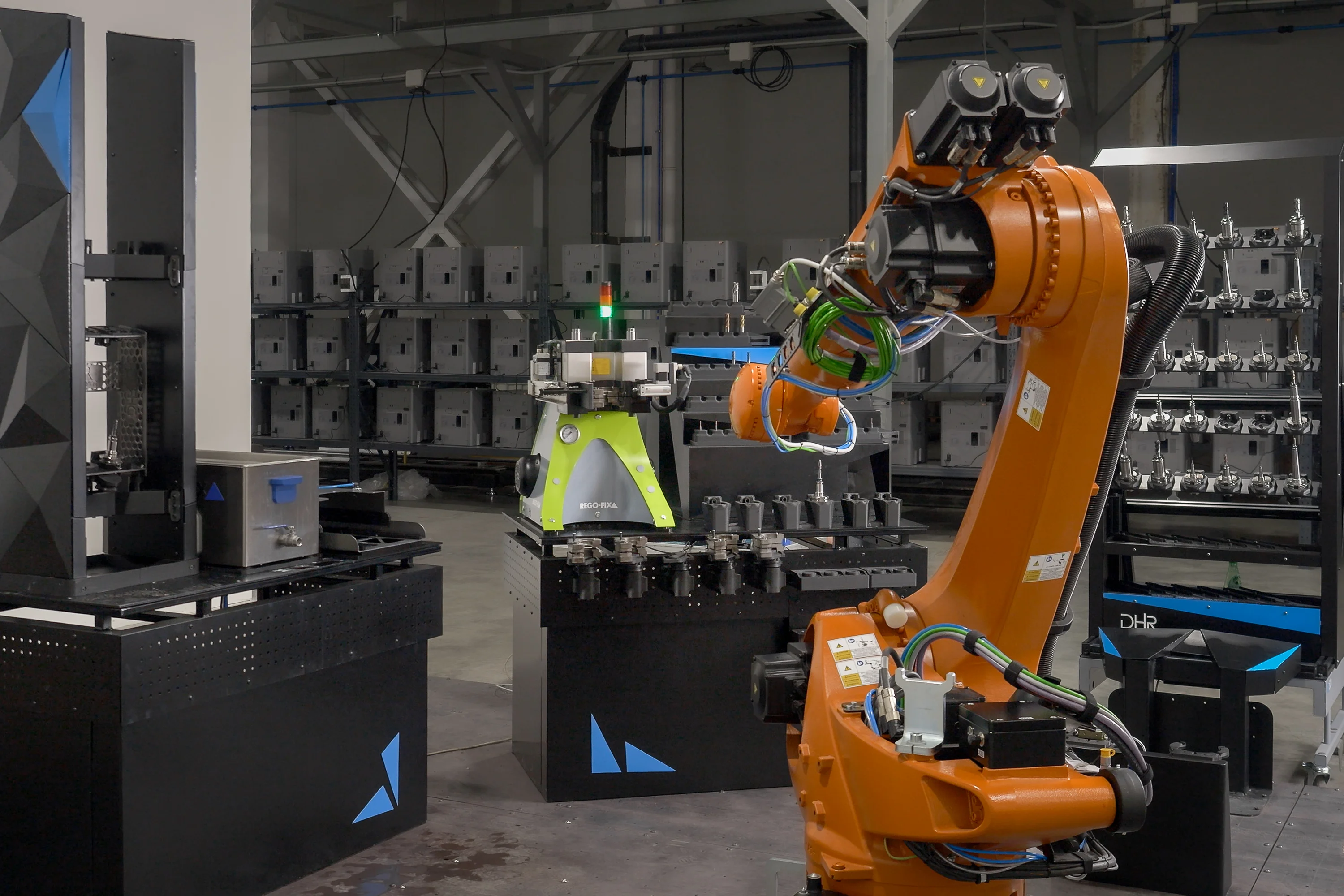
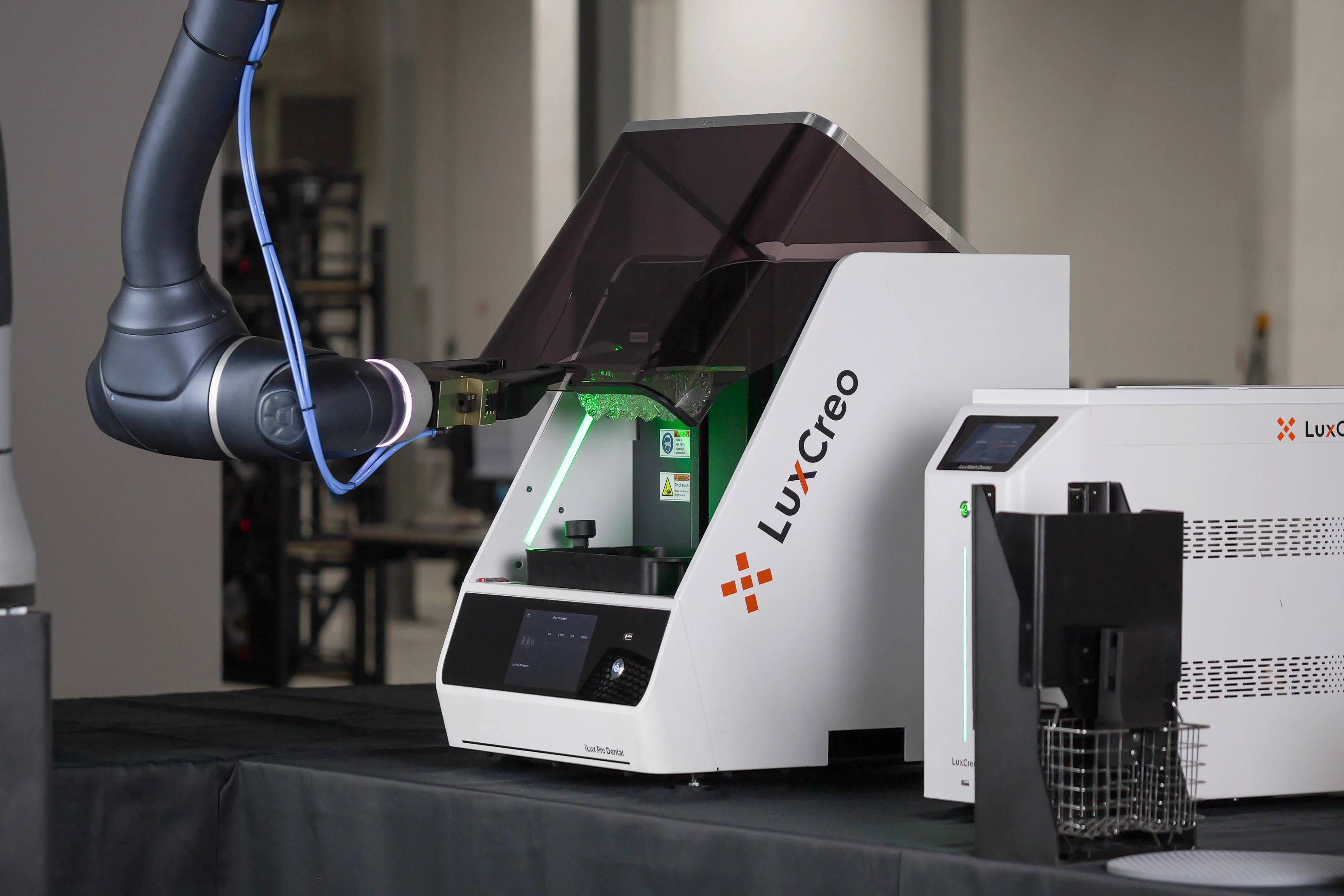
DHR Engineering designed a turnkey manufacturing cell anchored by a central 6-axis robotic arm. The system orchestrates the movement of build platforms and parts through a precise, linear workflow.
1. Custom End-Effectors and Hardware
DHR developed custom hardware to handle the delicate processes of orthodontic aligner production:
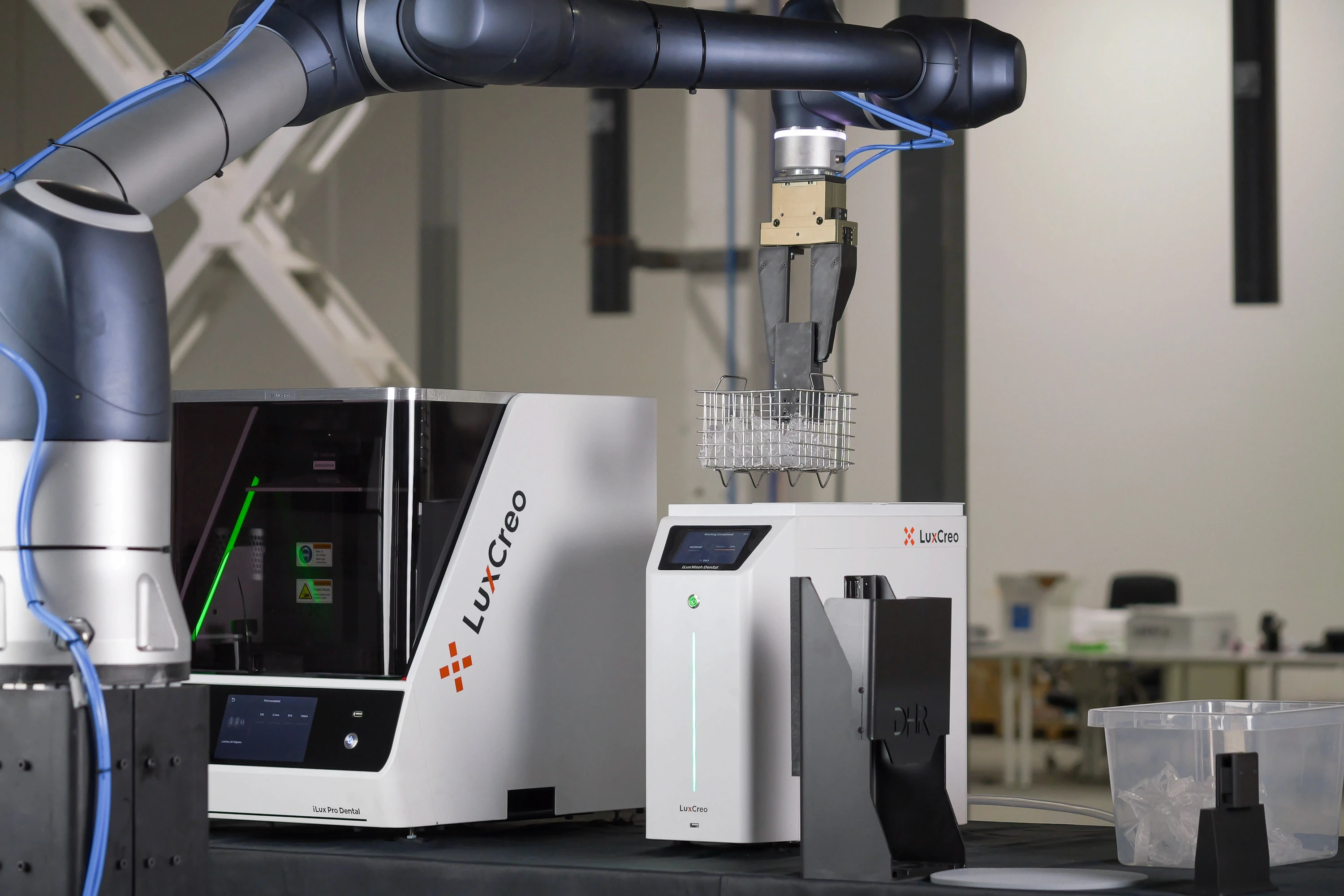
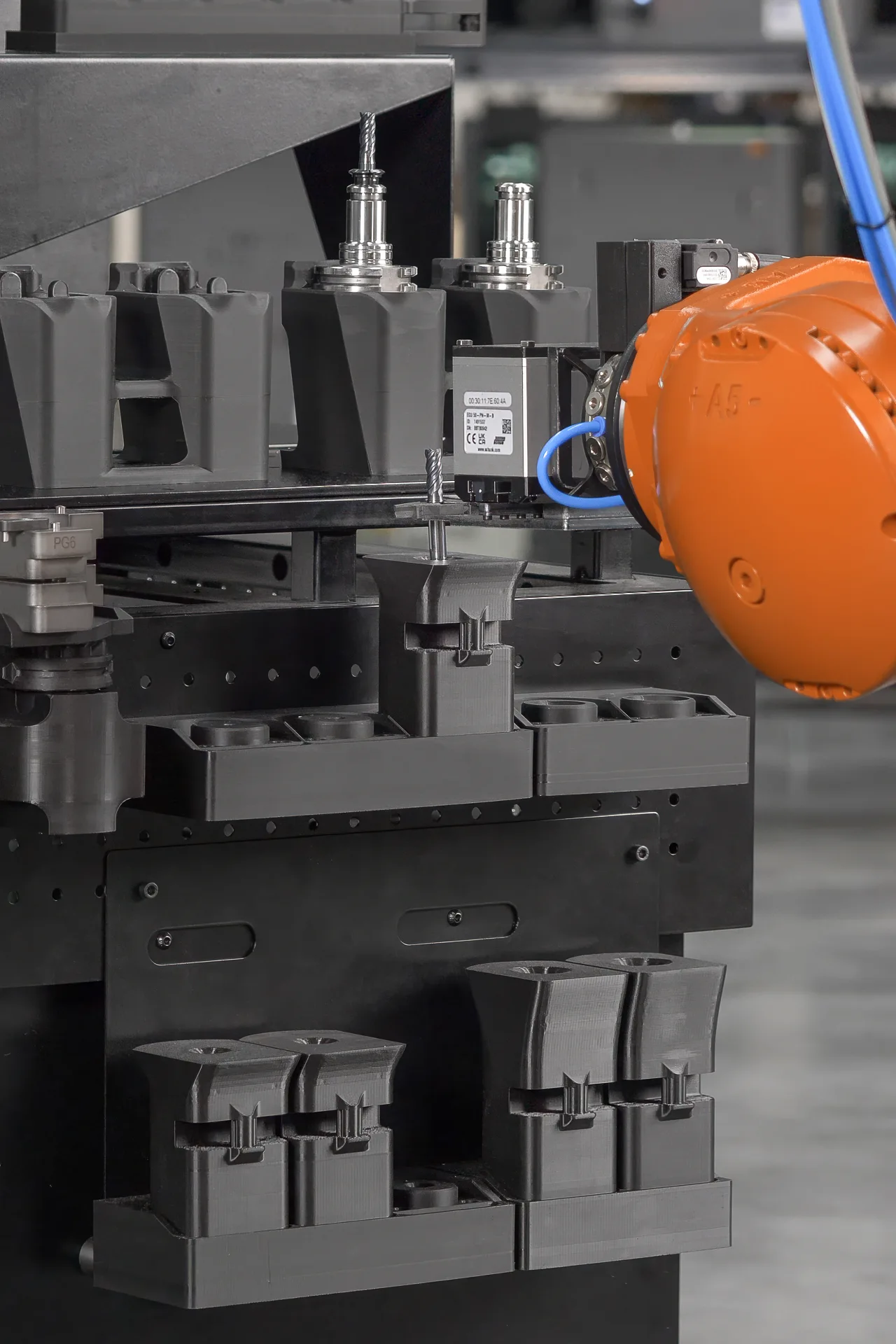
Custom Universal EOAT: Designed to securely handle build platforms and baskets of varying weights and dimensions for LuxCreo's equipment.
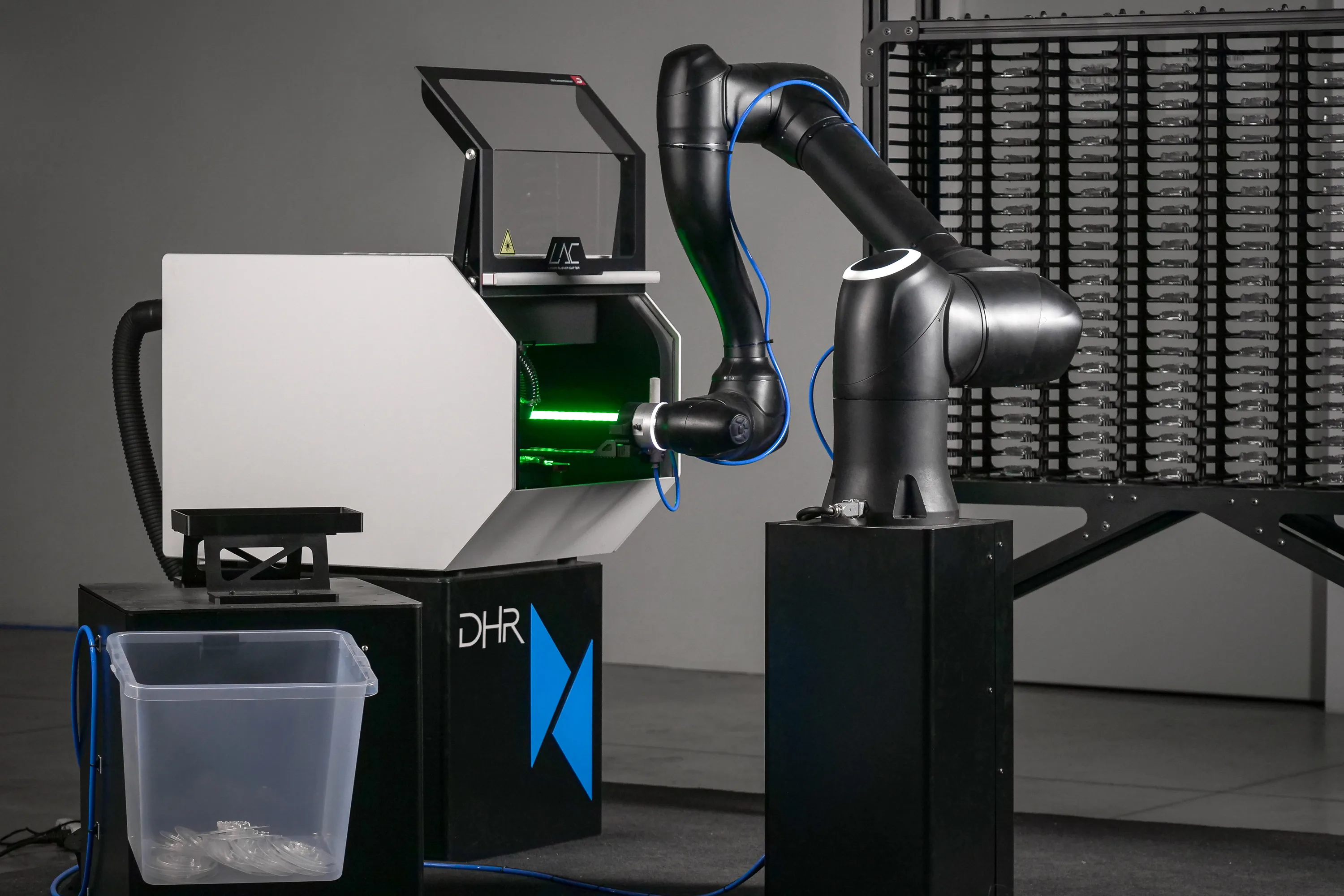
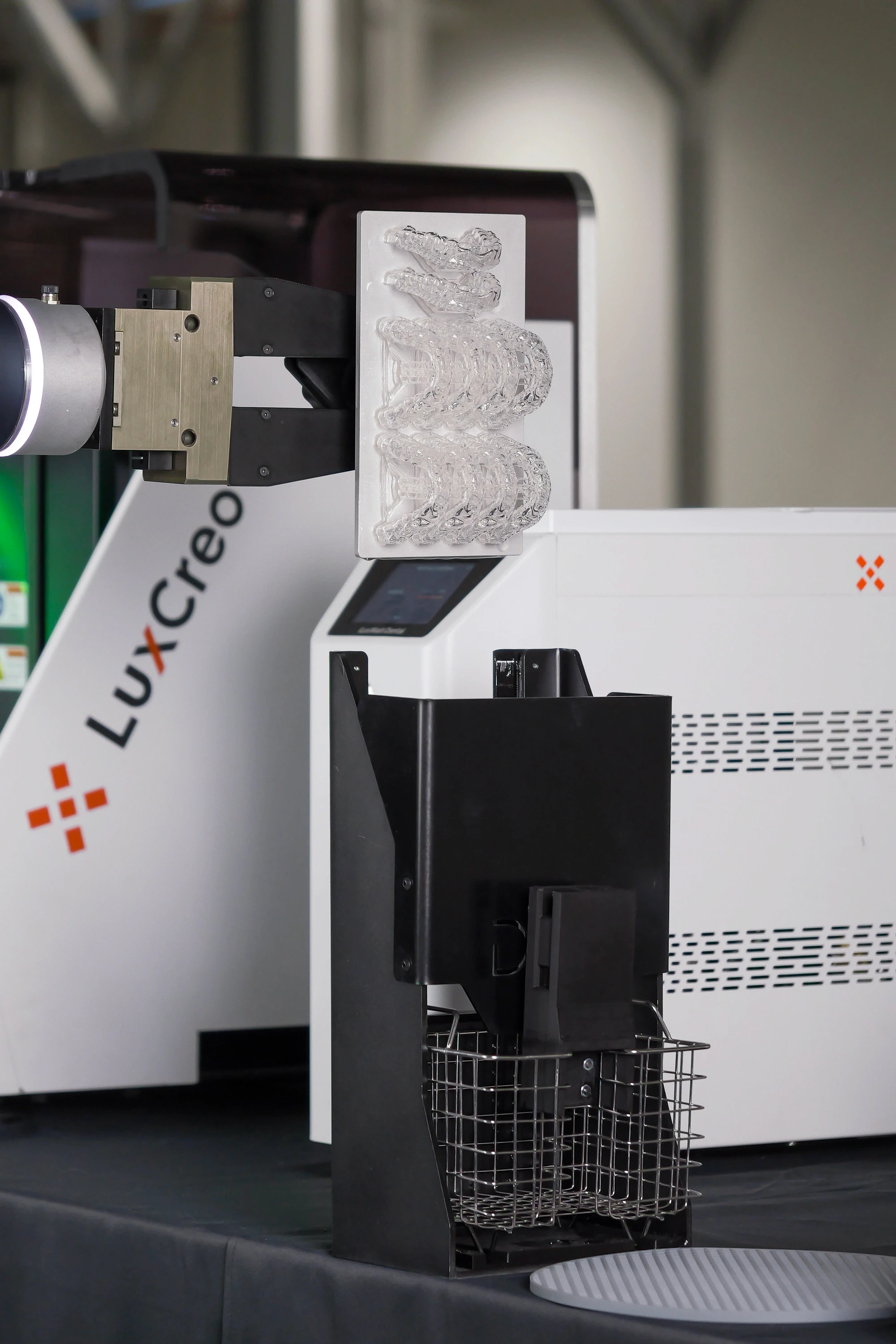
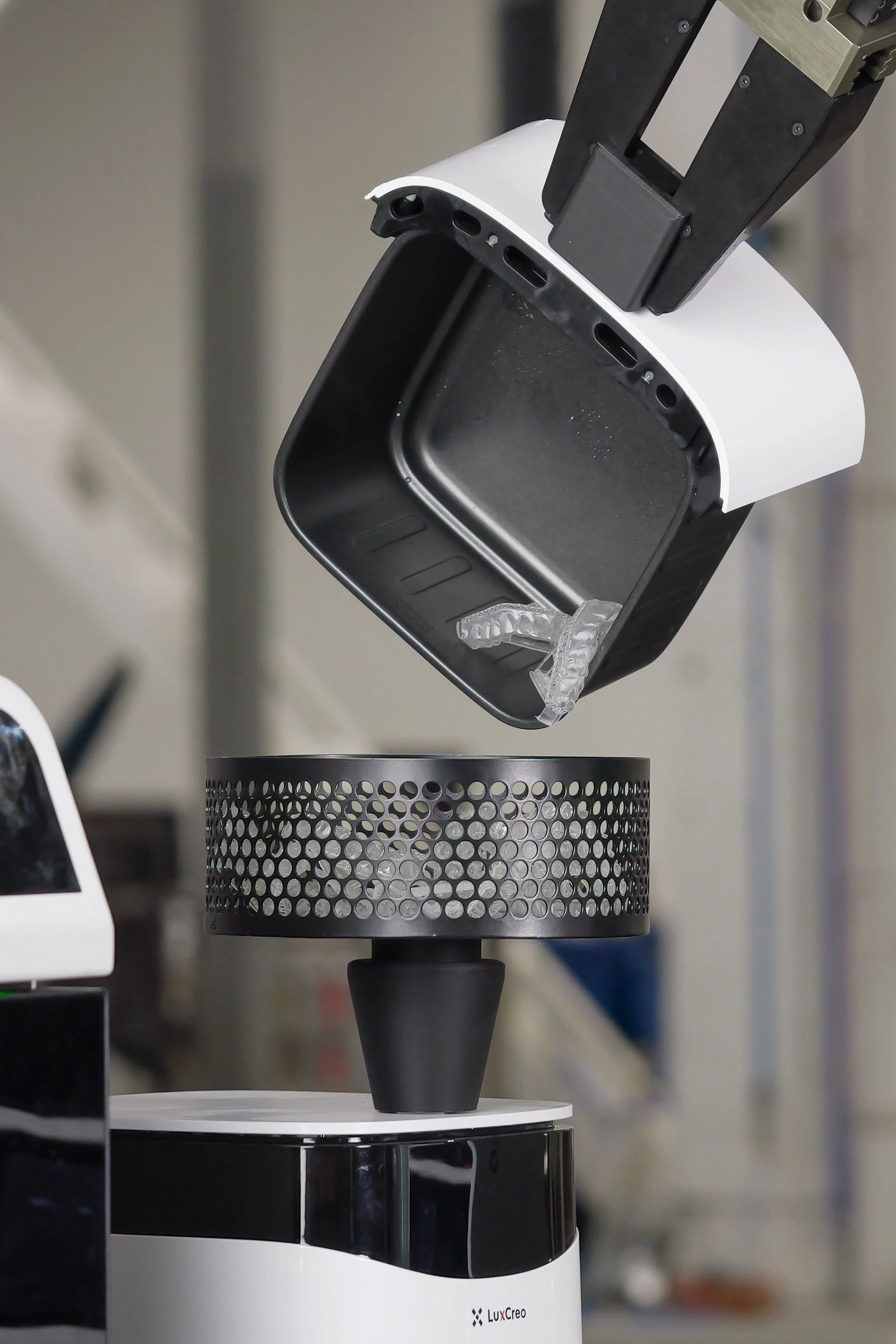
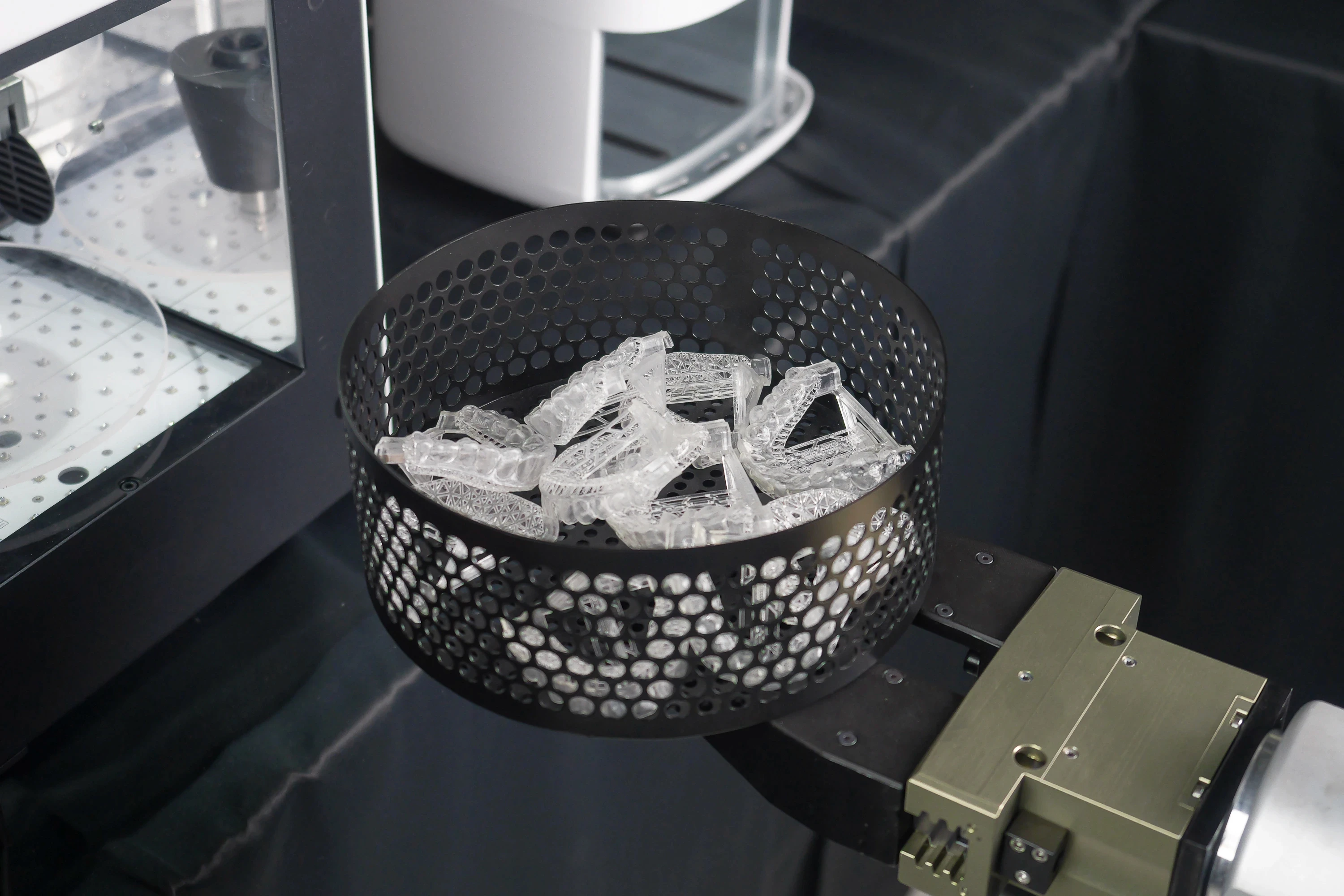
Automated Scraper Station: A custom station where the robot uses a scraper tool to gently remove printed aligners from the platform, dropping them into a wash basket.
Custom Baskets: Engineered for the iLuxCure Pro.
2. The Automated Workflow
The system manages the entire lifecycle of the aligner:
Harvesting: The robot opens the iLux Pro Dental 3D Printer, retrieves the build platform, and moves it to the removal station.
Part Separation: The robot scrapes the aligners into a collection basket and moves the dirty platform to a cleaning station.
Washing: The basket is placed into the iLuxWash Dental unit for automated cleaning.
Baking & Curing: Post-wash, aligners are transferred to the LuxOven Pro and subsequently the iLuxCure Pro to ensure biocompatibility and mechanical strength.
Storage: Finished aligners are moved to a designated storage station, ready for packaging.
End-to-end workflows
Direct Printing vs. Thermoforming for Clear Aligners: Which Automation is Right for You?
Our automation strategy remains the same for different production paths:
SLA Printing Automation for Dental Models (e.g., Formlabs): In our Formlabs Automation Project, the focus is often on high-volume model production. This route is excellent for labs that have already invested heavily in thermoforming infrastructure but need to speed up the model generation phase.
Direct Print Automation (e.g., LuxCreo): As detailed here, this method prints the actual aligner. It is ideal for labs prioritizing speed (same-day dentistry) and eliminating the thermoforming labor entirely. Post-processing involves the removal of printing supports.
Note: Determining the best automated clear aligner systems for dental practices depends heavily on your existing equipment and volume requirements.
Key Performance Indicators
The integration of LuxCreo’s direct-print technology with DHR’s automation delivers:
0% Manual Intervention: The system creates a true lights-out factory capable of running 24/7.
Throughput: A cell with one printer is capable of producing up to 240 clear aligners per day. This number can easily be scaled by simply adding more machines.
Precision: By removing manual trimming, the system utilizes LuxCreo's ±0.1 mm print accuracy for better clinical tracking compared to the ±0.4 mm variance seen in thermoforming.
Cost Efficiency: The combination of direct printing and robotics can yield up to 75% reduction in labor costs.
Applicability across dental appliances
The automation principles extend across the full dental spectrum:
Direct-printed aligners and retainers
Night guards and splints
Surgical guides
Denture bases and try-ins
Diagnostic models
Ready to Automate Your Dental Manufacturing?
We don't just build these systems for ourselves. We engineer custom robotic workcells and unified MES software to turn your resin printing fleet into a 24/7 industrial powerhouse. Scale your output without scaling your headcount.
CONCLUSION
Integrating Automation into Your Dental Workflow
For dental labs asking how to integrate clear aligner automation into existing dental workflows, the answer lies in modularity. You do not need to replace your entire floor at once. By automating specific cells, you can resolve bottlenecks without disrupting upstream processes.
Whether you are looking for affordable clear aligner automation solutions for small dental clinics or industrial-scale lines, the key is custom integration that respects your specific hardware constraints. For labs already using LuxCreo printers, automation can be added without disrupting clinical delivery.
DHR Engineering designs automation that:
Works with existing lab software
Adapts to current scan-to-print pipelines
Scales from pilot cell to full production line
Ready to Automate Your Production Line?
DHR Engineering specializes in solving complex robotic and software integration challenges. If you need to scale your dental production or build a custom manufacturing cell, let’s talk.