2026
DHR's proof of concept for a high-throughput clear aligner trimming cell with the DMU LAC: over 1,000 aligners a day, each trimmed, marked, and sorted into the correct patient tray. The same architecture scales to four LAC machines per robot, producing 5,760 sorted aligners in 24 hours of unattended production.
Dental Manufacturing
Automation
Intro
A laser cutting machine that trims an aligner in 40 seconds automatically sounds like the opposite of a bottleneck. But in aligner labs that want to scale production, it is one of the worst, and the reason is that short time frame itself. Short cycles dictate that a technician must be tethered to the machine, loading and removing a finished part, one by one, roughly every minute. Furthermore, the operator must then manually sort that finished aligner into the correct patient's tray.
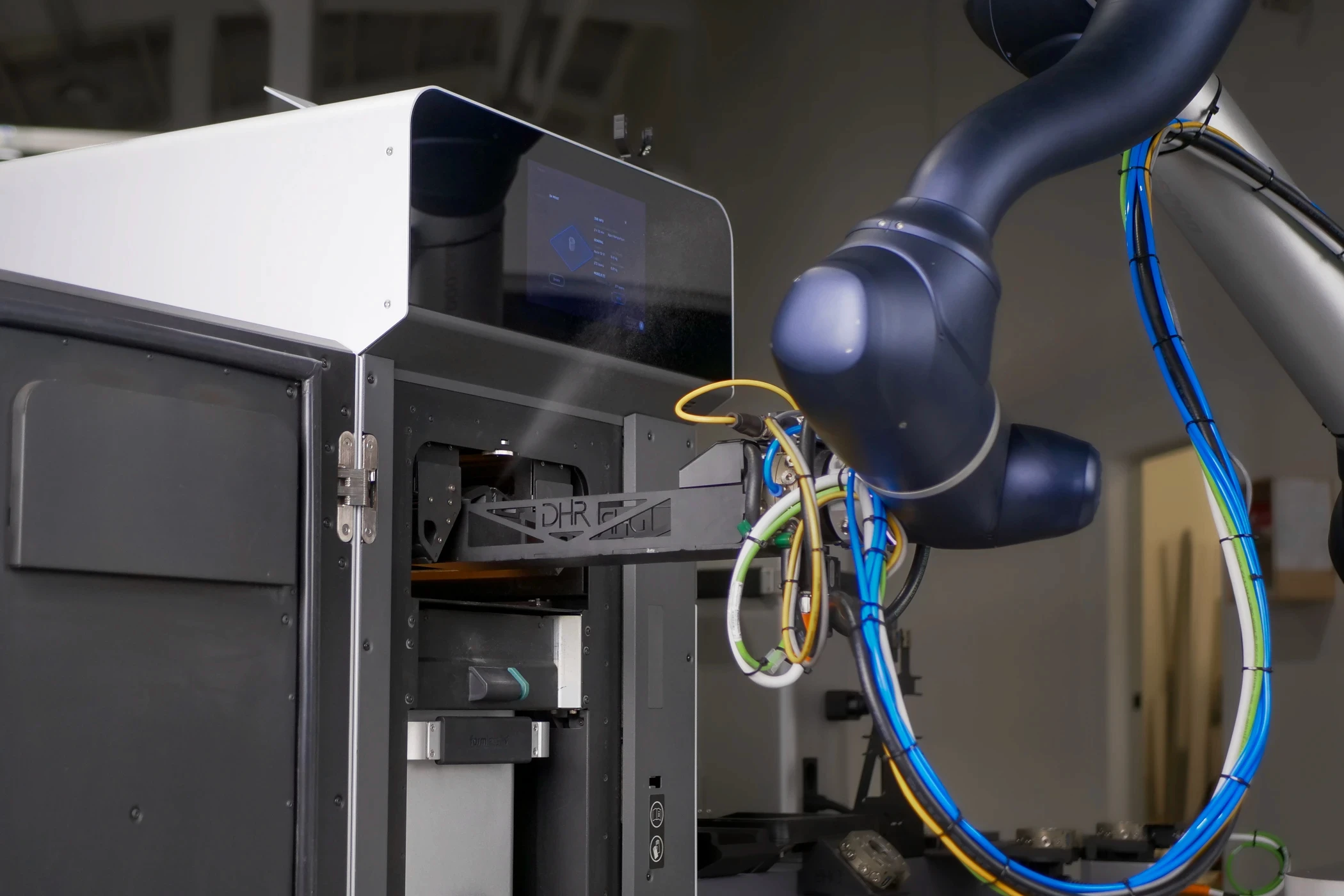
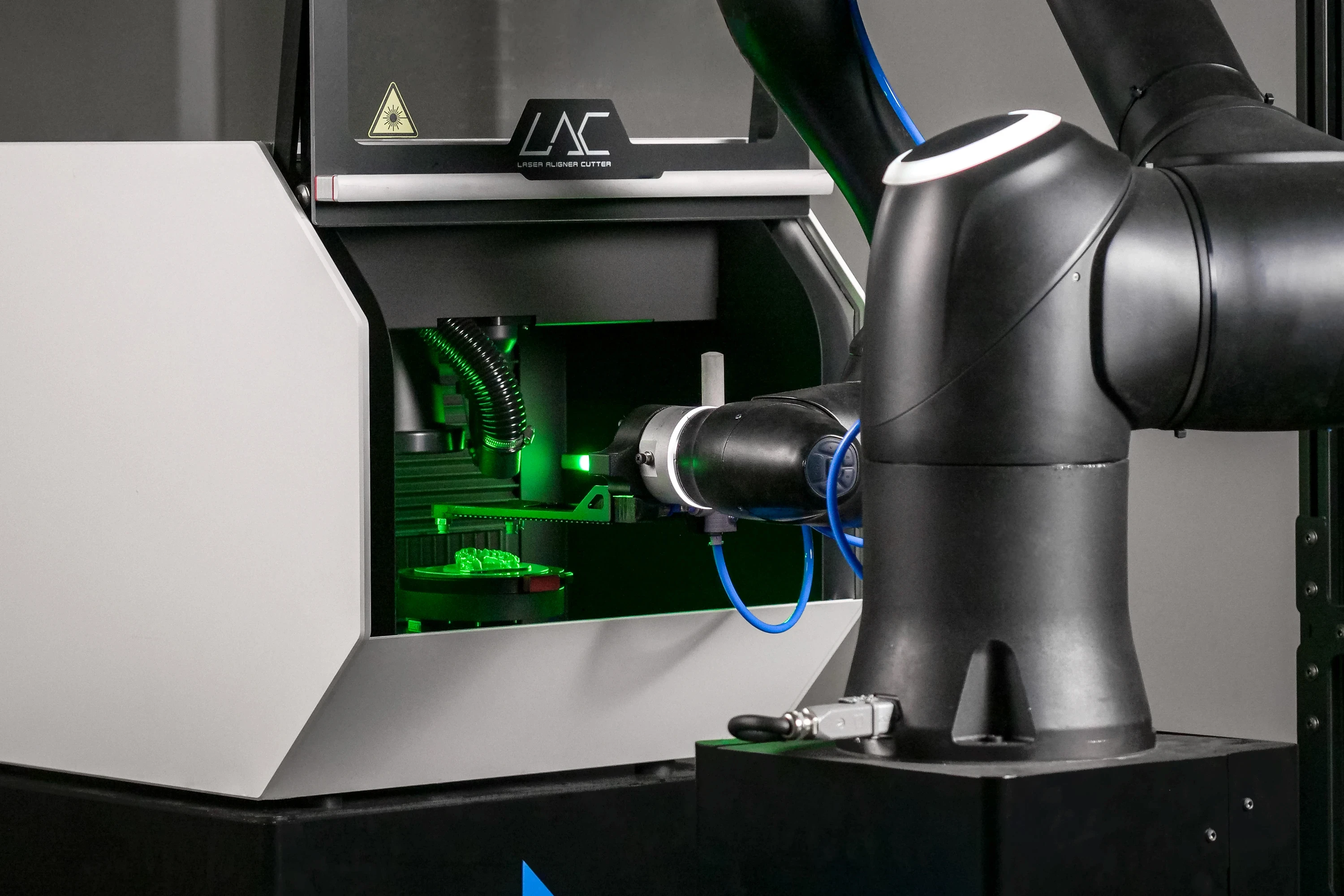
When a lab scales, this manual handling and sorting collapses. DHR Engineering built a proof of concept to break that pattern: a machine tending cell for the LAC (Laser Aligner Cutter) from DMU, running with DMU's SpeedTrim option, which brings trim time down to 40 seconds. The LAC is a CO₂ laser system that cuts thermoformed aligners with sealed edges, requiring no manual post-processing. Paired with the AutoTrim workflow, the LAC reads an optical ID on each sheet, selects the matching trim path on its own, cuts, and laser-marks an identifier onto the finished part.
We chose the LAC deliberately, because the cutting process inside is already automated. Everything still manual sits around the machine rather than inside it: loading, unloading, separating the offcut, quality checking and deciding which patient each finished aligner belongs to. By uniting the LAC's existing optical intelligence with our robotic orchestration, we have combined rapid cutting with high-volume, ready-to-ship sorting.
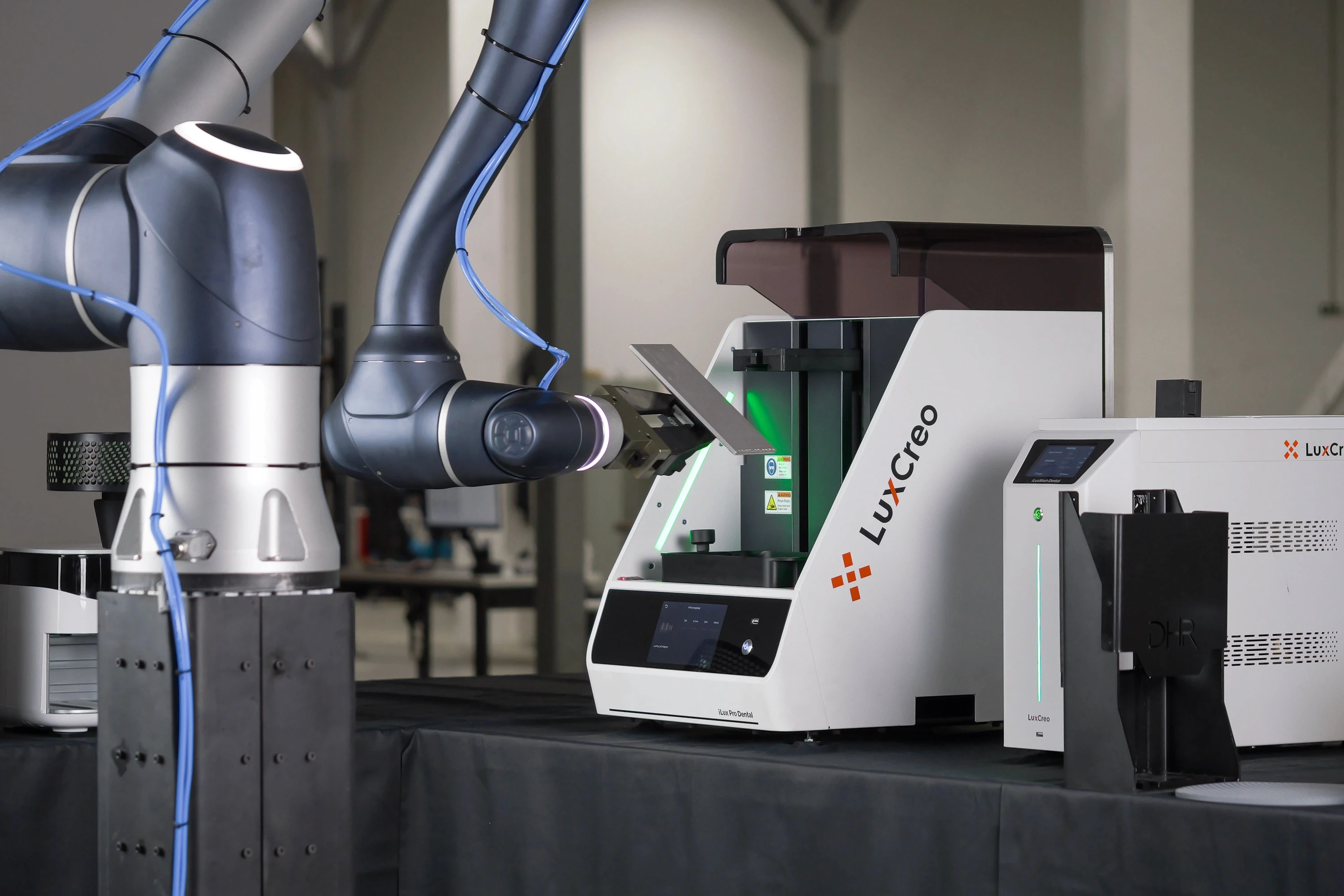
This is the second half of our dental automation PoC series. Our fully automated SLA printing workflow for dental aligner molds proved the capacity to yield 7,280 dental arch models in 24 hours with no manual intervention, covering printing, washing, curing, and storing. Building on that foundation, automating the aligner trimming process brings us one step closer to the concept of a fully lights-out dental production floor.
Problem
Why manual cutting and sorting do not scale
The short-cycle trap
Machine tending splits into in-cycle and out-of-cycle time. Out-of-cycle work is what an operator can do while a machine runs. A resin printer with a fully loaded build platform may give you hours of it. A laser trimmer gives you a minute or less, which is not enough time to walk to another station and come back, so all of it collapses into standing and waiting.
At full machine utilization, that means a technician performs the same four-step loop, load, wait, unload, sort, around forty times an hour and over three hundred times a shift. Nothing in that loop uses the judgment they were hired for. It is also, predictably, the station with the worst retention and the one nobody wants on a night shift, which is exactly the shift a growing lab needs to open next.
Half the machine hours are already gone
A manufacturer we spoke with recently produces around 700 aligners a day on two LAC machines, with inspection and packing also all manual. At a 2-minute effective cycle, those 700 aligners represent roughly 23 machine-hours out of the 48 the two cutters make available in a day. That is capital equipment already bought, already installed, already depreciating, and working slightly less than half the time.
Growth makes it sharper rather than easier. Labs in this segment strive to grow 10 to 15 percent a month, which doubles volume in five to seven months. The same manufacturer is planning for 2,000 a day. On manually tended machines, at the roughly 350 aligners per machine per day the model above implies, 2,000 a day means about six cutters and a staffed seat at each of them, bought to solve a utilization problem rather than a capacity one.
Sorting is a second full-time job
A treatment plan runs from a handful of stages to fifty or more aligner sets depending on case complexity. Take a 30-stage case as a mid-range example: 700 aligners a day is roughly a dozen patients' worth of parts, produced in a batch where parts for other patients are interleaved. Manual sorting scales linearly with volume, provides no error signal, and is highly prone to mistakes. Since the LAC already reads the ID of every aligner it cuts, this process is ripe for automation. The only thing left is coordinating that data with the robot so every finished part lands in the correct tray.


What we did
A cobot cell built on the ID data the LAC already produces
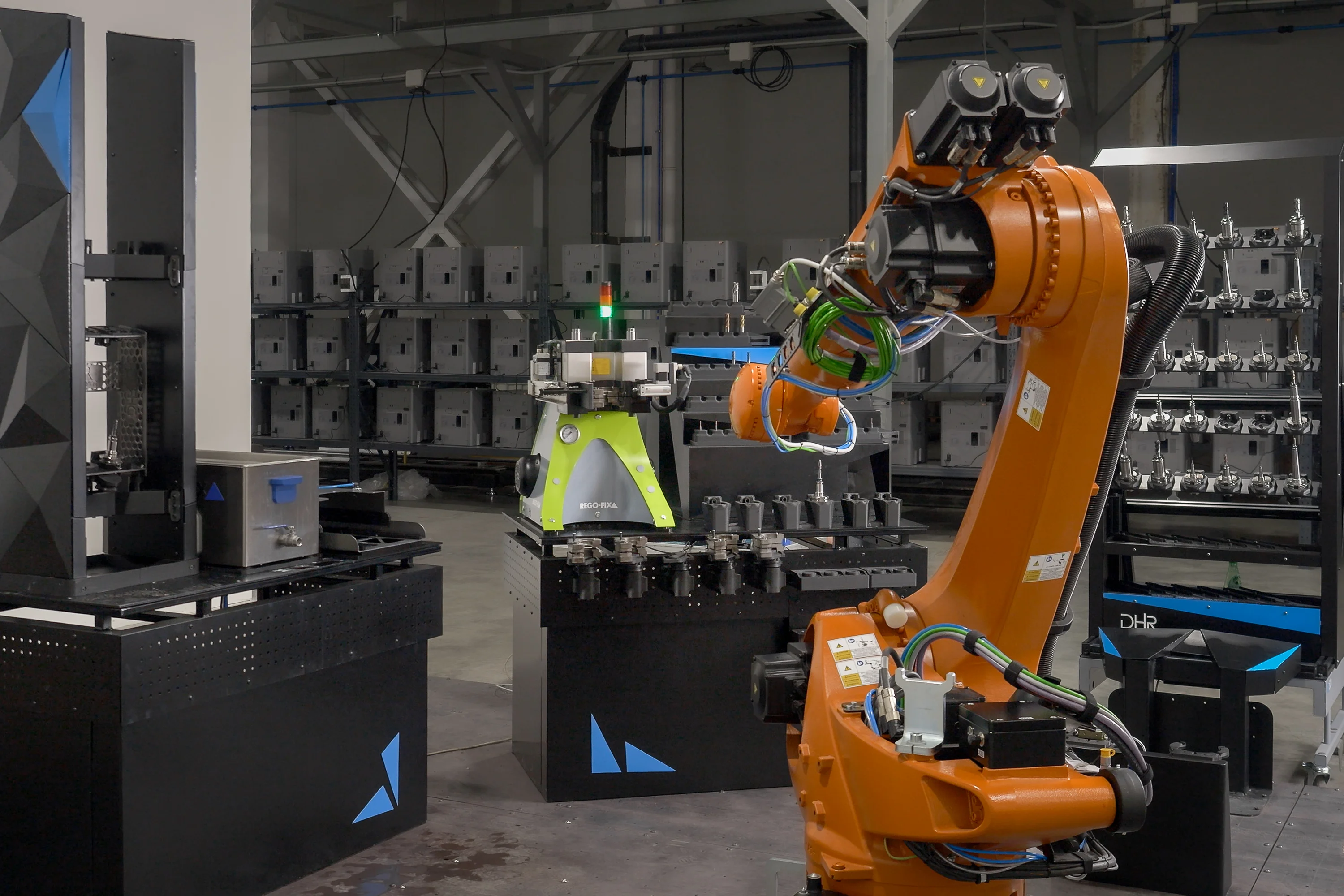
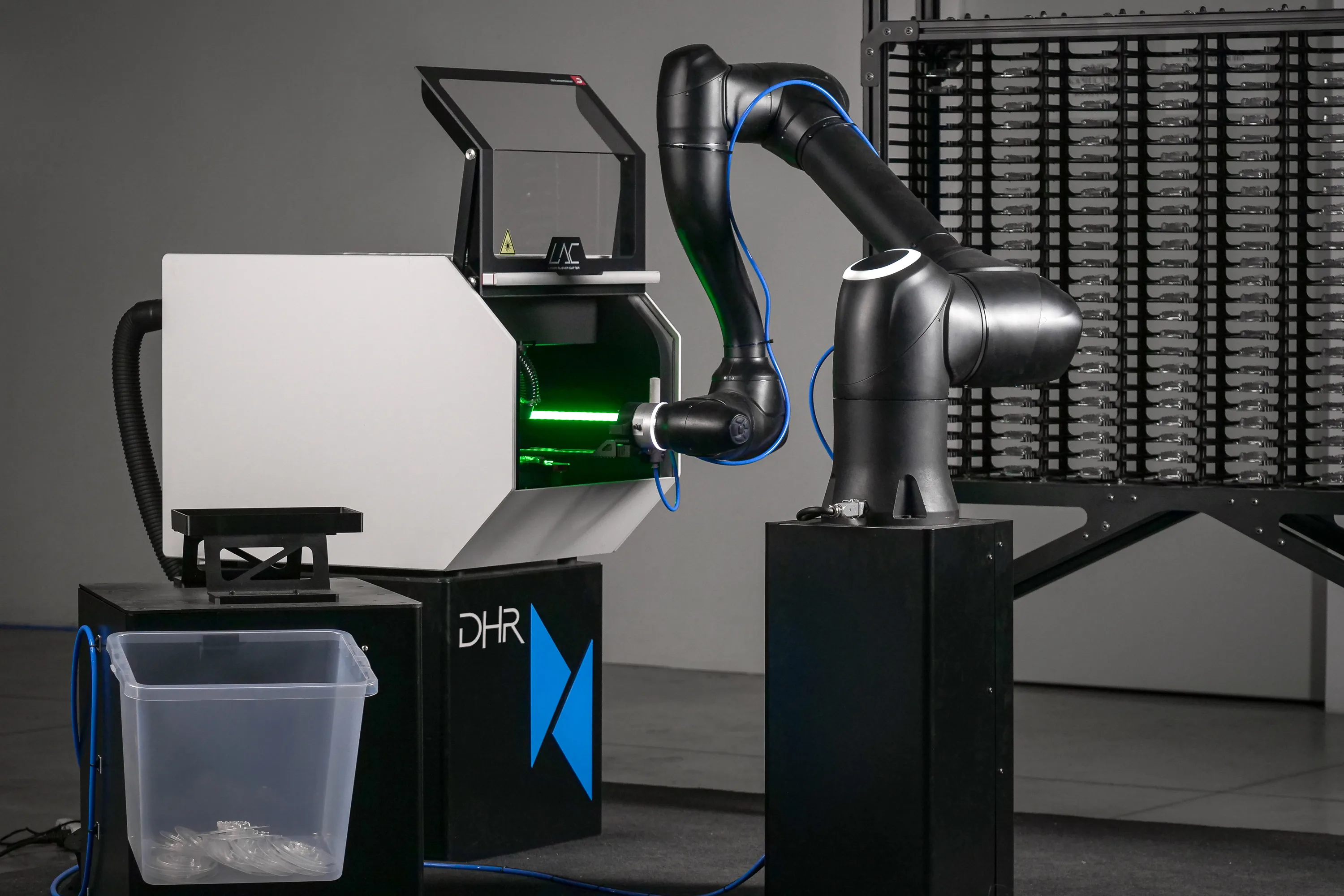
DHR Engineering designed the cell to cover every physical step of DMU LAC machine tending. A software layer sits underneath it, orchestrating the cycle and tracking which aligner belongs to whom. The decision that shaped the build was to use the identity the LAC already establishes. Building on that avoided a second vision system, and it means each part's identity is confirmed by the machine that cuts it rather than inferred from its position in a queue.
The cycle
The robot picks a thermoformed sheet from the storage rack and loads it into the LAC.
The LAC detects the optical ID, selects the matching trim file, and reports the corresponding patient order to our software.
Our software assigns the destination tray for that patient, and the robot retrieves it.
The LAC laser-trims the aligner in 40 seconds and engraves its ID number on it.
The robot removes the finished part, separates the aligner from the offcut directly into the tray, and drops the offcut into a waste bin.
85 seconds per aligner, including all handling, with no operator in the loop. That is 1,016 aligners per machine per day, close to three times what a manually tended machine sustains.
Custom pneumatic gripper
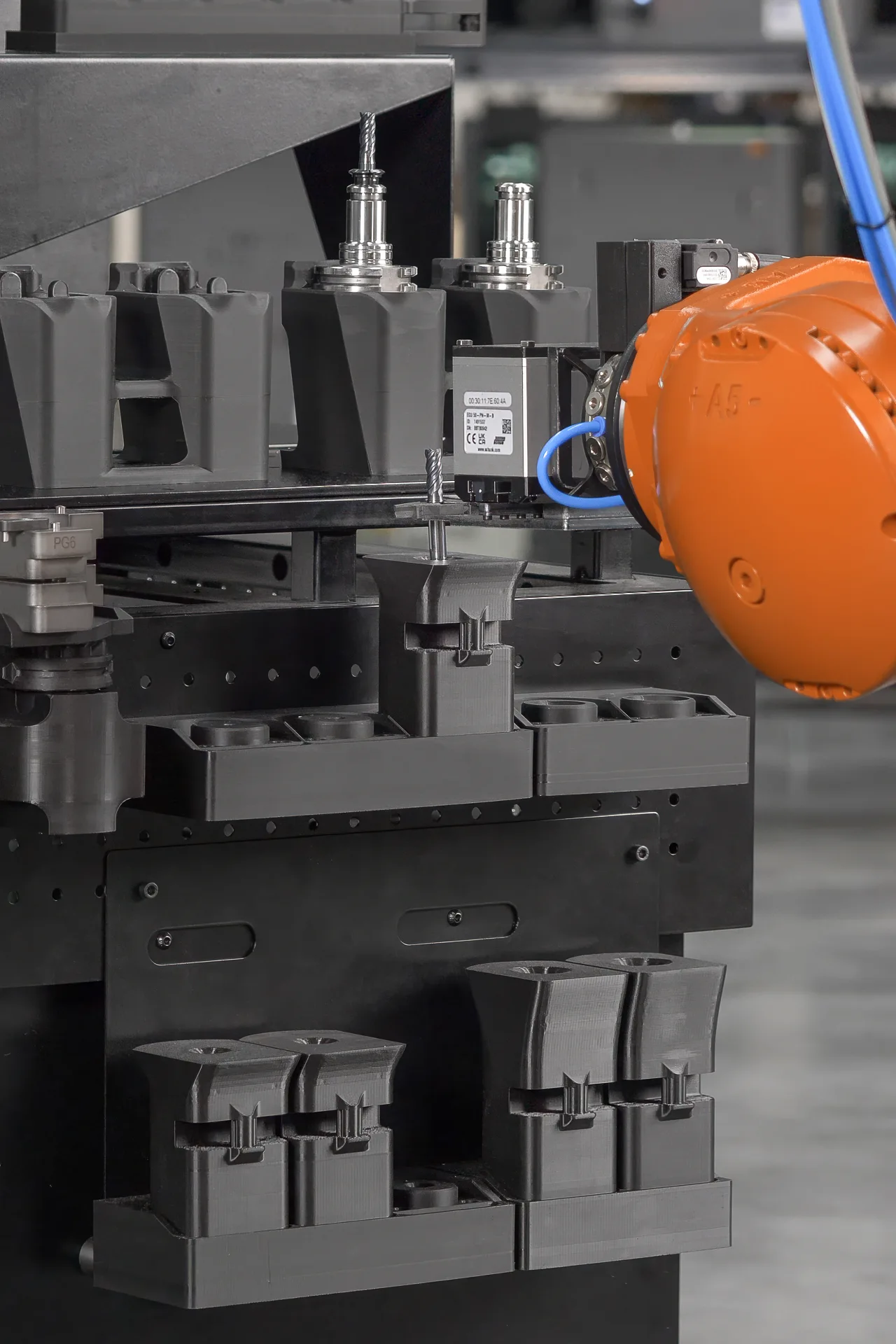
Aligners are thin formed plastic shells that deform under mechanical clamping. We built a pneumatic gripper that transfers parts by suction rather than jaw pressure, so it handles the untrimmed blank and the finished part without distorting either. One end effector covers loading, unloading, separation, and tray placement, which keeps tool changes out of the cycle and keeps the arm's time on productive moves.
Storage sized for unattended running
The storage rack holds two thermoformed sheets per slot and is modular, so runtime scales by adding racks around the robot rather than by redesigning the cell.
Loading it has no sequencing requirement. The operator stacks sheets in whatever order they come off the thermoformer, because each part's identity is resolved at the cut rather than at the infeed. That removes a preparation step that would otherwise have to be done correctly every time.
Designed to scale to four cutters per robot
Our engineering team has validated a configuration in which a single robot tends four LAC machines for a combined 5,760 sorted aligners in 24 hours, with each machine running at 1,571 a day rather than 1,016. We are keeping the layout details in-house, but the principle is the same one that runs through the whole cell: racks, trays, and cutters are modular and scalable in design.

Conclusion
Same machines, three times the output, and a path to 5,760 a day without hiring
This proof of concept resulted in 1,016 sorted aligners from one LAC in 24 hours, close to three times what we see from a manually tended machine, and a validated design for 5,760 a day from a single robot tending four cutters. Every part is laser-marked and already in the correct patient tray when the run ends.
For a lab, that changes the answer to a growing caseload. Instead of another cutting machine, a second operator, and more floor space, the next increment of volume comes from the machine already installed.
One module of an end-to-end aligner line
The aligner cutting cell is designed to drop into a larger system. Our automated resin workflow already covers model printing, washing, and curing. This cell covers trimming, sorting, and marking.
The target is a lights-out factory floor where printing, post-processing, thermoforming, trimming, sorting, inspection, and packing are grouped into automated cells, unified under one MES layer. Every part stays traceable from treatment plan to sealed tray.
This also fits well into the idea for automated point-of-care manufacturing performed inside hospitals and clinical facilities, close to or at the point of patient treatment.
We've built more additive and dental manufacturing automation PoCs than anyone we know of, across SLA, SLS, FDM, and direct printing. If you have a stage that won't scale, talk to an engineer on our team.