2026
Loading a cutting tool into a toolholder is one of the hardest joining tasks to automate, because the fit is tighter than a robot can reliably hit. DHR engineered a guiding funnel that solves it mechanically: the robot releases the tool, gravity does the rest.
CNC Automation
Tool Assembly
Overview
Ask a shop which part of tool preparation is hardest to automate and the answer is usually the same. It is not measuring the tool, not writing the data to the chip, not moving the assembly to the machine. It is the moment the shank has to go into the bore. An end mill shank and a clamping bore are matched to a fit measured in hundredths of a millimeter, and a robot arm working from taught positions alone does not land inside that window every time.
At DHR Engineering we design and build CNC automation for manufacturers, and tool preparation keeps showing up as a manual step even when the machines themselves run unattended. We recently demonstrated what а fully automated toolholder assembly station looks like. Today we're showing one crucial piece of that cell on its own: our simple but effective solution for automating the insertion of a cutting tool into a high-precision toolholder.
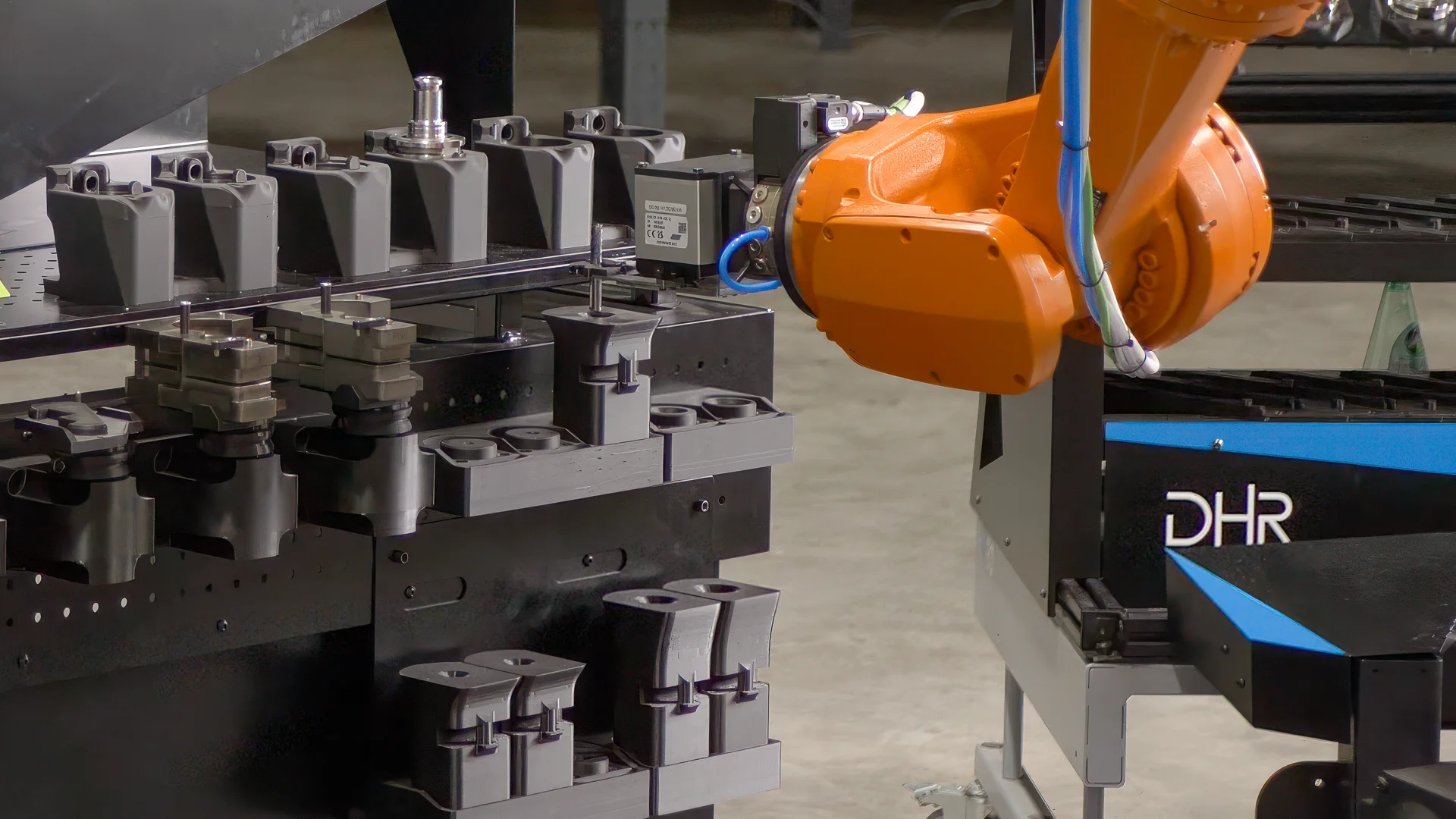
The goal was to make that step repeatable and reliable for any cutting tool and any toolholder type. The result is a guiding funnel, a cost-effective mechanical part that sits in a defined position above the receiving bore and does the alignment itself. The robot's job is reduced to bringing the tool close and letting go. The only force involved after that is gravity, and the same principle works whether the tool is seating into a collet, a hydraulic expansion holder, or a shrink-fit holder.
Problem
Why Can't a Robot Just Seat a Tool Into a Tight Toolholder?
The joining task here is unforgiving in a specific way. Cutting tool shanks are typically ground to h6 tolerance, and the receiving bore of a collet or holder leaves only a few micrometers of clearance around them. The shank has to arrive at that bore with almost no radial offset and almost no angular deviation, and both errors stack: a small tilt at the gripper becomes a large offset at the tip of the shank. Add the tolerances of the gripper, the tool position inside the gripper, the fixture holding the toolholder, and the robot's own repeatability, and the error budget is used up before the tool reaches the bore.
In robotics this is a known challenge called a peg-in-hole task, and shops that automate it usually pay for the accuracy somewhere:
Vision systems to locate the bore, which adds cameras, lighting, calibration, and a maintenance burden in an environment full of coolant mist and chips
Force-torque control on the robot, which adds cost to the arm and complexity to the program
Active search movements, where the robot probes for the opening. That works, but it costs cycle time on every single tool and puts repeated contact loads on the bore
Tighter mechanical accuracy everywhere, which means a more expensive robot and more precise fixturing to hold a tolerance the robot then has to keep holding
So the question we started from was simple. Is there a way to make this reliable without any of that?
What we did
Self-Centering Cutting Tool Insertion, Without Cameras or Force Control
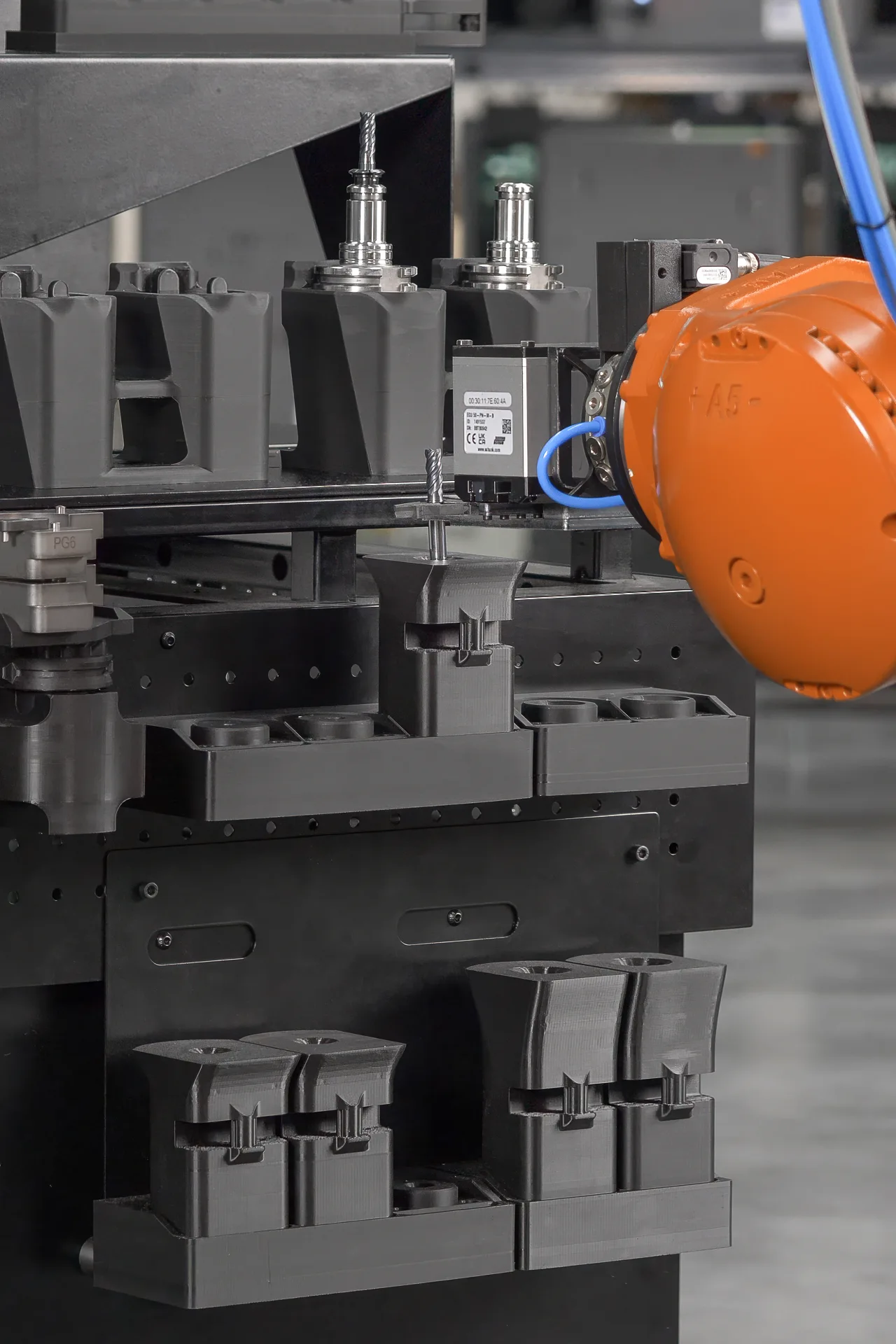
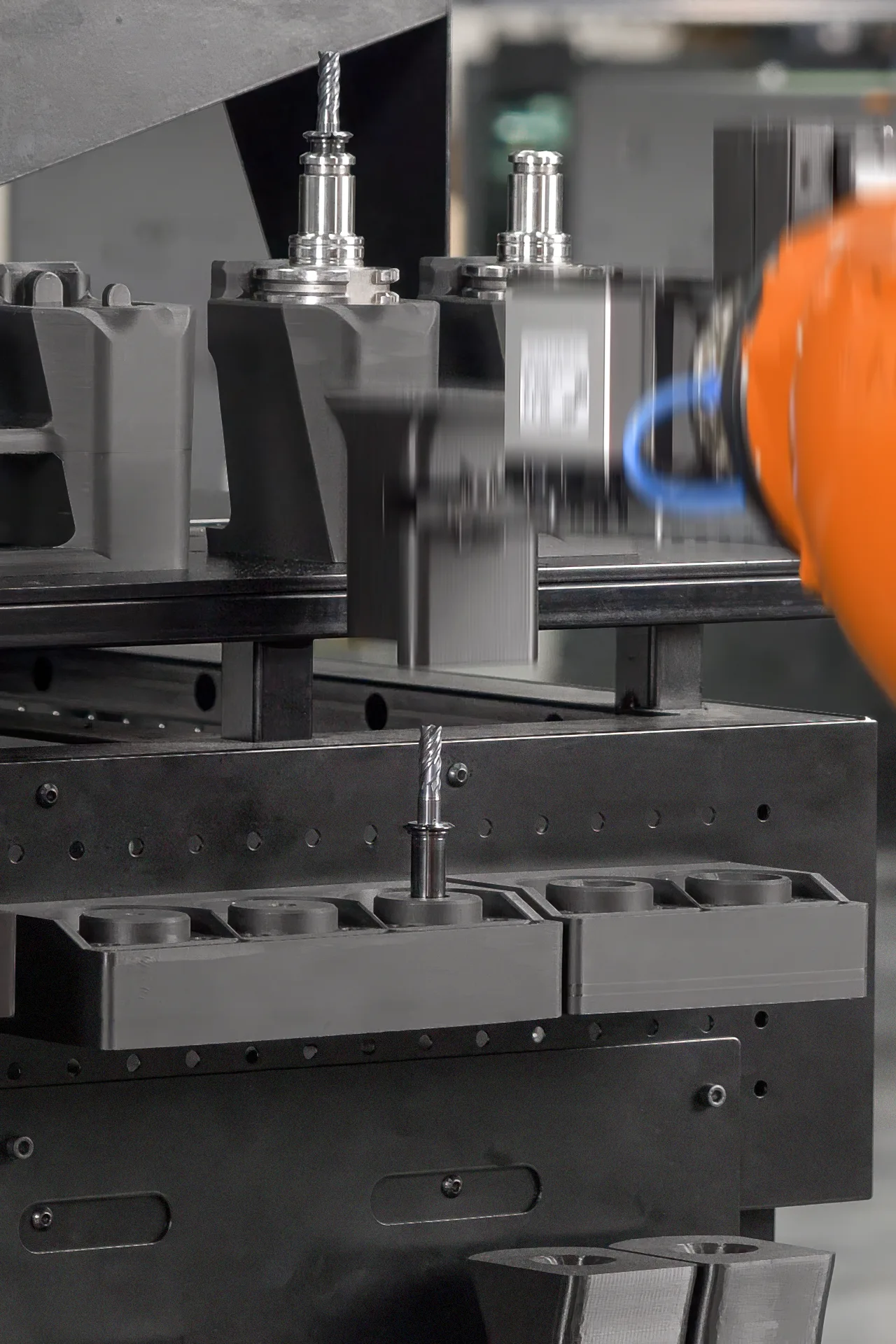
The solution was to take the robot out of the joining process entirely. Instead of the gripper carrying the tool all the way into the bore, the gripper carries it to a transfer position above the guiding funnel and opens. From that point the tool is no longer connected to the robot, so robot inaccuracy and any transverse force from the arm cannot be introduced into the fit.
What catches the tool is the funnel's guiding geometry, the interior shape that channels the tool toward the bore. This geometry can take different forms and include additional helper elements depending on the tool and holder, but the function stays the same.
The funnel is positioned in a defined relationship to the collet or toolholder, so the guiding geometry and the clamping bore share a common axis. A shank that arrives with a radial offset or an angular deviation touches the geometry first and is guided toward the center axis of the bore as it descends. By the time the shank reaches the opening, it is aligned and slides in.
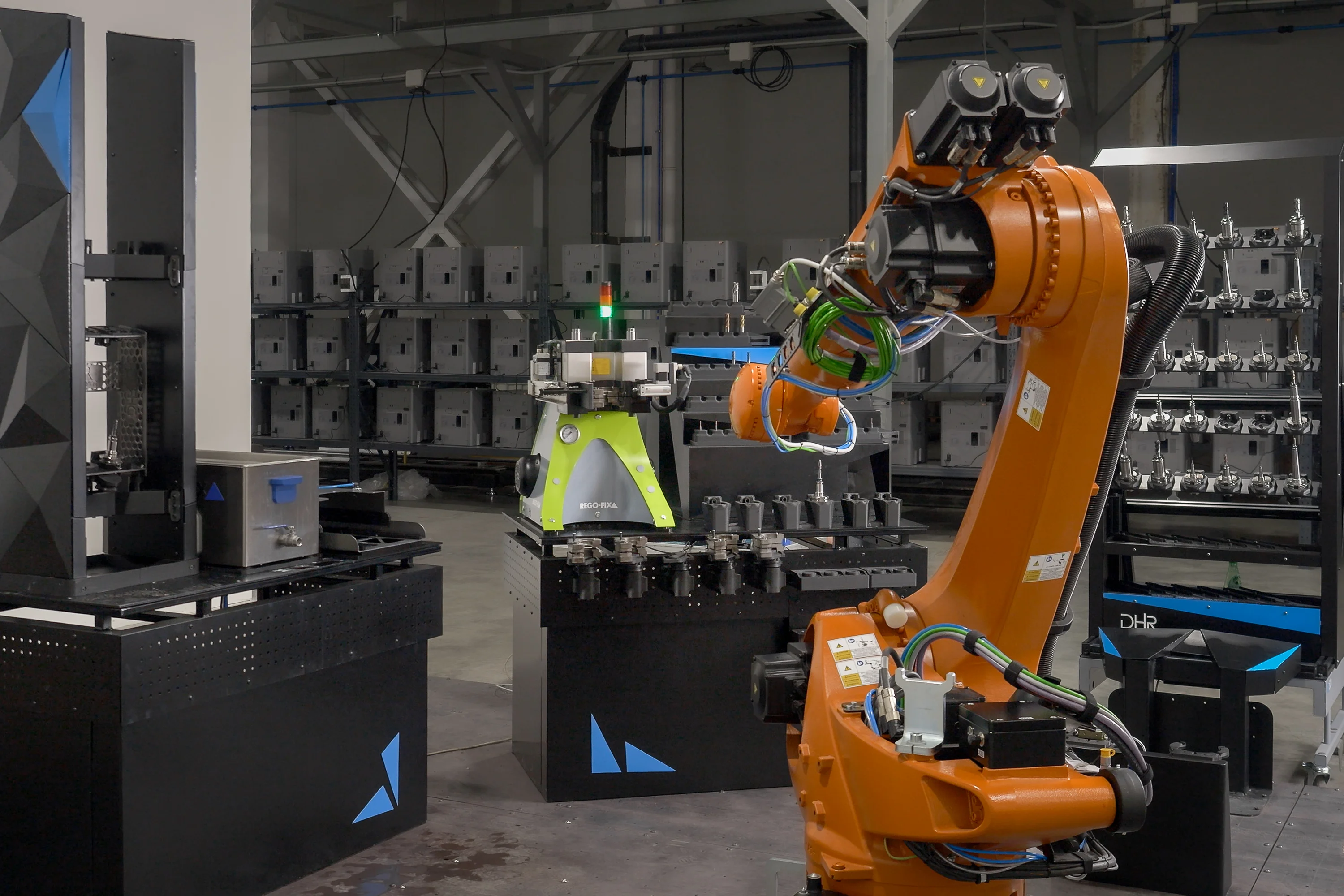
In our tool assembly demo cell, using Rego-Fix PowRgrip holders, the robot has two grippers: one for collets, cutting tools, and funnels, and a second for toolholders. The cycle runs like this:
The gripper places the collet onto the funnel base, then positions the right-sized guiding funnel on top
It picks the cutting tool from the station, positions it above the funnel's wide opening, and opens to release it
The tool falls into place and seats in the collet, guided by the funnel's geometry
That gripper places the collet into the waiting toolholder
The robot switches grippers and carries the assembly to the clamping unit
It works with any holder that has a receiving bore
The funnel is not tied to collet systems. The same principle applies to any holder where a tool shank has to enter a precise receiving bore:
Mechanical holders, including collet chucks and milling chucks
Hydraulic expansion holders
Shrink-fit holders
That matters for a real tool crib, because a shop rarely runs one holder type. It matters even more for high-mix, low-volume shops, where the mix of holders changes with every job, and covering all of them is what makes 24/7 automated tool assembly possible.
Conclusion
Cutting Tool Insertion Automation That Works With the Holders You Already Own
There is a wider reason we built this. Tool preparation is one of the areas where automation usually arrives as a closed package, with the holders, the magazine, the software, and the robot all coming from one supplier. The equipment works, but the shop ends up committed to that supplier's ecosystem for every future change, including which holders it is allowed to run.
We build the other way around. A shop already owns its holders, its presetters, and its machines, and those choices were made for good reasons. A passive funnel matched to the holders already in the crib keeps that freedom intact, because the automation adapts to the equipment instead of the equipment being replaced to suit the automation. That is the same reason we stay OEM-agnostic on robots and pick the arm by application fit rather than by partnership.
Automation should follow your equipment, not replace it
We developed the funnel as an internal build to solve a step we kept meeting in client CNC automation projects, and we are sharing it because it is a genuinely useful idea and a simple one.
If your company runs Haimer, Zoller, Schunk or any other holder system and this would solve a problem for you, send us an email and tell us which holders you use. We will share the funnel for it. We believe a good mechanical idea is worth more in a hundred shops than in one.