November 25, 2025
Formnext 2025 Recap: Where AM is Headed Next
Formnext 2025 made one thing clear: additive manufacturing is no longer held back by print speed or machine capability. The real challenge is everything that happens between the printing cycles. The question is no longer if AM can produce parts, but how it can do so reliably and at scale. And at the Formlabs booth, we had an answer worth showing.
Formnext 2025 made one thing clear: additive manufacturing is no longer held back by print speed or machine capability. The real challenge is everything that happens between the printing cycles. The question is no longer if AM can produce parts, but how it can do so reliably and at scale. And at the Formlabs booth, we had an answer worth showing.
Events
Additive Manufacturing
Automation
Events
Automation
Additive Manufacturing
Table of Contents
What We Demonstrated
An Automated Production Cell Combining SLA and SLS Workflows
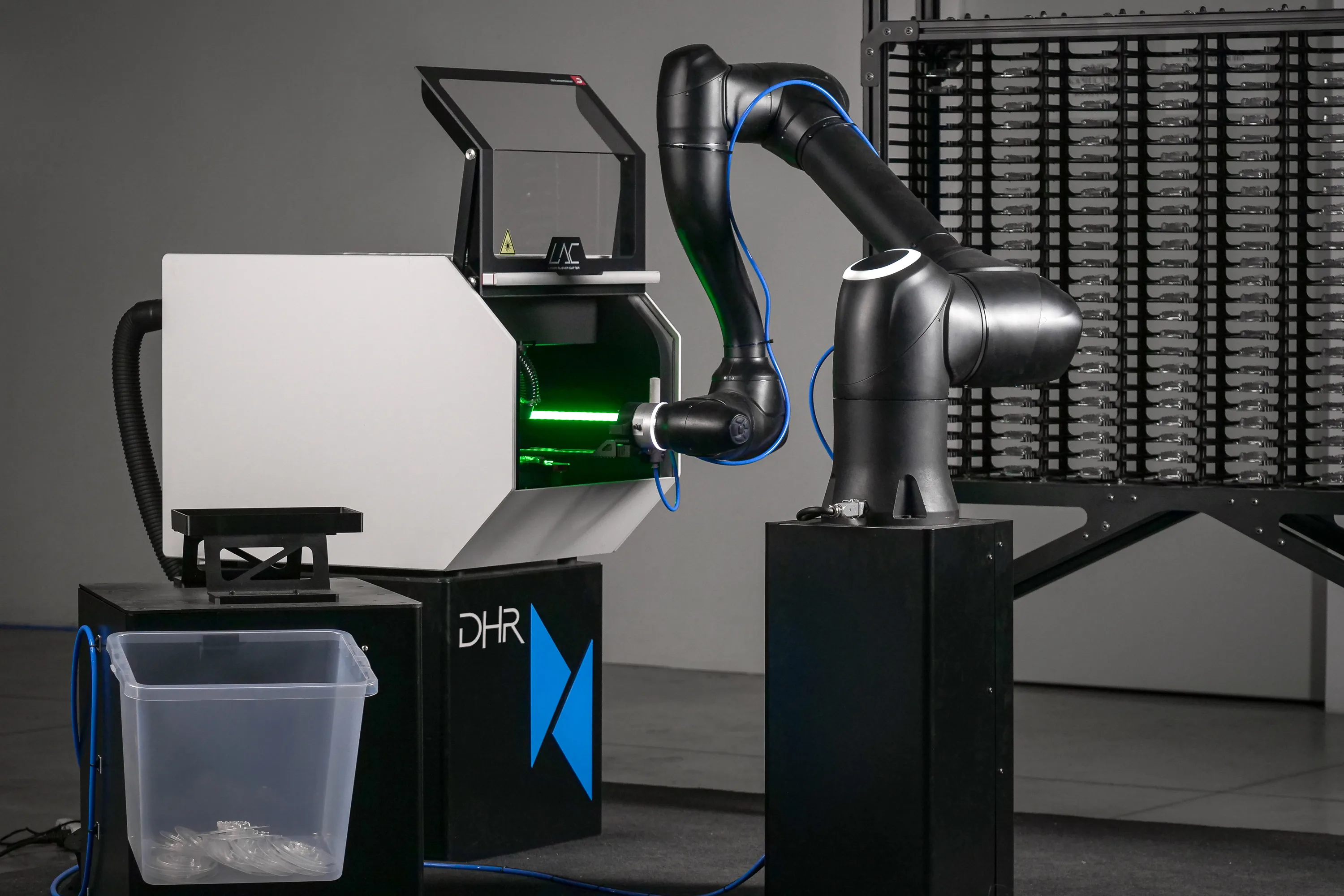
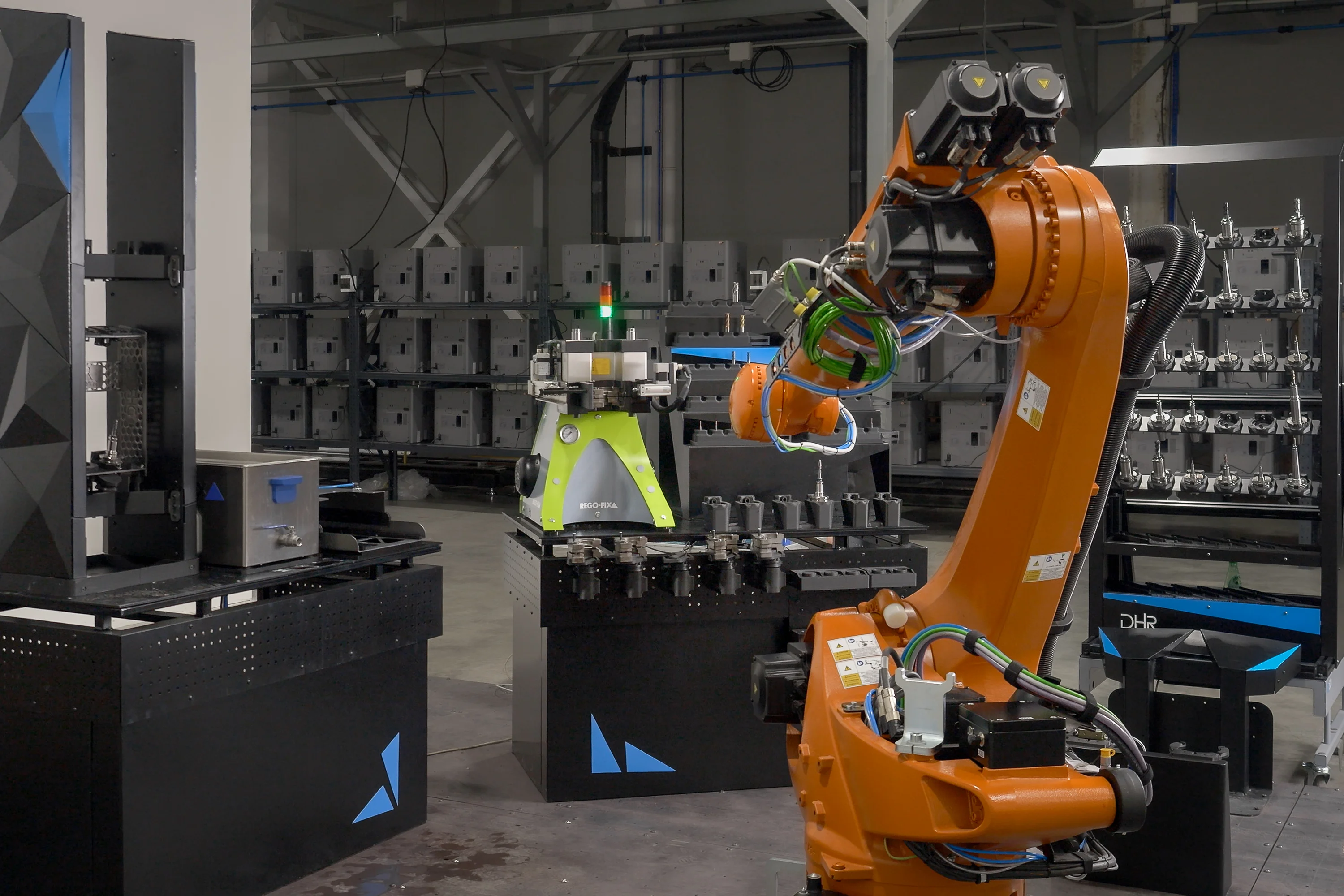
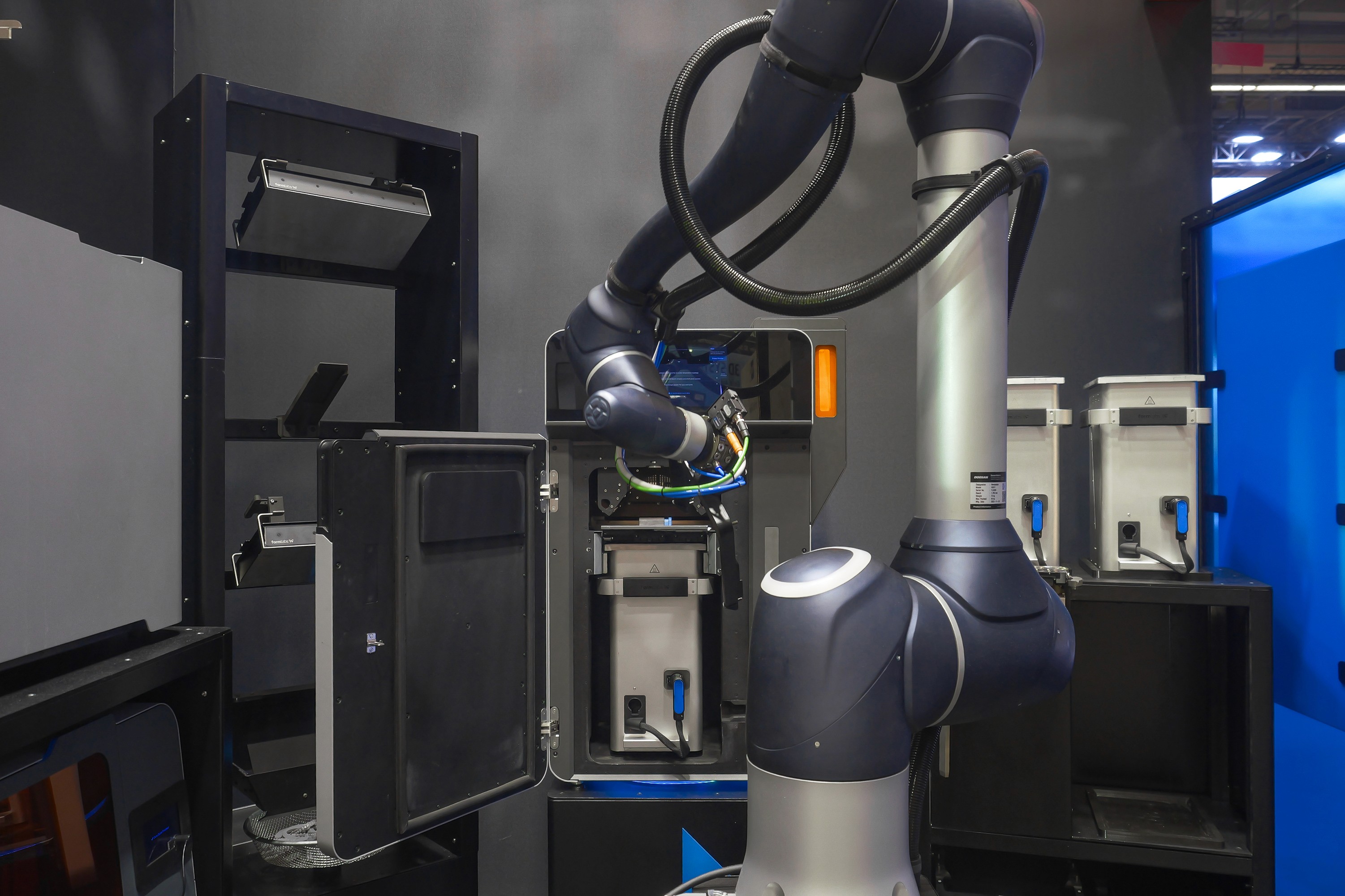
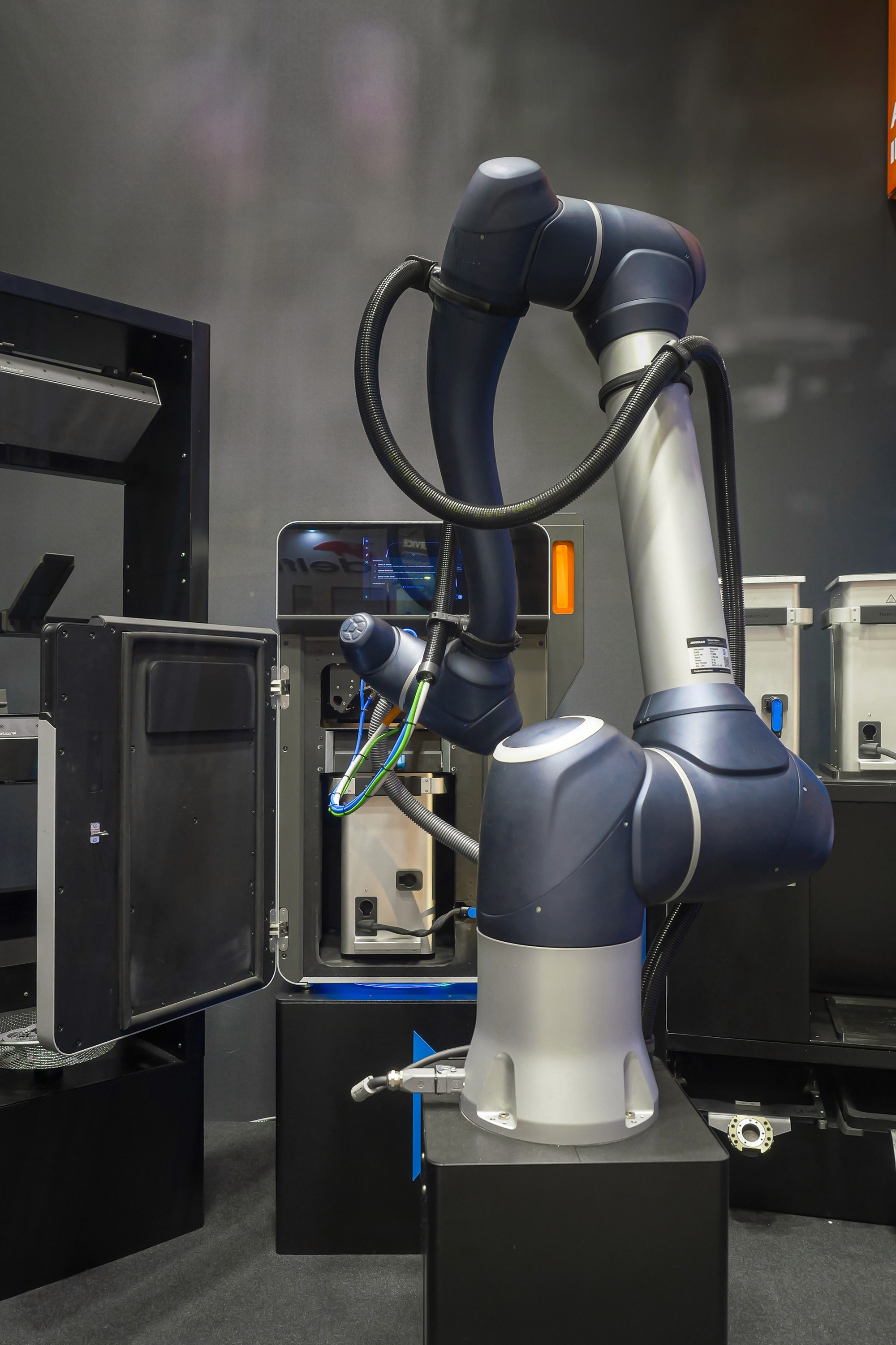
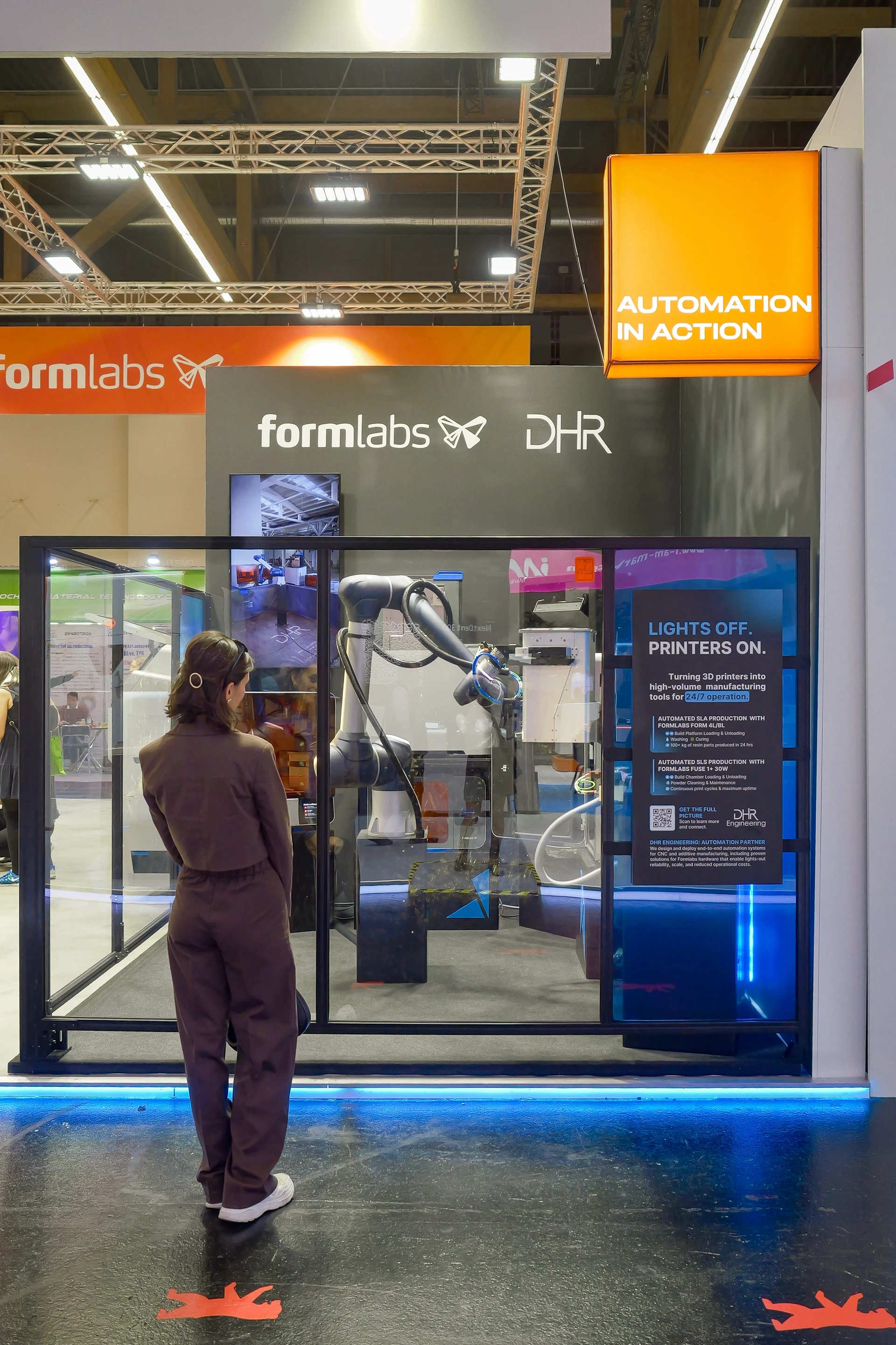
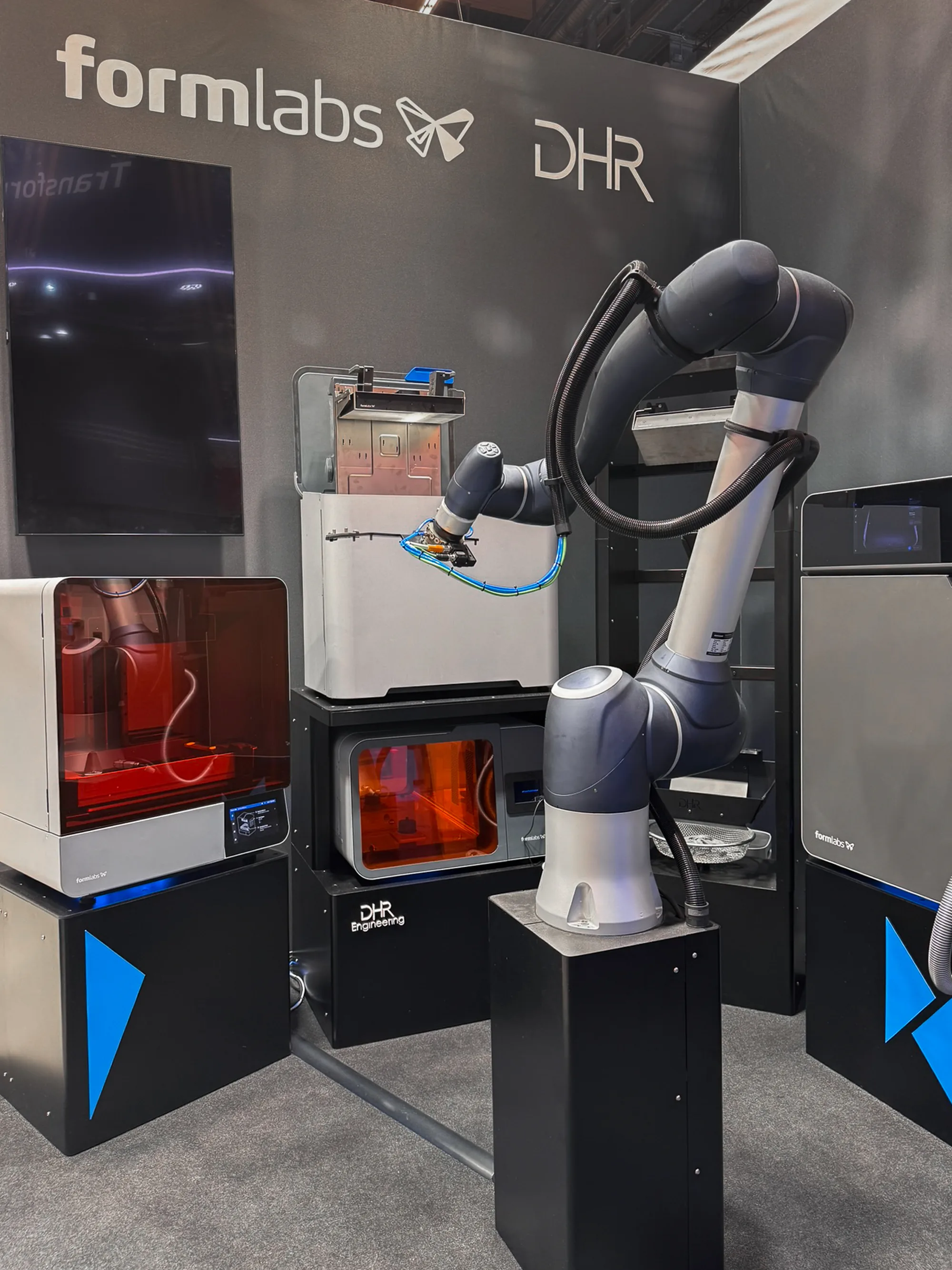
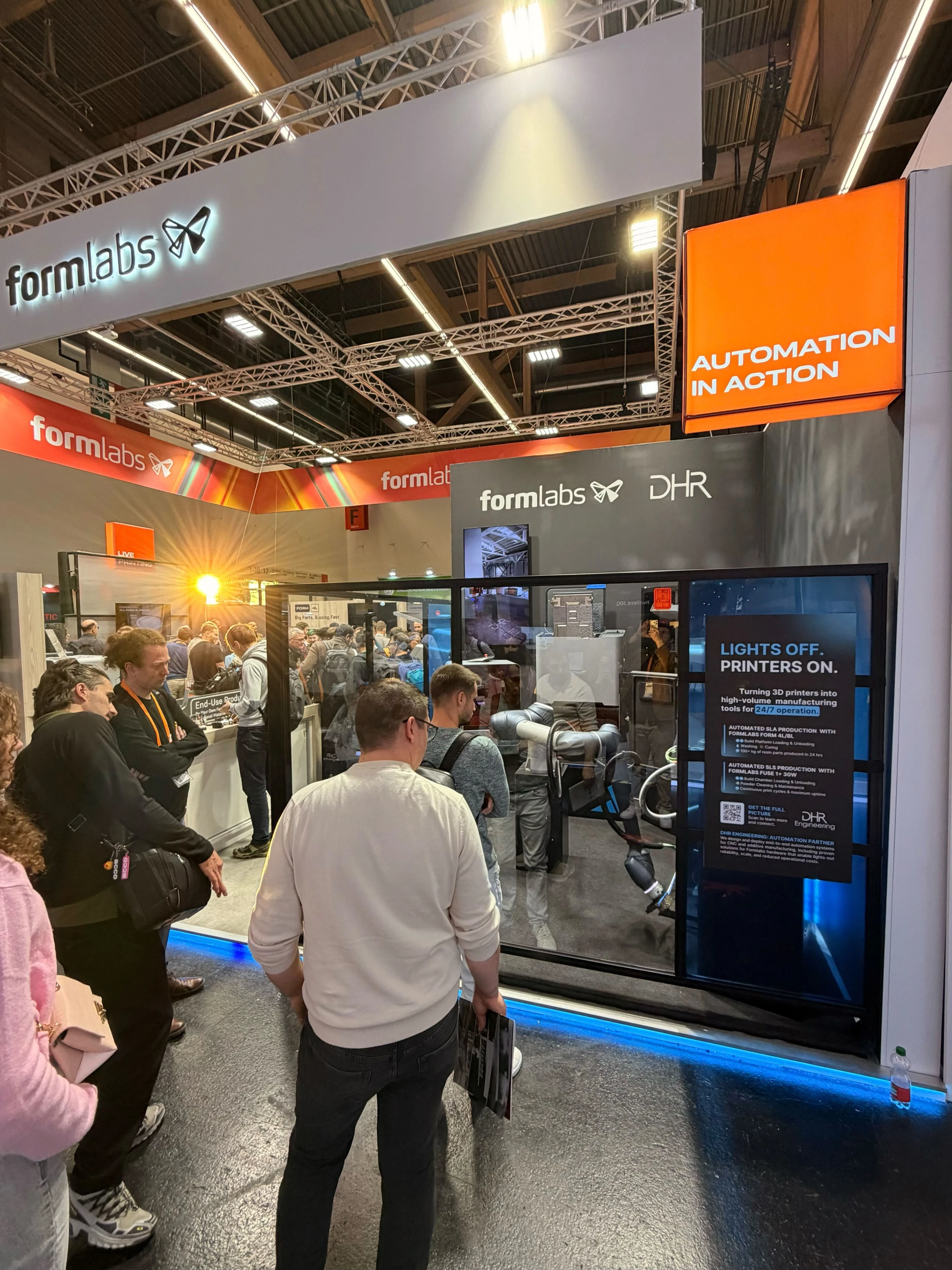
The DHR Engineering exhibit at Formnext 2025 demonstrated what happens when you remove the constraints of business hours and enable flexible, high-mix AM production. Located at the Formlabs booth (Hall 11.1, Stand E11), our automated cell was a compact "factory-in-a-box," managed by a single collaborative robot arm servicing multiple Formlabs printers. It ran two distinct workflows:
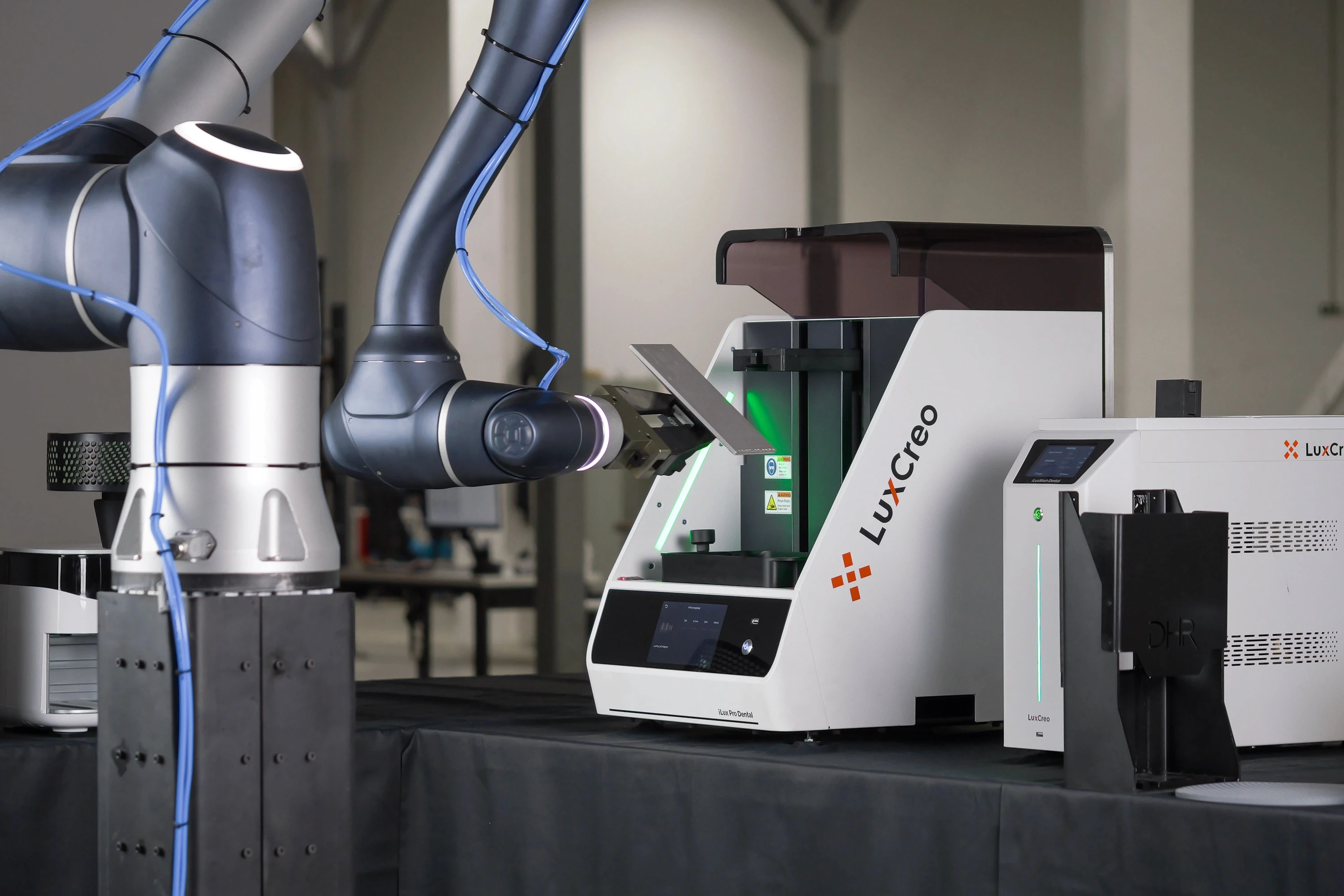
The SLA Workflow (Form 4L/BL) handled the full cycle: loading and unloading build platforms, then moving parts through the entire post-processing chain (Wash L, Cure L). The result is a system that completes the entire print-to-part workflow autonomously, delivering the reliable throughput needed for 24/7 resin part production.
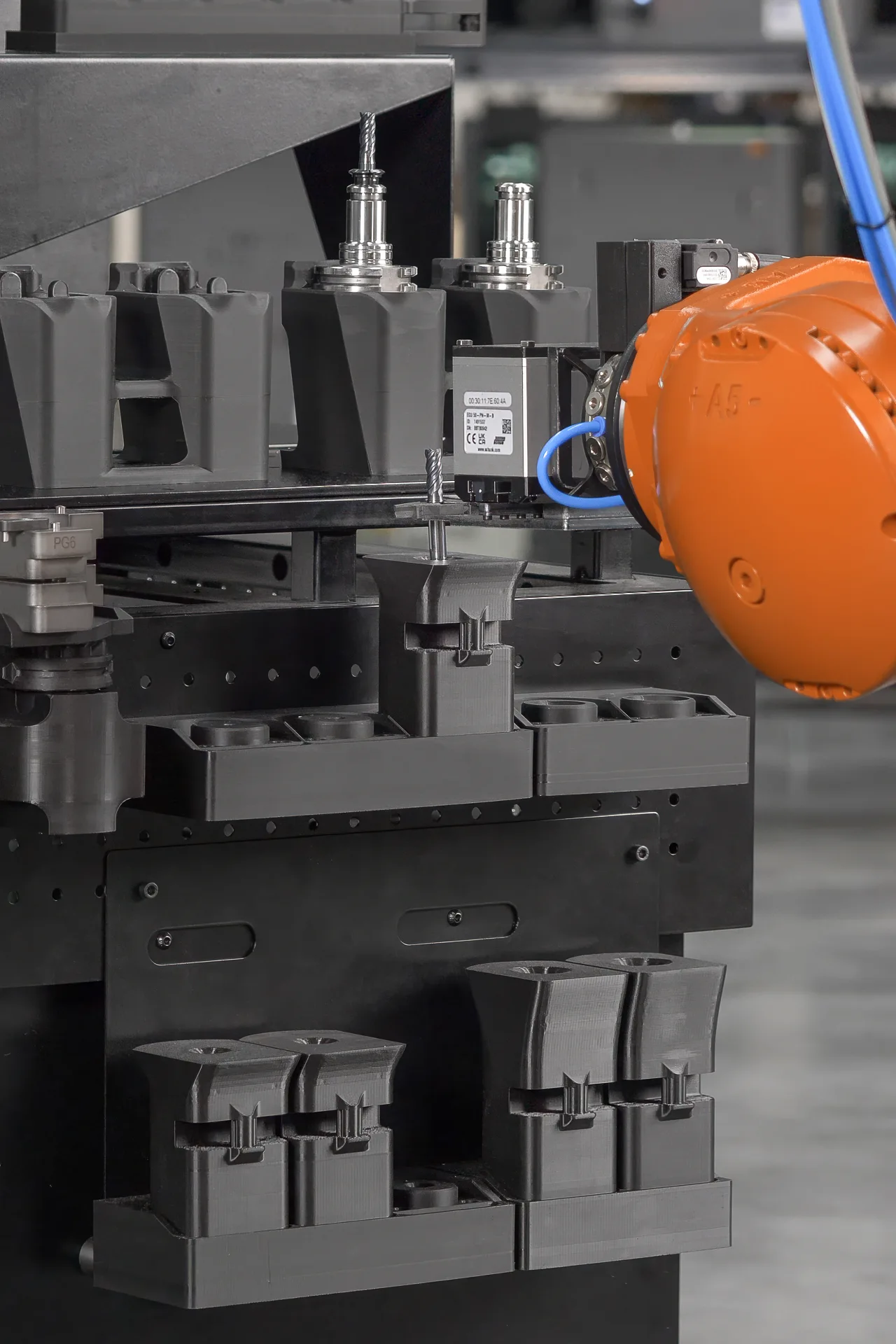
The SLS Workflow (Fuse 1+ 30W) addressed the bottleneck that typically stops continuous production: build chamber swaps and powder cleaning between cycles. By automating the tasks that normally mean "we'll finish this tomorrow," this workflow maximizes printer uptime while maintaining the consistent quality needed for lights-out production.
From the Show Floor: What People Actually Asked
"Wait, what's it doing?"
Once people realized the system could run fully unattended, the response shifted. R&D teams immediately saw the potential: faster prototype iterations and the ability to seamlessly scale a winning design to thousands of end-use parts.
"Does this only work with Formlabs machines?"
No. We design cells around any machine. We partnered with Formlabs for this demo, but the approach is platform-agnostic.
"Can you automate SLS depowdering?"
Yes. We're demonstrating that integration next. It was the most requested feature at the show - everyone struggles with it, but few vendors address it directly.
"Won't this replace technicians?"
No. It replaces the repetitive tasks no one wants to do: swapping build plates at 2 a.m., weekend shifts, manual cleaning cycles. Skilled people should solve problems and improve processes, not babysit machines.
What Surprised Us
Lots of people had already seen our automated FDM farm. Multiple visitors recognized the project from social media. It meant the conversations jumped straight into practical details instead of starting from zero.
People were genuinely impressed by our optical cassette cleaning automation for the Fuse 1+. That reaction confirmed just how underserved SLS post-processing is.
Teams agreed on the same point: "The biggest bottleneck is no longer printing. It's everything after printing." This was said in different ways dozens of times.
Conclusion
"Lights Off. Printers On." and the Future of Manufacturing
The trends observed at Formnext 2025 reflect the core principles of Industry 4.0 and the vision of the "lights-out" digital factory. Achieving this vision demands a sophisticated ecosystem where hardware, software, and data flows are seamlessly connected to operate with minimal human intervention. This transition enables 3D printers to evolve into reliable, high-volume manufacturing tools.
Our Take on When Automation Actually Makes Sense
We view automation as a precision tool, not a novelty. It's a decision driven by the need for control and performance. The investment makes sense when it solves problems manual labor can't. For high-volume production, automation delivers compelling returns by enabling 24/7 operation without multiple labor shifts. The math is straightforward: maximize asset utilization, minimize downtime, maintain quality.
What the Industry Wants Next
Four themes dominated conversations with AM leaders:
Unified software for mixed fleets: one system managing SLA, SLS, MJF, and FDM with complete data integrity and traceability.
Post-processing automation: depowdering, cleaning, finishing. This is where production gets stuck, and where the demand for solutions is highest.
AM as a strategic alternative to traditional manufacturing like injection molding: driven by supply chain resilience, onshoring needs, and schedule control.
Metal AM automation: the next frontier, requiring holistic systems that handle residual stress, heat treatments, and powder safety.
If You’re Planning for Production, Let’s Talk
If you’re scaling SLA, SLS, MJF, FDM or running a mixed fleet, we design automation systems that deliver real industrial throughput.
If you want to explore what automation could look like in your environment, schedule a call with our team. We're happy to discuss how end-to-end automation might fit your production requirements.
Special thanks to the Formlabs team for making this demonstration possible.
What We Demonstrated
An Automated Production Cell Combining SLA and SLS Workflows
The DHR Engineering exhibit at Formnext 2025 demonstrated what happens when you remove the constraints of business hours and enable flexible, high-mix AM production. Located at the Formlabs booth (Hall 11.1, Stand E11), our automated cell was a compact "factory-in-a-box," managed by a single collaborative robot arm servicing multiple Formlabs printers. It ran two distinct workflows:
The SLA Workflow (Form 4L/BL) handled the full cycle: loading and unloading build platforms, then moving parts through the entire post-processing chain (Wash L, Cure L). The result is a system that completes the entire print-to-part workflow autonomously, delivering the reliable throughput needed for 24/7 resin part production.
The SLS Workflow (Fuse 1+ 30W) addressed the bottleneck that typically stops continuous production: build chamber swaps and powder cleaning between cycles. By automating the tasks that normally mean "we'll finish this tomorrow," this workflow maximizes printer uptime while maintaining the consistent quality needed for lights-out production.
From the Show Floor: What People Actually Asked
"Wait, what's it doing?"
Once people realized the system could run fully unattended, the response shifted. R&D teams immediately saw the potential: faster prototype iterations and the ability to seamlessly scale a winning design to thousands of end-use parts.
"Does this only work with Formlabs machines?"
No. We design cells around any machine. We partnered with Formlabs for this demo, but the approach is platform-agnostic.
"Can you automate SLS depowdering?"
Yes. We're demonstrating that integration next. It was the most requested feature at the show - everyone struggles with it, but few vendors address it directly.
"Won't this replace technicians?"
No. It replaces the repetitive tasks no one wants to do: swapping build plates at 2 a.m., weekend shifts, manual cleaning cycles. Skilled people should solve problems and improve processes, not babysit machines.
What Surprised Us
Lots of people had already seen our automated FDM farm. Multiple visitors recognized the project from social media. It meant the conversations jumped straight into practical details instead of starting from zero.
People were genuinely impressed by our optical cassette cleaning automation for the Fuse 1+. That reaction confirmed just how underserved SLS post-processing is.
Teams agreed on the same point: "The biggest bottleneck is no longer printing. It's everything after printing." This was said in different ways dozens of times.
Conclusion
"Lights Off. Printers On." and the Future of Manufacturing
The trends observed at Formnext 2025 reflect the core principles of Industry 4.0 and the vision of the "lights-out" digital factory. Achieving this vision demands a sophisticated ecosystem where hardware, software, and data flows are seamlessly connected to operate with minimal human intervention. This transition enables 3D printers to evolve into reliable, high-volume manufacturing tools.
Our Take on When Automation Actually Makes Sense
We view automation as a precision tool, not a novelty. It's a decision driven by the need for control and performance. The investment makes sense when it solves problems manual labor can't. For high-volume production, automation delivers compelling returns by enabling 24/7 operation without multiple labor shifts. The math is straightforward: maximize asset utilization, minimize downtime, maintain quality.
What the Industry Wants Next
Four themes dominated conversations with AM leaders:
Unified software for mixed fleets: one system managing SLA, SLS, MJF, and FDM with complete data integrity and traceability.
Post-processing automation: depowdering, cleaning, finishing. This is where production gets stuck, and where the demand for solutions is highest.
AM as a strategic alternative to traditional manufacturing like injection molding: driven by supply chain resilience, onshoring needs, and schedule control.
Metal AM automation: the next frontier, requiring holistic systems that handle residual stress, heat treatments, and powder safety.
If You’re Planning for Production, Let’s Talk
If you’re scaling SLA, SLS, MJF, FDM or running a mixed fleet, we design automation systems that deliver real industrial throughput.
If you want to explore what automation could look like in your environment, schedule a call with our team. We're happy to discuss how end-to-end automation might fit your production requirements.
Special thanks to the Formlabs team for making this demonstration possible.