February 25, 2026
How Automation and Digital Workflows Reshape Modern Dentistry
The dental industry is moving rapidly past standalone 3D printers. DHR Engineering attended LMT LAB DAY Chicago 2026 to analyze the latest dental industry shifts. The takeaway is clear: dental labs and manufacturers are prioritizing end-to-end automation and digital workflows in order to scale efficiently. This article explores how modern additive manufacturing, digital assembly lines, and robotic integration are redefining high-efficiency dental production.
The dental industry is moving rapidly past standalone 3D printers. DHR Engineering attended LMT LAB DAY Chicago 2026 to analyze the latest dental industry shifts. The takeaway is clear: dental labs and manufacturers are prioritizing end-to-end automation and digital workflows in order to scale efficiently. This article explores how modern additive manufacturing, digital assembly lines, and robotic integration are redefining high-efficiency dental production.
Dental
Additive Manufacturing
Events
Dental
Events
Additive Manufacturing
Table of Contents
Industry Context
The Key Drivers Behind Dental Lab Automation
Dental lab automation is driven primarily by skilled labor shortages and the need for scalable production models. Mid-sized and large labs require reliable efficiency solutions to handle increasing daily case volumes. Therefore, the industry is shifting focus from isolated machine purchases toward comprehensive workflow optimization and complete system integration to ensure consistent, high-quality output.
At LMT LAB DAY Chicago 2026, conversations on the trade show floor reflected this reality. The dialogue centers far more on workflow optimization than on individual machine specifications. Buyers are asking how a specific machine can fit into a broader, automated production layout. They want to know how data flows from the initial scan to the final packaged product. The real challenge is not hardware. It is integration.
This shift in mindset is not limited to large production centers. We see an increasing focus on scalability for mid-sized labs. These smaller facilities want to compete with larger corporate labs. To do this, they require robust automation solutions that do not require hiring dozens of new employees.
Furthermore, this demand has created a new business opportunity for dental equipment retailers and distributors. These companies are highly interested in adding automation as a service to their portfolios. Instead of just selling a milling machine or a 3D printer, distributors want to offer a fully planned, automated production cell. At DHR Engineering, we work with both startups and established manufacturers who are navigating this transition.
Digital Assembly Lines
How Do End-to-End Digital Workflows Improve Dental Production
End-to-end digital workflows improve dental production by seamlessly connecting intraoral scanning data directly to final manufacturing hardware. This creates a full-service digital lab environment with minimal human intervention. Consequently, manufacturers can deploy distributed manufacturing models, producing high-value medical devices on-demand near the point of care to reduce lead times.
A true digital assembly line requires a continuous flow of data and physical materials. In a traditional lab, workers manually move files between different software programs. Then, they manually move physical parts between different machines. End-to-end digital workflows eliminate these disconnected steps.
To put it simply, a digital workflow begins when a dentist uploads an intraoral scan. Software automatically analyzes the scan, generates a CAD model, and sends the nesting data directly to the production floor. This software-to-hardware integration is critical for building a full-service digital lab. It ensures that every step is tracked, quality-controlled, and optimized for speed.
Distributed Manufacturing and the On-Demand Dental Factory
Because digital workflows standardize production, they enable distributed manufacturing. The dental industry is moving toward a model where high-value devices like clear aligners and retainers are produced on-demand near the patient. Instead of shipping physical impressions across the country, a clinic sends a digital file to a local, highly automated dental factory. This approach mitigates supply chain risks. It also drastically reduces lead times for patients.
Building these networks requires careful facility planning and robust engineering. Companies looking to implement these advanced setups often rely on comprehensive dental manufacturing automation services to ensure their layouts maximize yield and minimize bottlenecks.
Advanced Additive Systems
Advanced Additive Manufacturing Technologies Reshaping Dental Manufacturing
Advanced additive systems redefine dental manufacturing through metal 3D printing, direct-print clear aligners, and highly automated SLA production. Hybrid setups combine metal printing with CNC precision. Direct printing eliminates wasteful thermoforming steps entirely. Meanwhile, automated SLA workflows scale traditional methods, allowing facilities to produce thousands of precise dental models daily with minimal human intervention.
Metal 3D Printing and Hybrid CNC: Getting the Best of Both
A major trend observed at Lab Day Chicago was the growing presence of metal 3D printing and hybrid manufacturing setups. Metal additive manufacturing is becoming essential for producing complex frameworks, crowns, and partial dentures. Hybrid manufacturing combines the geometric freedom of metal 3D printing with the high-tolerance surface finishing of CNC milling. A part is printed near net shape and then transferred to a milling machine for precise detailing. This approach provides the best of both worlds because it relies on seamless digital workflows to function correctly.
Direct-Print Clear Aligners: Eliminating the Thermoforming Step
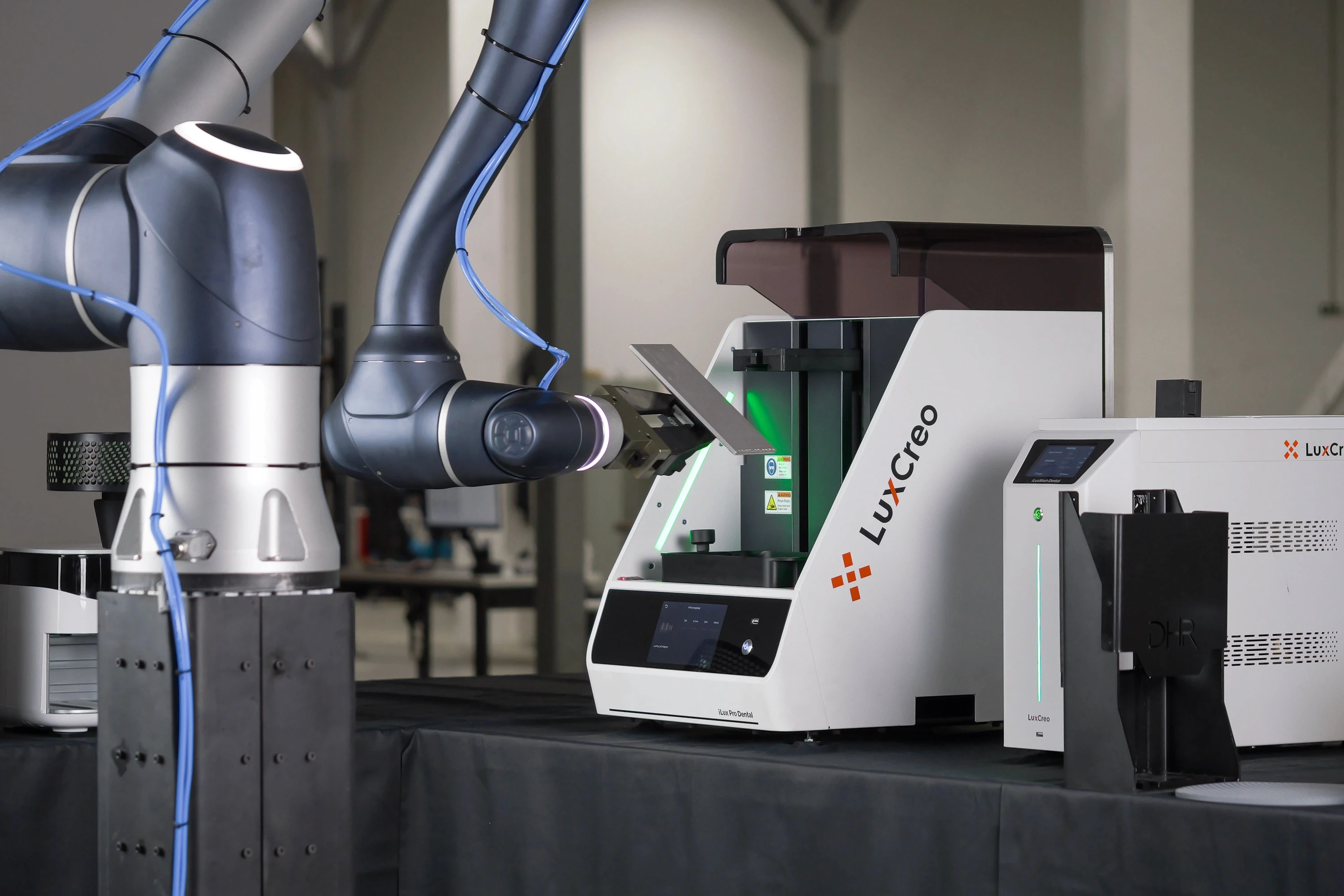
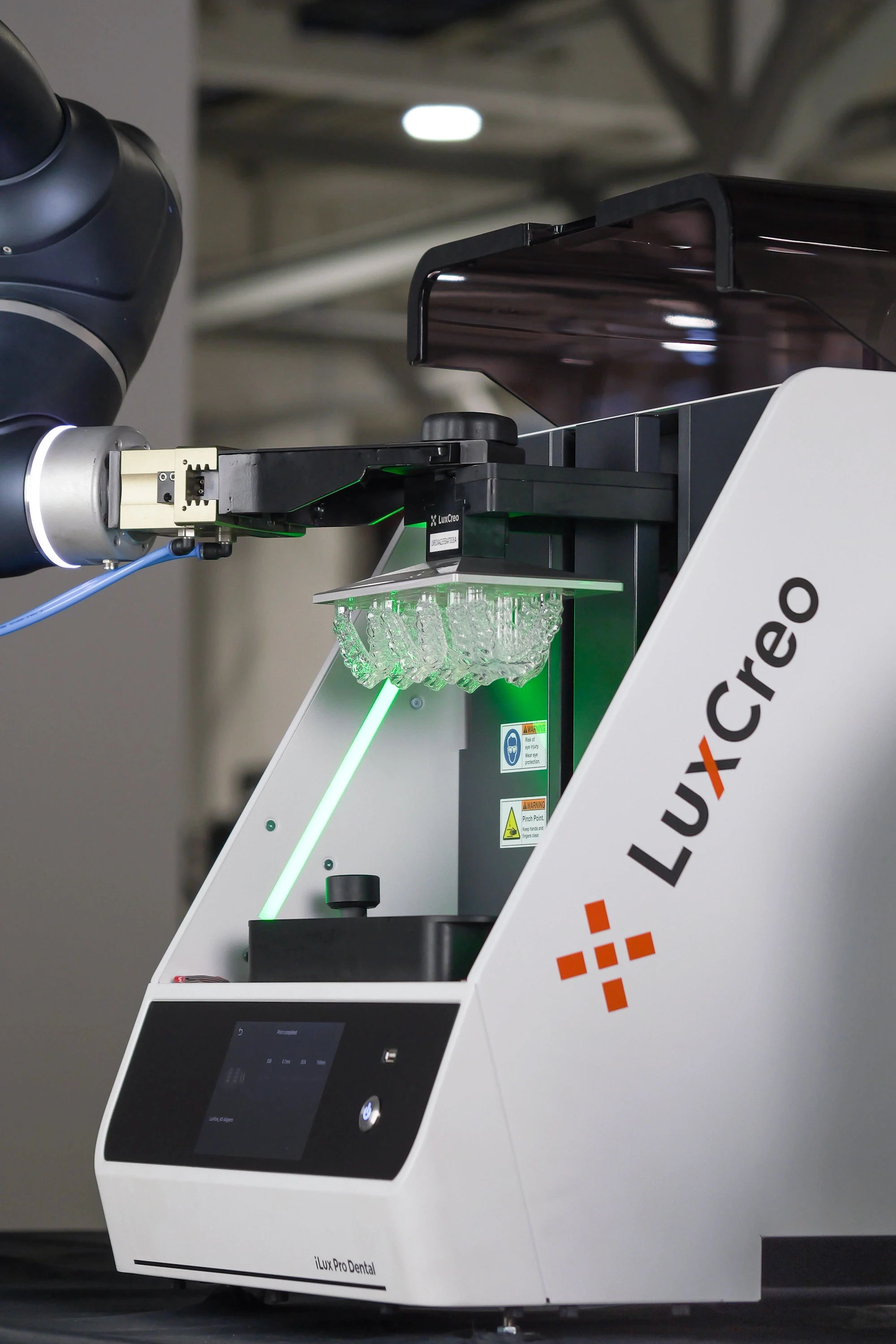
Beyond metals, direct printing is transforming orthodontic workflows by eliminating intermediate steps. Usually, a lab would print an arch model and then thermoform a plastic sheet over it to create a clear aligner. This requires multiple machines, manual labor, trimming, and material waste. Using highly specialized, biocompatible resins, dental 3D printers can now produce clear aligners that are safe for intraoral use directly. To understand the benefits of this technology combined with automation, you can explore DHR's deployment of a fully automated direct print aligner production with LuxCreo. This project demonstrates how eliminating the thermoforming step increases output and drastically reduces overhead.
Scaling Traditional SLA Workflows to Industrial Output
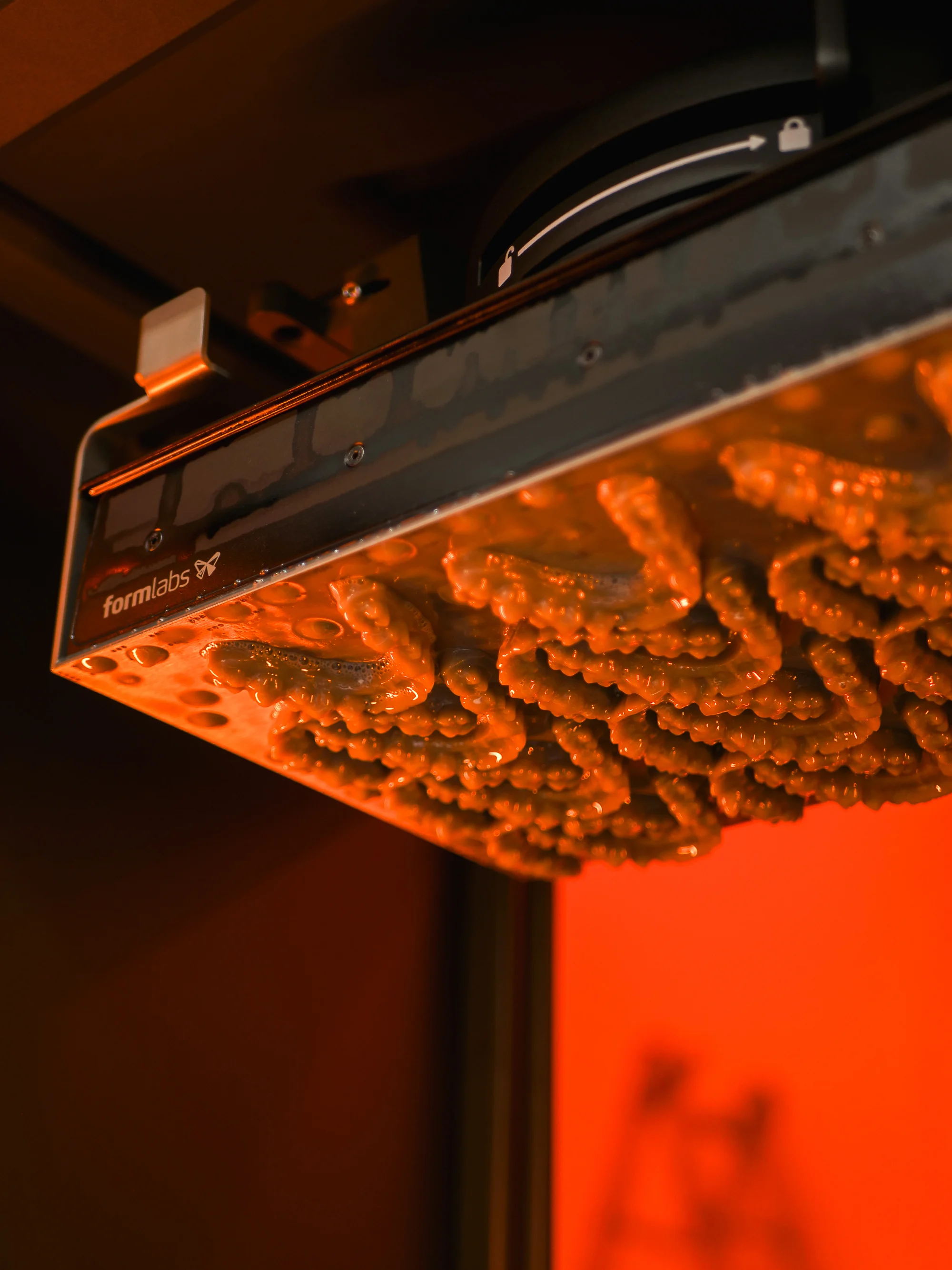
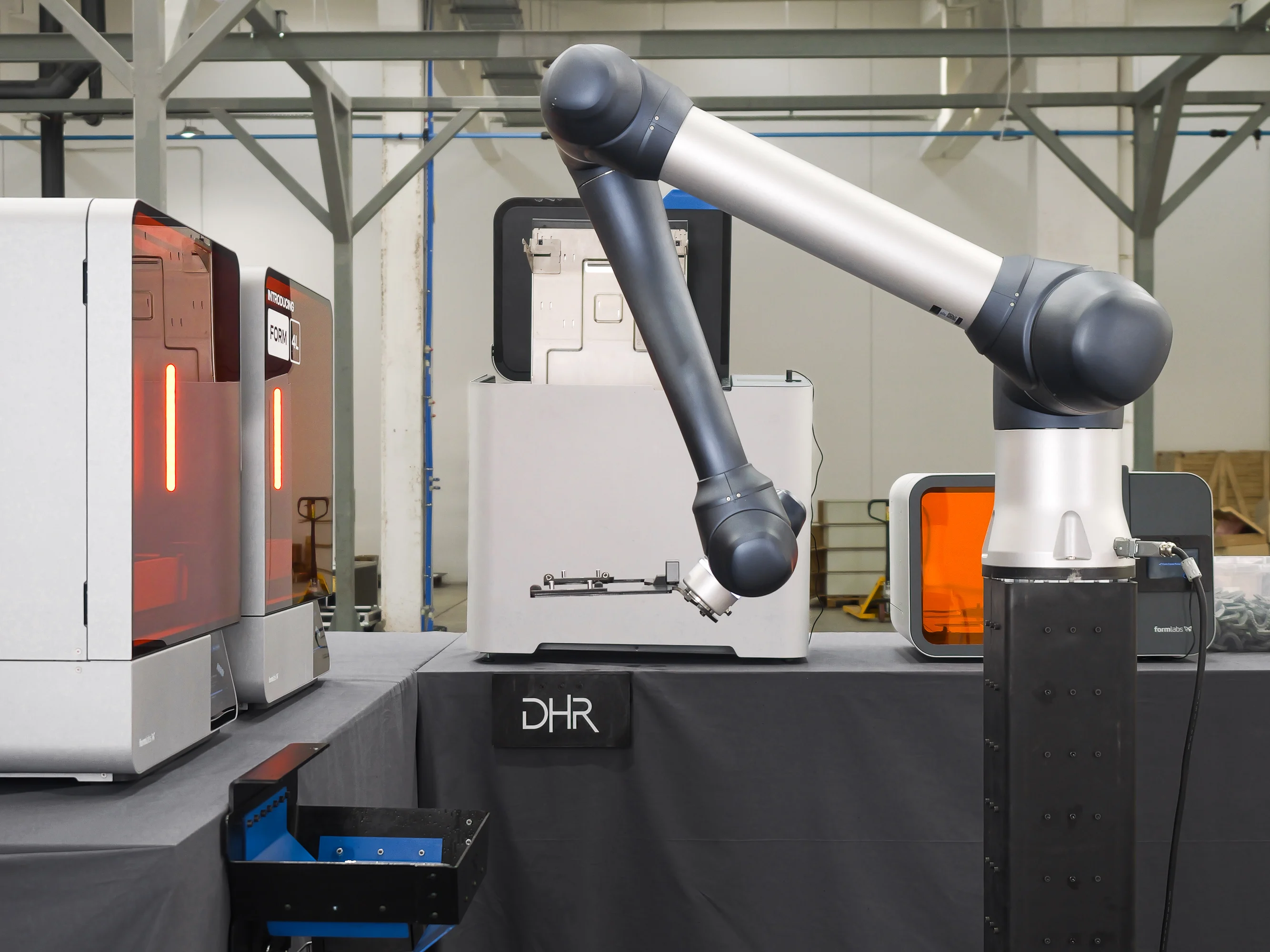
However, traditional methods are still highly relevant for specific workflows, provided they are scaled properly. Automation is the key to high-throughput dental production. For example, labs still require physical models for various restorative and orthodontic appliances. DHR Engineering has successfully implemented a fully automated SLA printing workflow for dental models to address this exact need. By utilizing smart queuing, robotic build platform handling, automated part removal and post-processing, this system with just two Formlabs Form 4L/BLs is capable of manufacturing 7,000+ dental arch models in 24 hours. This opens the doors for true industrial scale.
Dental Automation
Robotics and Lights-Out Manufacturing in Dental Production
Robotic integration increases throughput by automating repetitive tasks like machine loading, unloading, and part transfer between stations. This allows 3D printers and CNC mills to operate continuously without human intervention. Therefore, labs achieve true lights-out manufacturing, maximizing equipment uptime and transforming isolated machines into highly efficient production cells.
High-throughput hardware innovations are only effective if they are kept running constantly. If a fast 3D printer sits idle waiting for a human operator to remove a finished build plate, the speed advantage is lost. This is exactly why we are seeing a rising interest in robotic loading and unloading for additive systems and mills.
Robotic Loading/Unloading, Part Transfer and Post-Processing
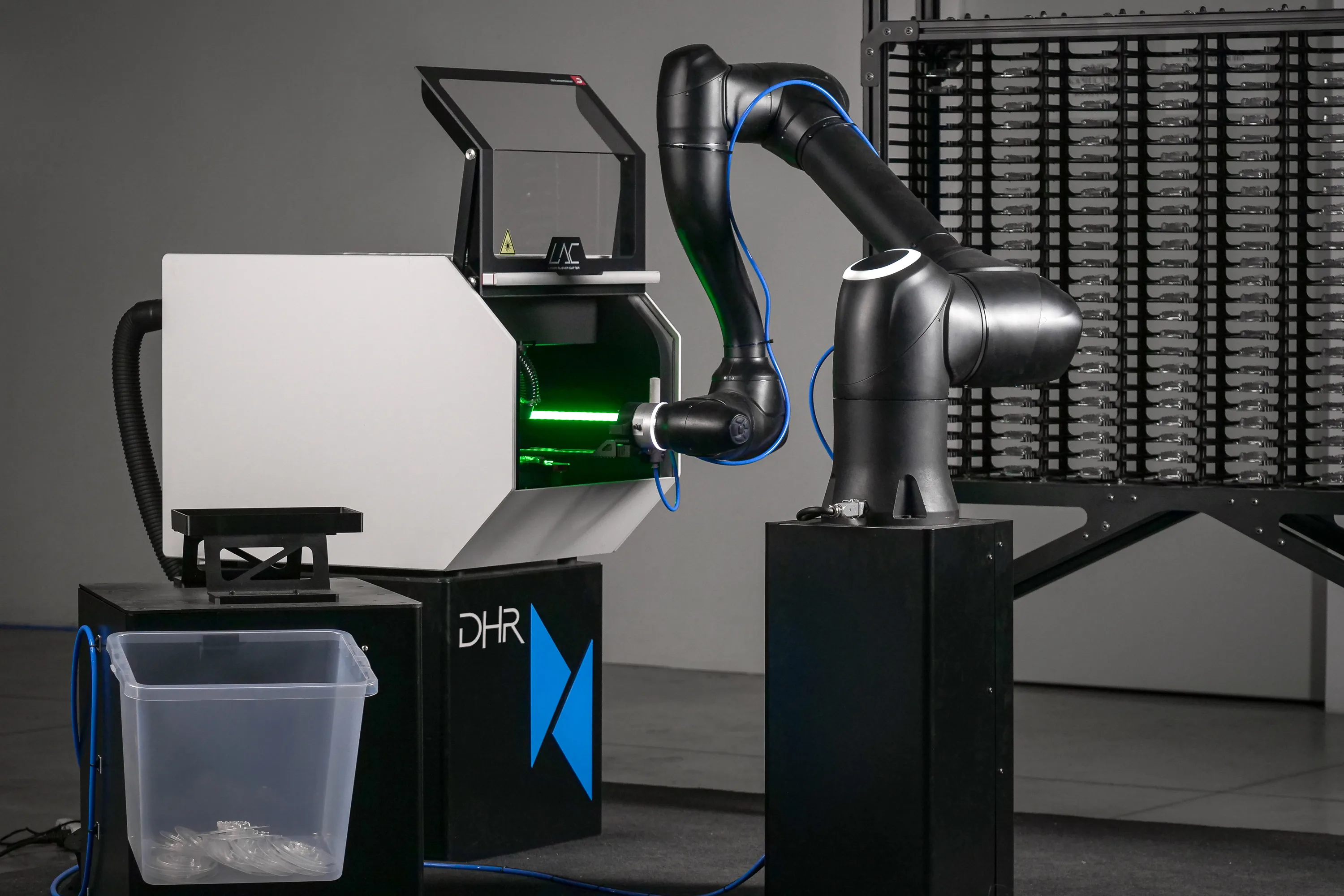
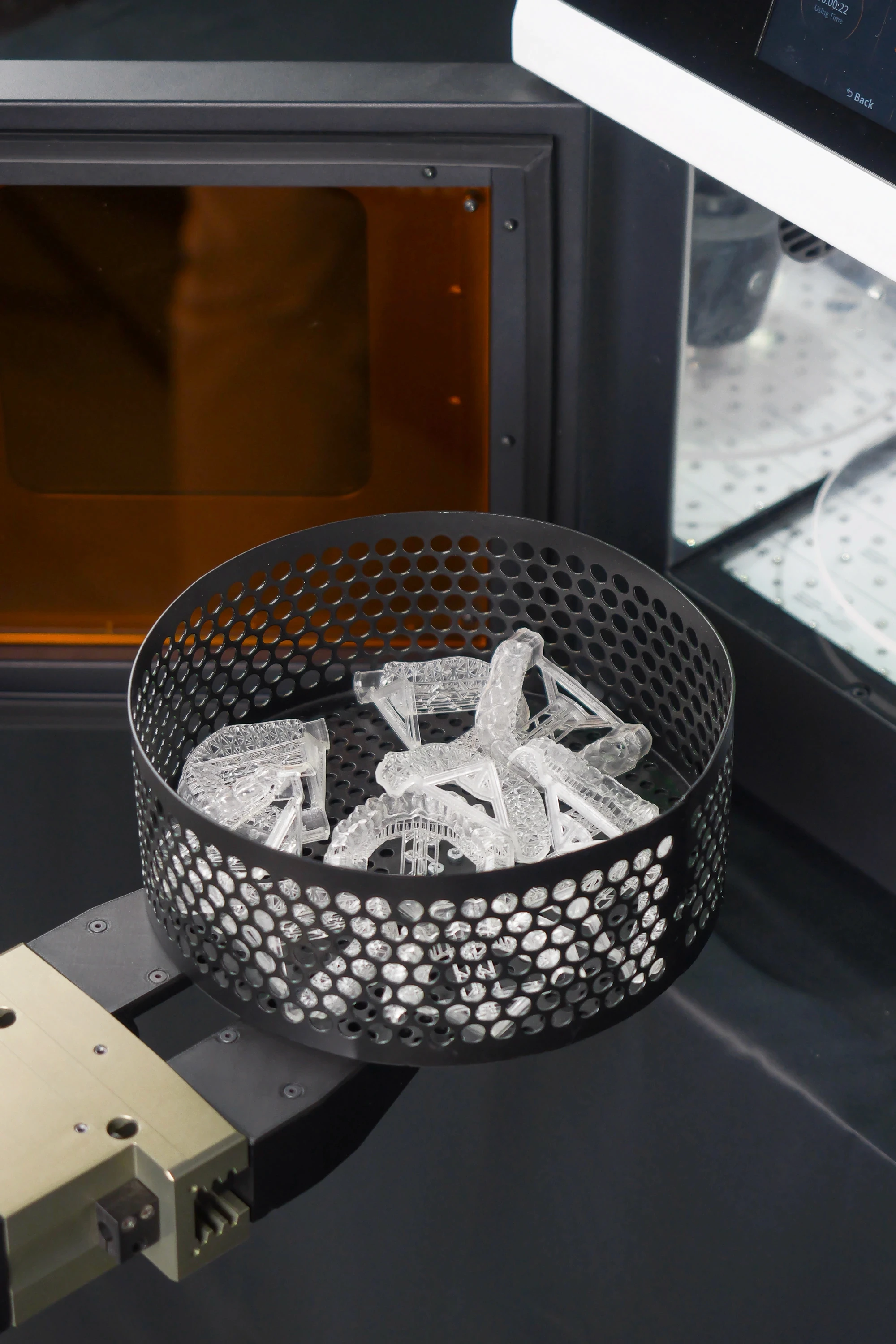
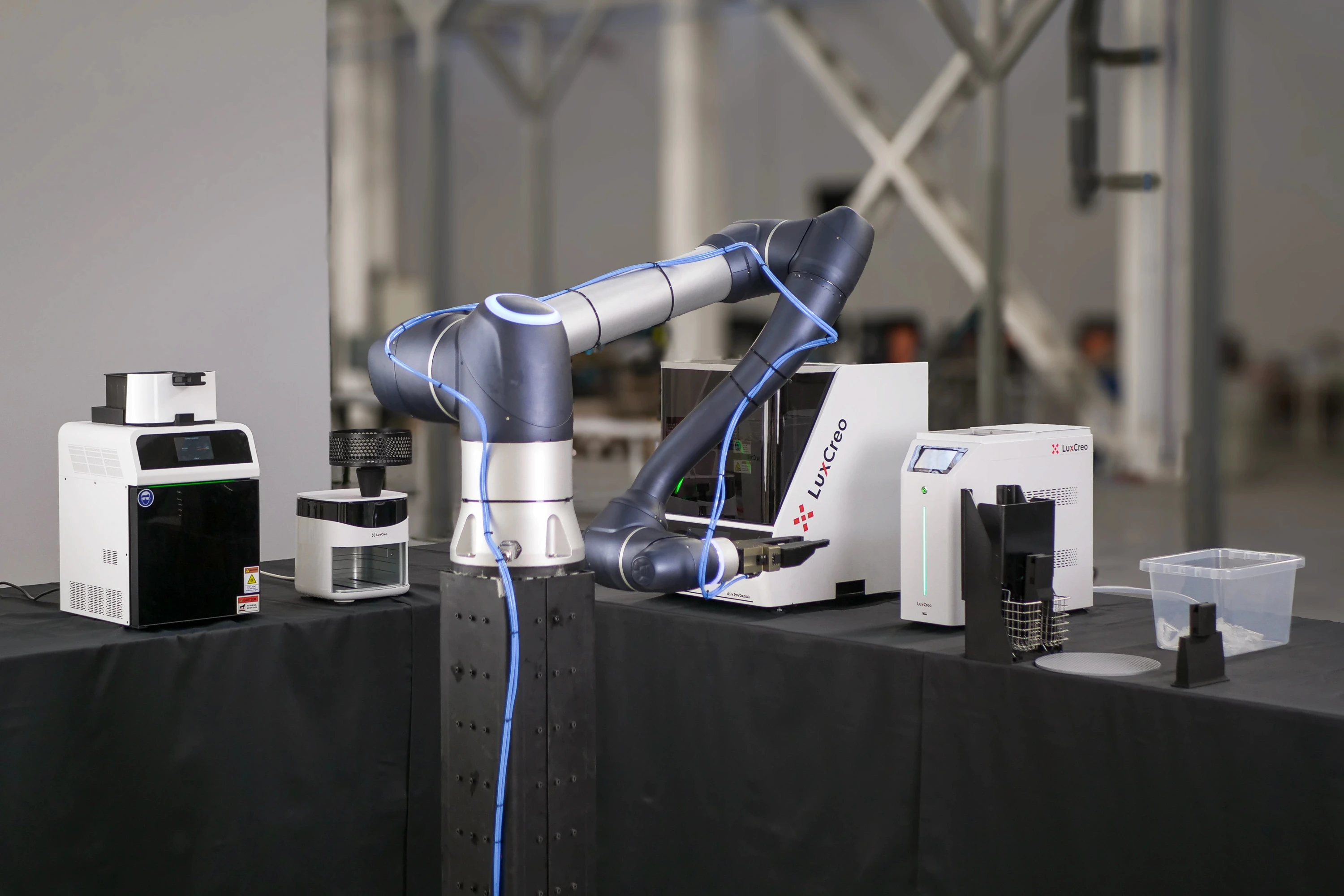
Industrial robotic arms are now being integrated directly into dental production environments. These robots handle the physical transfer of materials. For example, a robotic arm can remove a finished build platform from a 3D printer, place a fresh build platform into the machine, and trigger the next print job. The robot then moves the finished parts to an automated post-processing station.
Automated post-processing is a critical component of the digital assembly line. Printing the part is only half the battle. Dental resins typically require rigorous washing and precisely calibrated UV curing to achieve biocompatibility. Automated washing and curing stations, fed by robotic arms, ensure every part receives the exact same treatment. This guarantees consistent quality and prevents bottlenecks at the end of the production line.
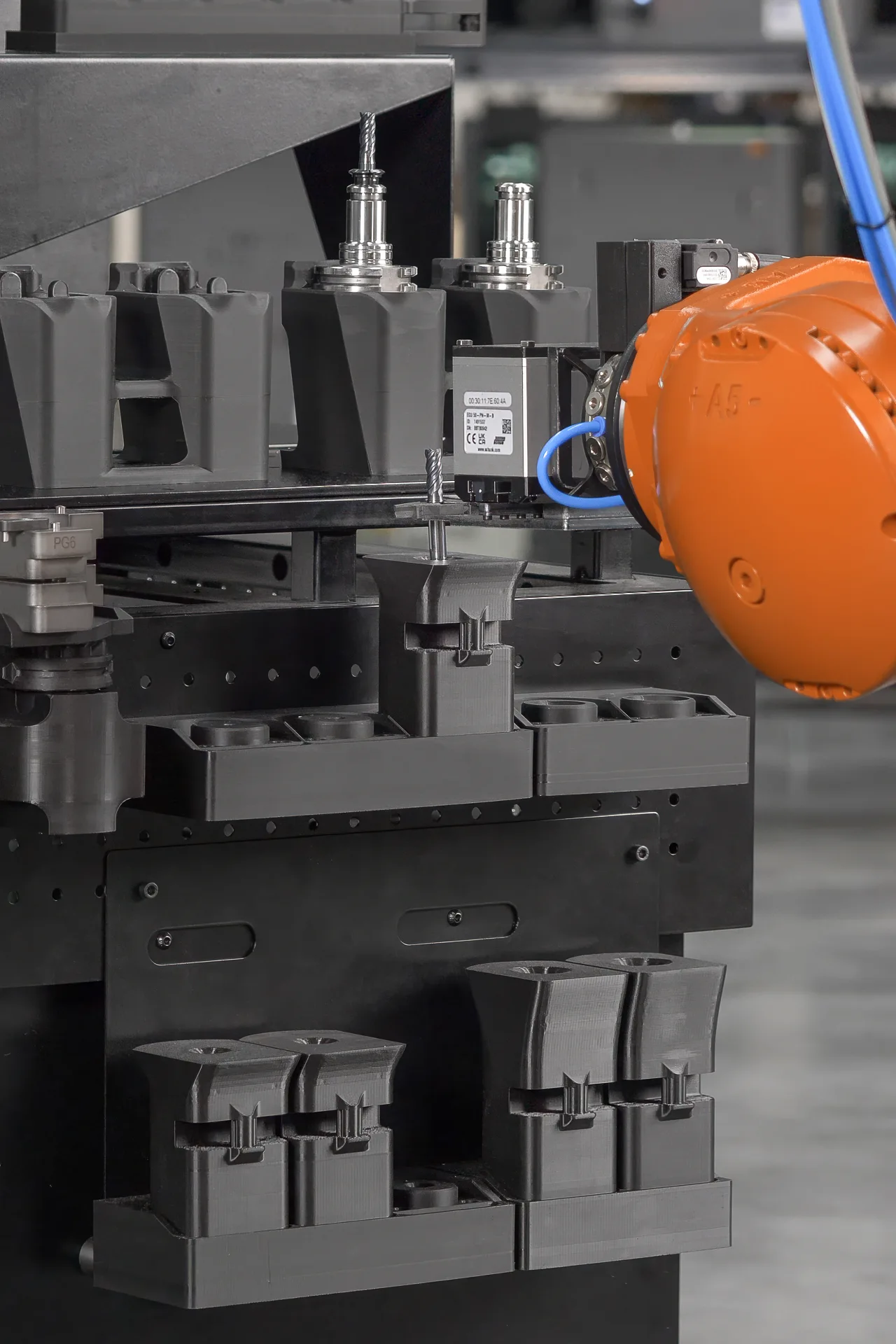
Robotics are also transforming subtractive manufacturing in the dental space. CNC mills require constant feeding of material pucks or blocks. By utilizing zero-point clamping systems and robotic loaders, a single mill can run 24 hours a day. The robot retrieves a raw puck from a magazine, loads it into the mill, and removes it when the machining cycle is complete.
Building the Unified Dental Factory
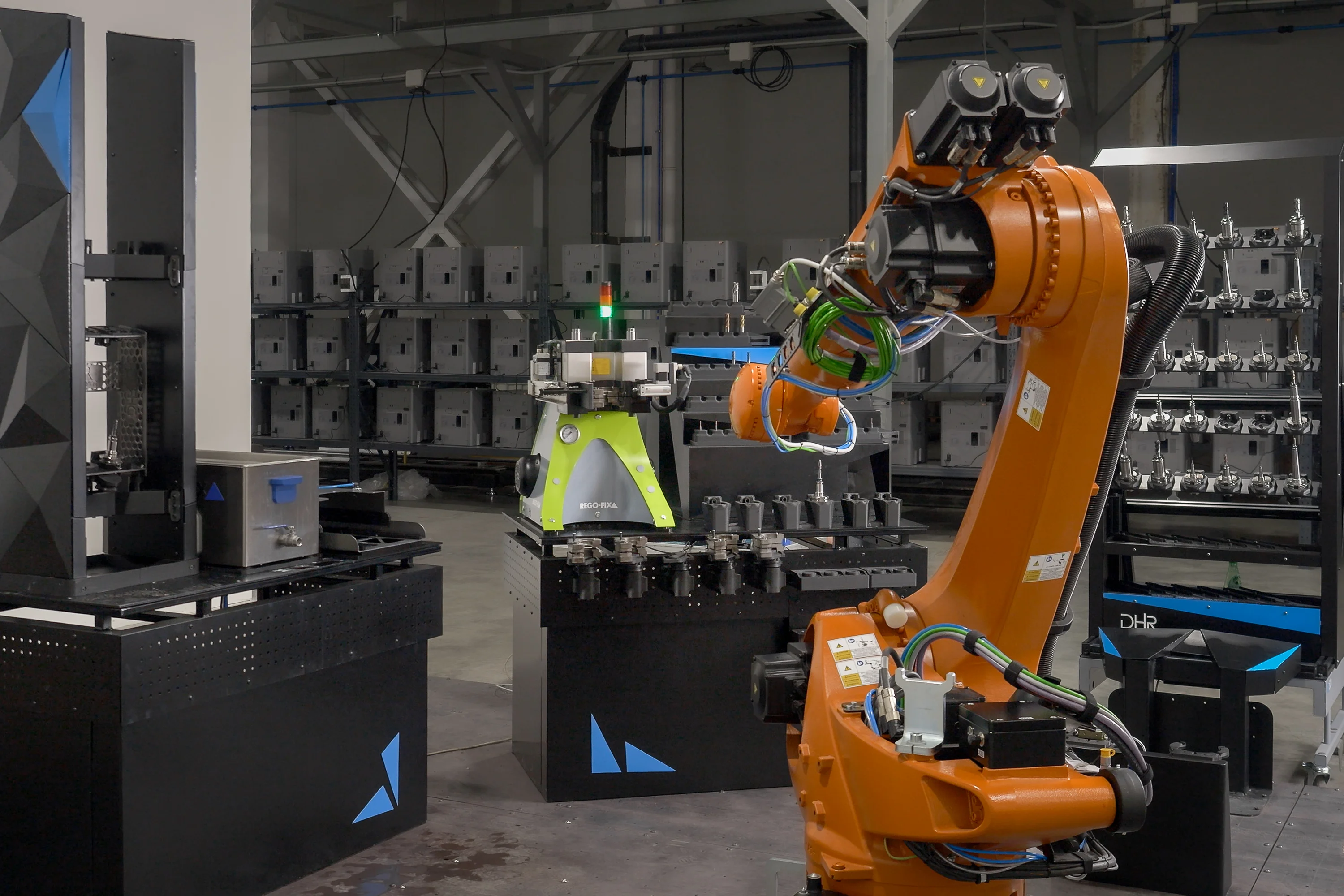
Labs that integrate additive manufacturing, robotics, AI, and automated post-processing into a unified system will operate with higher consistency, lower cost per unit, and scalable output capacity. Building a modern dental factory requires precise layout planning to ensure robots have the necessary reach and clearance. It requires custom end-of-arm tooling to handle delicate dental equipment. DHR Engineering specializes in this exact type of automation design, deployment, and on-site management. We ensure that your investment in robotics translates directly into increased yield and reduced labor reliance.
Are you building a high-capacity dental manufacturing facility or looking to offer automated solutions to your clients?
DHR Engineering provides expert layout planning, custom robotic integration, and comprehensive deployment management. Contact our team to discuss a custom automation roadmap for your specific production goals.
FAQ
Frequently Asked Questions on Dental Manufacturing Automation
Industry Context
The Key Drivers Behind Dental Lab Automation
Dental lab automation is driven primarily by skilled labor shortages and the need for scalable production models. Mid-sized and large labs require reliable efficiency solutions to handle increasing daily case volumes. Therefore, the industry is shifting focus from isolated machine purchases toward comprehensive workflow optimization and complete system integration to ensure consistent, high-quality output.
At LMT LAB DAY Chicago 2026, conversations on the trade show floor reflected this reality. The dialogue centers far more on workflow optimization than on individual machine specifications. Buyers are asking how a specific machine can fit into a broader, automated production layout. They want to know how data flows from the initial scan to the final packaged product. The real challenge is not hardware. It is integration.
This shift in mindset is not limited to large production centers. We see an increasing focus on scalability for mid-sized labs. These smaller facilities want to compete with larger corporate labs. To do this, they require robust automation solutions that do not require hiring dozens of new employees.
Furthermore, this demand has created a new business opportunity for dental equipment retailers and distributors. These companies are highly interested in adding automation as a service to their portfolios. Instead of just selling a milling machine or a 3D printer, distributors want to offer a fully planned, automated production cell. At DHR Engineering, we work with both startups and established manufacturers who are navigating this transition.
Digital Assembly Lines
How Do End-to-End Digital Workflows Improve Dental Production
End-to-end digital workflows improve dental production by seamlessly connecting intraoral scanning data directly to final manufacturing hardware. This creates a full-service digital lab environment with minimal human intervention. Consequently, manufacturers can deploy distributed manufacturing models, producing high-value medical devices on-demand near the point of care to reduce lead times.
A true digital assembly line requires a continuous flow of data and physical materials. In a traditional lab, workers manually move files between different software programs. Then, they manually move physical parts between different machines. End-to-end digital workflows eliminate these disconnected steps.
To put it simply, a digital workflow begins when a dentist uploads an intraoral scan. Software automatically analyzes the scan, generates a CAD model, and sends the nesting data directly to the production floor. This software-to-hardware integration is critical for building a full-service digital lab. It ensures that every step is tracked, quality-controlled, and optimized for speed.
Distributed Manufacturing and the On-Demand Dental Factory
Because digital workflows standardize production, they enable distributed manufacturing. The dental industry is moving toward a model where high-value devices like clear aligners and retainers are produced on-demand near the patient. Instead of shipping physical impressions across the country, a clinic sends a digital file to a local, highly automated dental factory. This approach mitigates supply chain risks. It also drastically reduces lead times for patients.
Building these networks requires careful facility planning and robust engineering. Companies looking to implement these advanced setups often rely on comprehensive dental manufacturing automation services to ensure their layouts maximize yield and minimize bottlenecks.
Advanced Additive Systems
Advanced Additive Manufacturing Technologies Reshaping Dental Manufacturing
Advanced additive systems redefine dental manufacturing through metal 3D printing, direct-print clear aligners, and highly automated SLA production. Hybrid setups combine metal printing with CNC precision. Direct printing eliminates wasteful thermoforming steps entirely. Meanwhile, automated SLA workflows scale traditional methods, allowing facilities to produce thousands of precise dental models daily with minimal human intervention.
Metal 3D Printing and Hybrid CNC: Getting the Best of Both
A major trend observed at Lab Day Chicago was the growing presence of metal 3D printing and hybrid manufacturing setups. Metal additive manufacturing is becoming essential for producing complex frameworks, crowns, and partial dentures. Hybrid manufacturing combines the geometric freedom of metal 3D printing with the high-tolerance surface finishing of CNC milling. A part is printed near net shape and then transferred to a milling machine for precise detailing. This approach provides the best of both worlds because it relies on seamless digital workflows to function correctly.
Direct-Print Clear Aligners: Eliminating the Thermoforming Step
Beyond metals, direct printing is transforming orthodontic workflows by eliminating intermediate steps. Usually, a lab would print an arch model and then thermoform a plastic sheet over it to create a clear aligner. This requires multiple machines, manual labor, trimming, and material waste. Using highly specialized, biocompatible resins, dental 3D printers can now produce clear aligners that are safe for intraoral use directly. To understand the benefits of this technology combined with automation, you can explore DHR's deployment of a fully automated direct print aligner production with LuxCreo. This project demonstrates how eliminating the thermoforming step increases output and drastically reduces overhead.
Scaling Traditional SLA Workflows to Industrial Output
However, traditional methods are still highly relevant for specific workflows, provided they are scaled properly. Automation is the key to high-throughput dental production. For example, labs still require physical models for various restorative and orthodontic appliances. DHR Engineering has successfully implemented a fully automated SLA printing workflow for dental models to address this exact need. By utilizing smart queuing, robotic build platform handling, automated part removal and post-processing, this system with just two Formlabs Form 4L/BLs is capable of manufacturing 7,000+ dental arch models in 24 hours. This opens the doors for true industrial scale.
Dental Automation
Robotics and Lights-Out Manufacturing in Dental Production
Robotic integration increases throughput by automating repetitive tasks like machine loading, unloading, and part transfer between stations. This allows 3D printers and CNC mills to operate continuously without human intervention. Therefore, labs achieve true lights-out manufacturing, maximizing equipment uptime and transforming isolated machines into highly efficient production cells.
High-throughput hardware innovations are only effective if they are kept running constantly. If a fast 3D printer sits idle waiting for a human operator to remove a finished build plate, the speed advantage is lost. This is exactly why we are seeing a rising interest in robotic loading and unloading for additive systems and mills.
Robotic Loading/Unloading, Part Transfer and Post-Processing
Industrial robotic arms are now being integrated directly into dental production environments. These robots handle the physical transfer of materials. For example, a robotic arm can remove a finished build platform from a 3D printer, place a fresh build platform into the machine, and trigger the next print job. The robot then moves the finished parts to an automated post-processing station.
Automated post-processing is a critical component of the digital assembly line. Printing the part is only half the battle. Dental resins typically require rigorous washing and precisely calibrated UV curing to achieve biocompatibility. Automated washing and curing stations, fed by robotic arms, ensure every part receives the exact same treatment. This guarantees consistent quality and prevents bottlenecks at the end of the production line.
Robotics are also transforming subtractive manufacturing in the dental space. CNC mills require constant feeding of material pucks or blocks. By utilizing zero-point clamping systems and robotic loaders, a single mill can run 24 hours a day. The robot retrieves a raw puck from a magazine, loads it into the mill, and removes it when the machining cycle is complete.
Building the Unified Dental Factory
Labs that integrate additive manufacturing, robotics, AI, and automated post-processing into a unified system will operate with higher consistency, lower cost per unit, and scalable output capacity. Building a modern dental factory requires precise layout planning to ensure robots have the necessary reach and clearance. It requires custom end-of-arm tooling to handle delicate dental equipment. DHR Engineering specializes in this exact type of automation design, deployment, and on-site management. We ensure that your investment in robotics translates directly into increased yield and reduced labor reliance.
Are you building a high-capacity dental manufacturing facility or looking to offer automated solutions to your clients?
DHR Engineering provides expert layout planning, custom robotic integration, and comprehensive deployment management. Contact our team to discuss a custom automation roadmap for your specific production goals.
FAQ