April 2, 2026
Drone Manufacturing: Scaling Production and Cutting Costs with Automated 3D Printing
Demand for UAVs is accelerating in every direction - military, commercial, agriculture, infrastructure, delivery services, and the production systems built to meet that demand are struggling to keep pace. This article covers why additive manufacturing is replacing traditional production for drone airframes and parts, why automation is the critical multiplier that makes it viable at military and industrial scale, and what that looks like in practice.
Demand for UAVs is accelerating in every direction - military, commercial, agriculture, infrastructure, delivery services, and the production systems built to meet that demand are struggling to keep pace. This article covers why additive manufacturing is replacing traditional production for drone airframes and parts, why automation is the critical multiplier that makes it viable at military and industrial scale, and what that looks like in practice.
Drone Manufacturing
Defense
3D Printing
Drone Manufacturing
3D Printing
Defense
Table of Contents
The Demand Signal: Why Conventional Drone Manufacturing Cannot Keep Up
The traditional path to drone manufacturing is slow, expensive, and geographically constrained. It depends on specialized tooling, centralized supply chains, and production timelines measured in months. When the threat environment changes overnight, or a forward operating unit needs a hundred airframes by morning, those systems fail completely.
The global market for 3D-printed drones was valued at approximately USD 707 million in 2024. It is forecast to reach USD 1.89 billion by 2029, growing at a compound annual rate of 21.8%.[^1] That trajectory is not driven by consumer gadgetry. It is driven by defense agencies, border security operations, and critical infrastructure operators who need UAVs in volumes and at unit costs that conventional manufacturing simply cannot deliver.
The FY2026 Pentagon budget allocated USD 3.3 billion to additive manufacturing projects - an 83% increase over the prior year.[^2] The DoD has separately committed USD 1 billion to domestic production of low-cost military drones, with 3D printing as the primary production technology.[^3] Defense Secretary Pete Hegseth described drones as "the biggest battlefield innovation in a generation" in a 2025 memorandum ordering the military to scale production and integrate UAV capabilities into training.[^4]
The evidence from active conflict makes this concrete. Facing Russian Shahed launches exceeding 5,000 per month,[^5] Ukrainian operators built decentralized print farm networks to produce interceptors at speed. Wild Hornets, a non-profit using consumer FDM printers, reached approximately 100 drones per day.[^6] The U.S. Army's 101st Airborne Division separately demonstrated the same model onshore, producing over 100 airframes using unit-level funding and in-house printing, bypassing procurement entirely.[^7]
This shift from field-expedient tactic to institutional strategy is now backed by major defense capital. In early 2025, the U.S. Air Force awarded Firestorm Labs a $100 million contract to scale the development of 3D-printed unmanned aerial systems.[^8] The premise of the deal represents a universal shift in aerospace manufacturing: instead of relying on massive, centralized factories and vulnerable supply chains, highly customizable drones can now be printed and assembled directly at the point of need.
USD 3.3B | 21.8% | 80% |
|---|---|---|
Pentagon FY2026 additive manufacturing budget, 3D Printing Industry, 2025 | CAGR of the 3D-printed drone market through 2029, Research and Markets, 2024 | Cost reduction per drone airframe when switching to on-site FDM printing, 3D Printing Industry, 2025 |
The challenge is not demand. It is production capacity and supply chain independence, and the answer is not more factories. It is smarter ones.
The Manufacturing Case: Why 3D Printing Wins for Drone Bodies
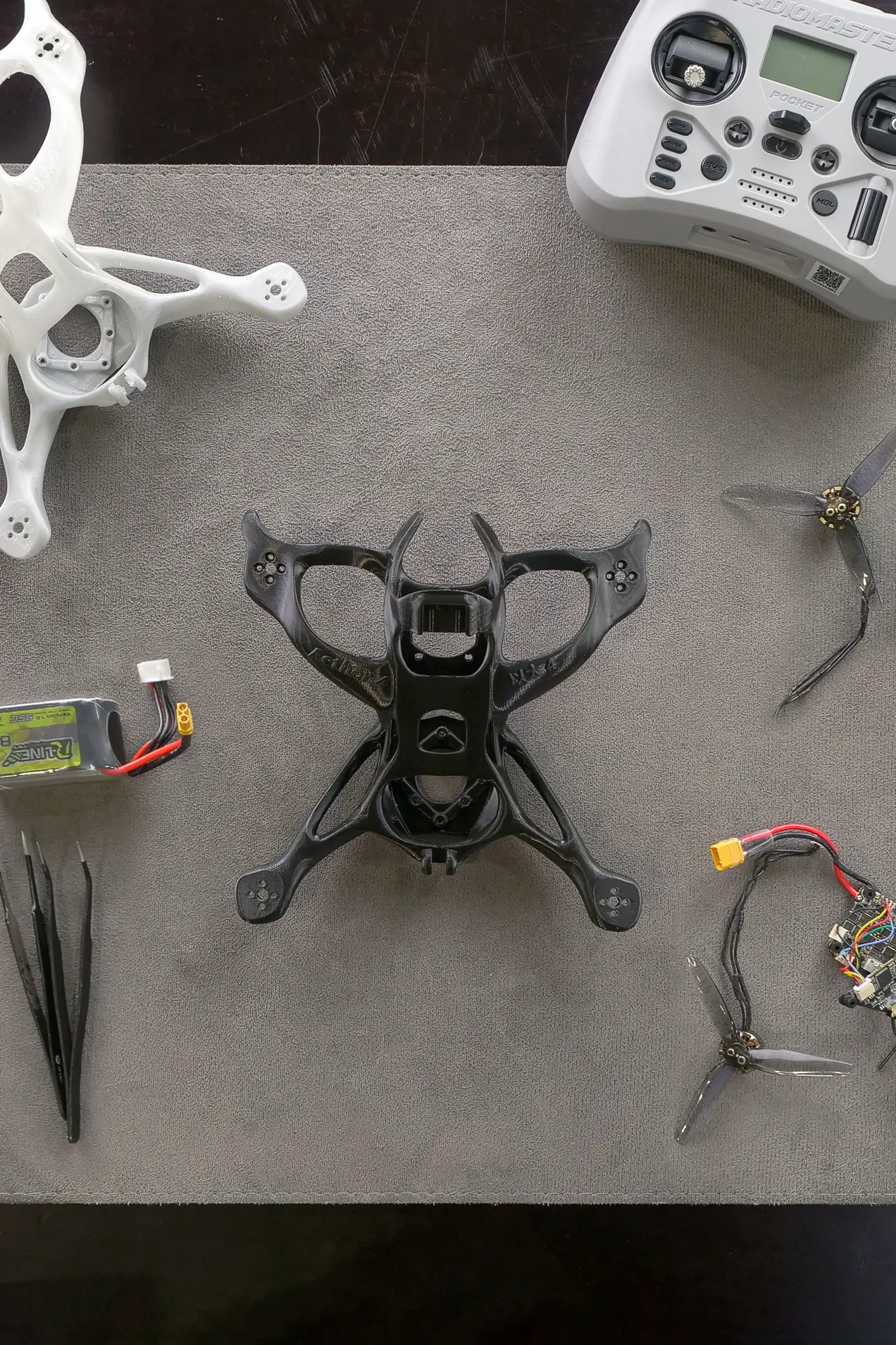
Drone airframes have specific requirements that make additive manufacturing particularly well-suited to producing them. Drone airframes need to be light, geometrically complex, rapidly iterable, and producible at varying volumes without the unit economics collapsing. Traditional manufacturing is structurally misaligned with all of those requirements.
Tooling costs kill low-volume viability. Injection molding requires molds and dies costing USD 10,000–50,000 or more before a single part is produced.[^9] 3D printing builds directly from a CAD file without upfront tooling, which means low-volume and one-off production are economically viable from unit one.
Lighter parts through geometry. Additive manufacturing enables topology optimization and internal lattice structures that reduce component mass by 25–70% while maintaining structural integrity. These geometries cannot be machined or molded. For drones, mass reduction directly translates to longer flight time and higher payload capacity.
Rapid design iteration in hours, not weeks. Ukrainian drone technology becomes outdated roughly every six weeks as adversaries adapt countermeasures.[^10] A manufacturing method that requires retooling for every design revision cannot operate at that tempo. 3D printing requires only a file update and the next print reflects the change.
The cost data is stark. The British Army ran a field exercise in Kenya in 2025 where a team used a portable FDM printer to produce drone airframes at roughly £400 per unit, compared to £2,000 for conventionally procured equivalents, an 80% cost reduction.[^11] U.S. Army field-printed FPV drones have come in at USD 400–500 per unit versus USD 5,000 for commercially sourced alternatives.
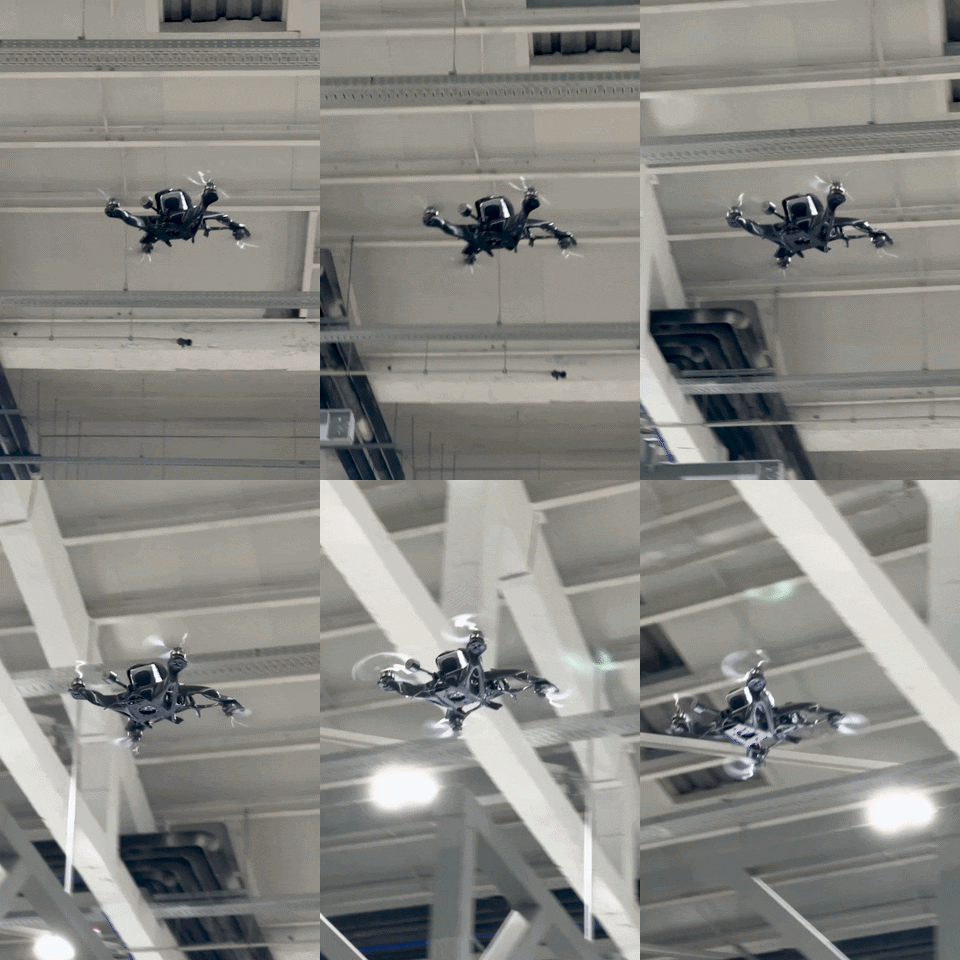
The drone that can be printed overnight, repaired in the field, and redesigned between missions is not a prototype. It is the new production standard.
The Automation Imperative: Why Lights-Out Print Farms Drone Manufacturing
3D printing changes the economics of drone manufacturing. Automated 3D printing changes the scale. These are different problems, and both matter.
A single printer producing drone airframes is useful for prototyping. A farm of 40 printers operated manually, where a person clears beds, restarts jobs, and monitors failures across every machine, does not scale. The throughput ceiling is the manual labor, not the hardware.
What automated print farm architecture looks like
An automated 3D print farm for drone manufacturing combines three integrated layers:
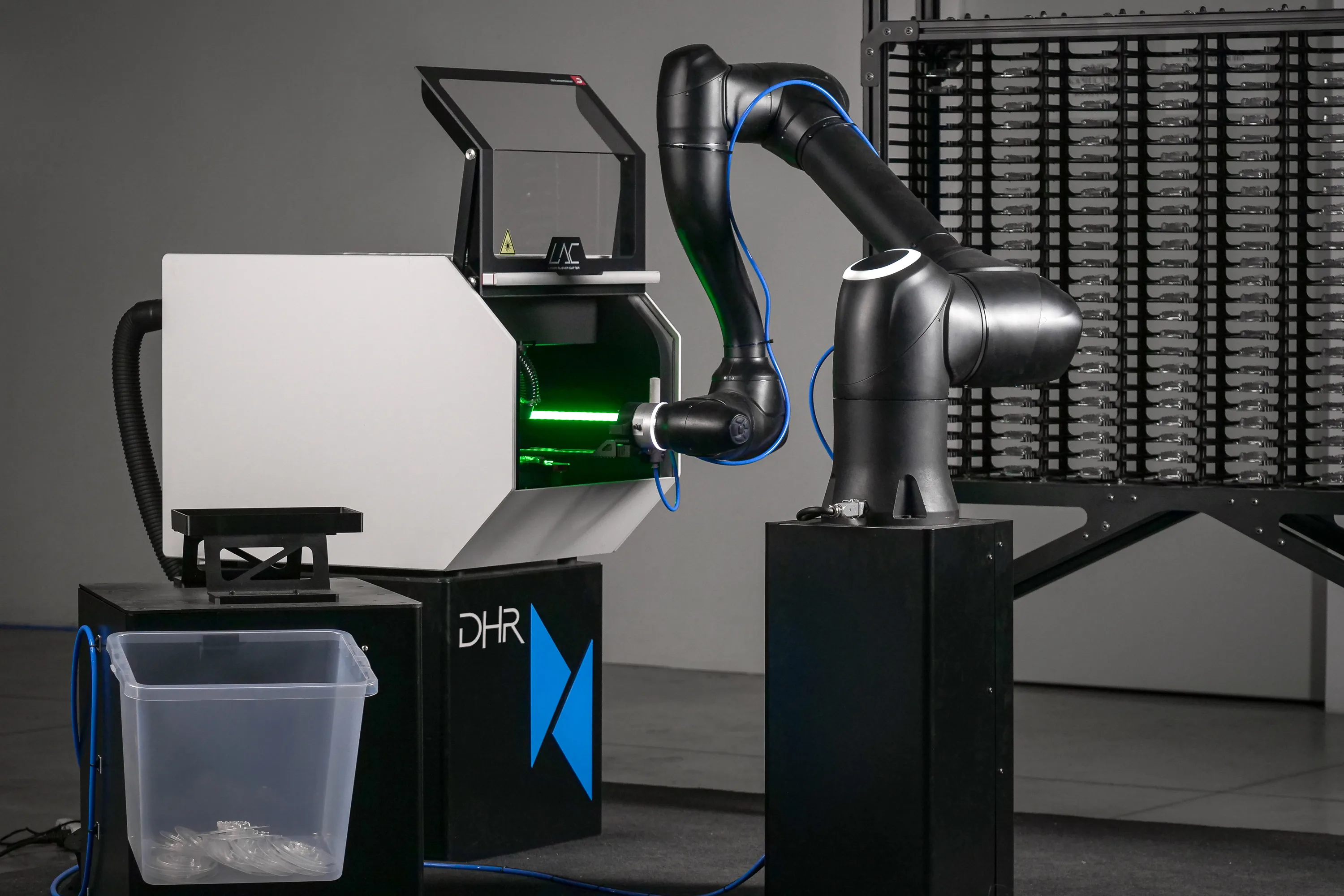
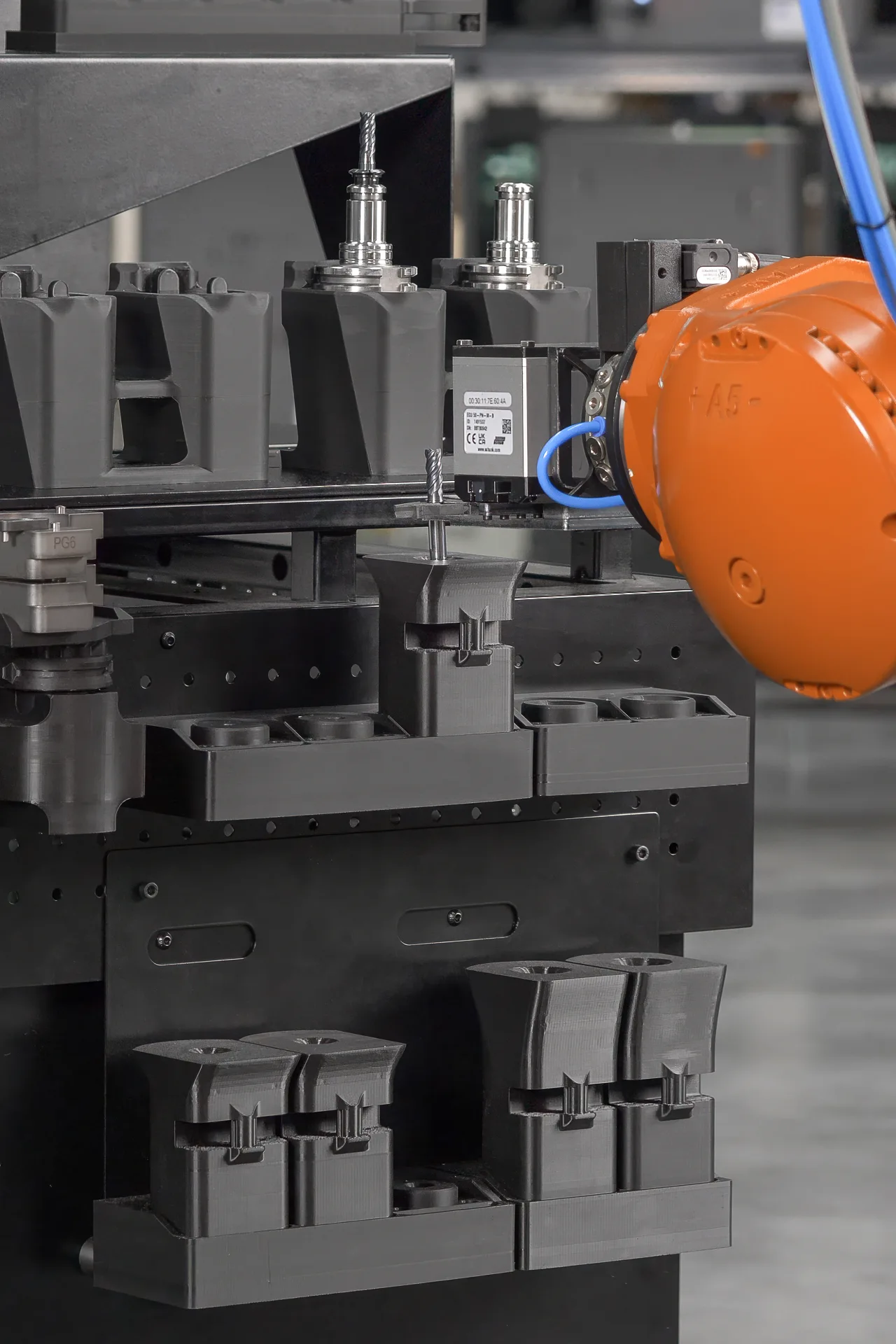
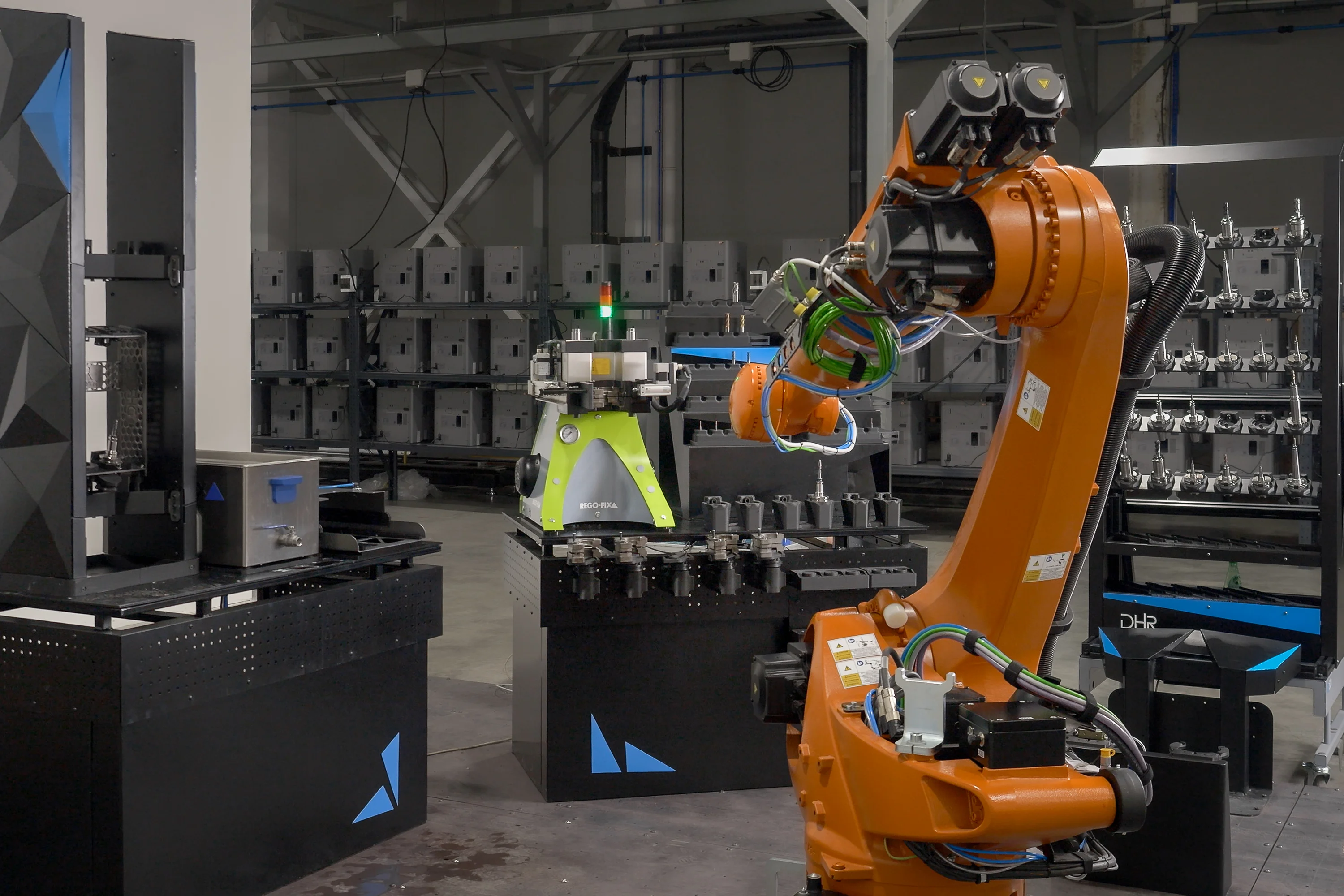
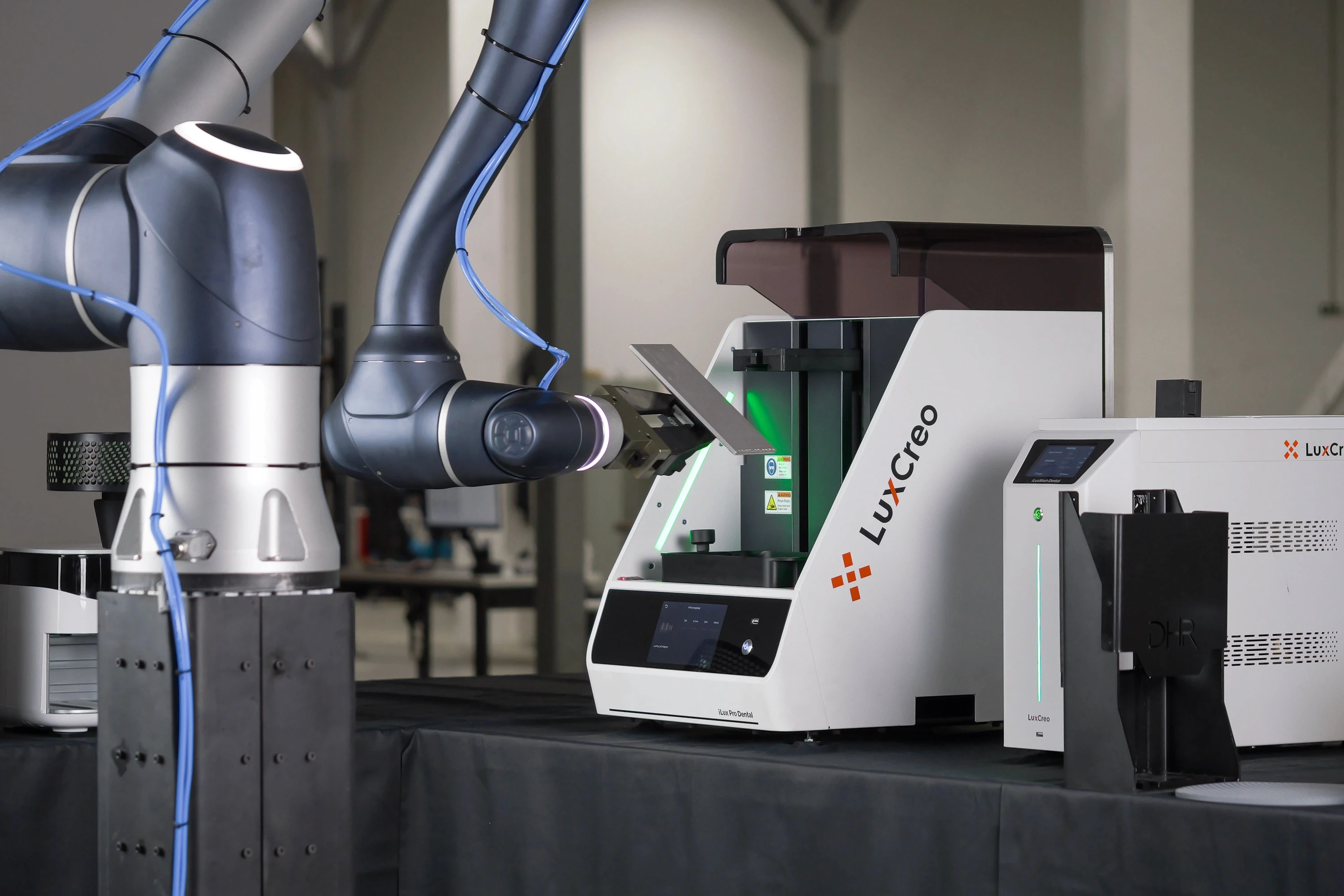
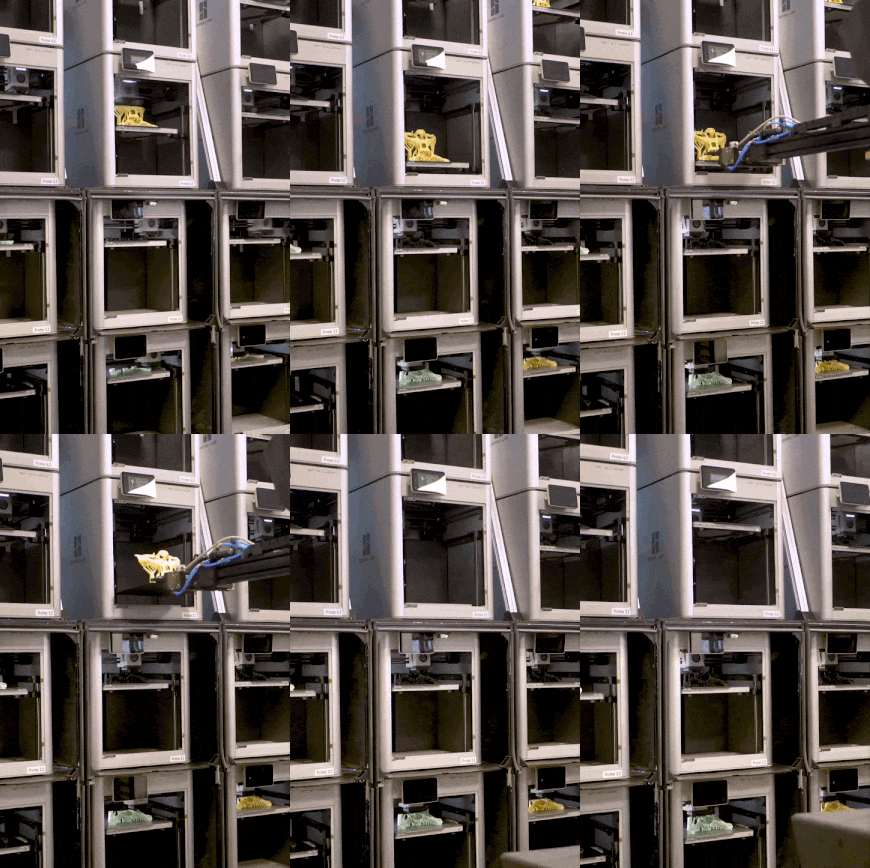
Robotic Handling: A robot identifies completed prints, removes the build plate, deposits it on output racking, loads a clean bed, and signals the software to begin the next job. The machine does not wait for a technician to walk over and swap the bed. It proceeds immediately. Across a farm of 40 or more machines, this eliminates the idle time that occurs between print completion and job restart in manual operations - the single largest source of lost production capacity in non-automated farms.[^12]
Centralized Scheduling Software: Jobs are assigned to available machines based on material requirements and queue status. The MES manages complex batch queues involving different materials, different file types, and different priority levels. The result is continuous production: machines running more than 95% of the time rather than the 40–60% utilization typical of manually operated farms.
Automated Material Management: Filament inventory is tracked across machines, ensuring continuous supply without manual cartridge changes. For high-volume drone body production using consistent materials across a standardized airframe design, this allows production runs of hundreds of units to complete entirely unattended.
Why the defense sector needs automated production
For drone manufacturing, the defense case for automation goes beyond throughput. Demand is episodic - a unit may need zero drones for a week, then need 80 overnight. An automated farm can idle or ramp immediately. Designs change constantly; automated farms running from digital files implement those changes with zero tooling lead time. And the model is location-independent: mobile containerized print farms can operate at forward bases or on naval vessels, taking production to where it is needed rather than shipping finished goods through vulnerable supply chains.[^13]
The U.S. Army's "transforming-in-contact" initiative formalizes this model. Soldiers provide real-time operational feedback, designers update files, and printers at the forward edge produce the updated airframes immediately. This creates a local, organic capability, not a dependency on distant industry.[^14]
In Practice: 120 Airframes, Under 24 Hours, Unattended
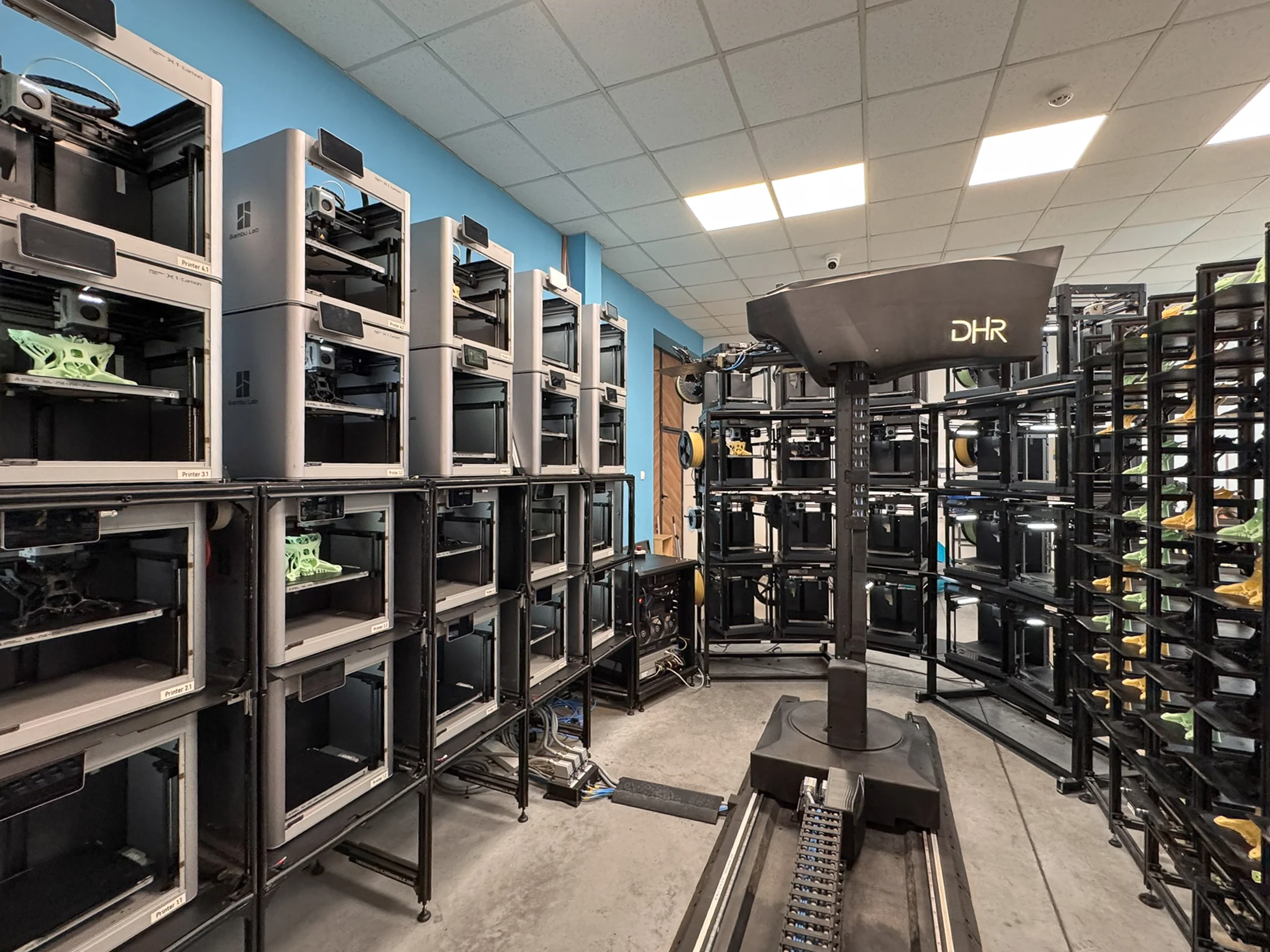
DHR's automated print farm was built as a universal manufacturing infrastructure - a high-throughput, lights-out production capability built to support DHR's own industrial automation work, churning out jigs, fixtures, brackets, and functional components for CNC and additive manufacturing systems. The capability also translates directly to drone body production.
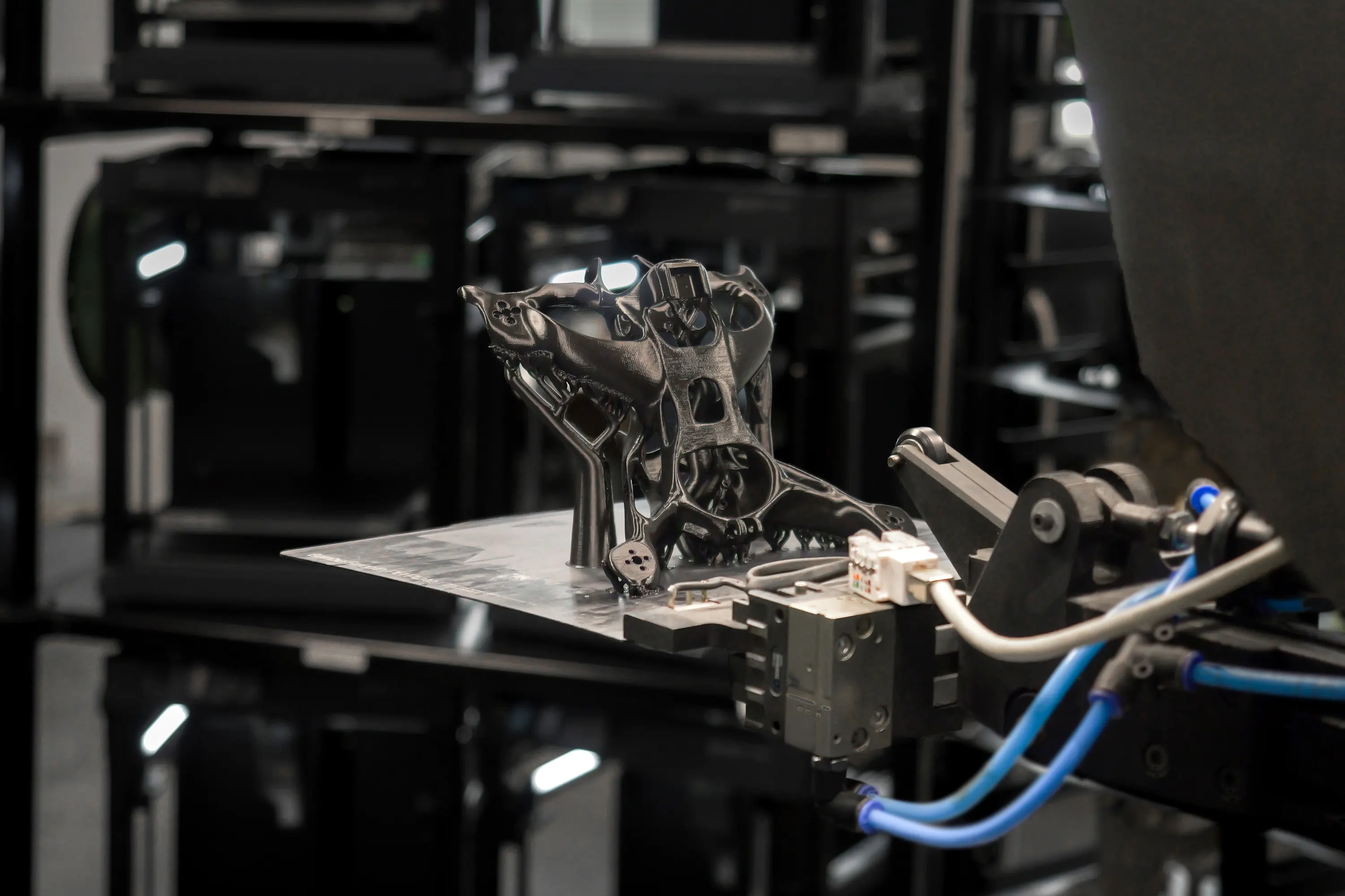
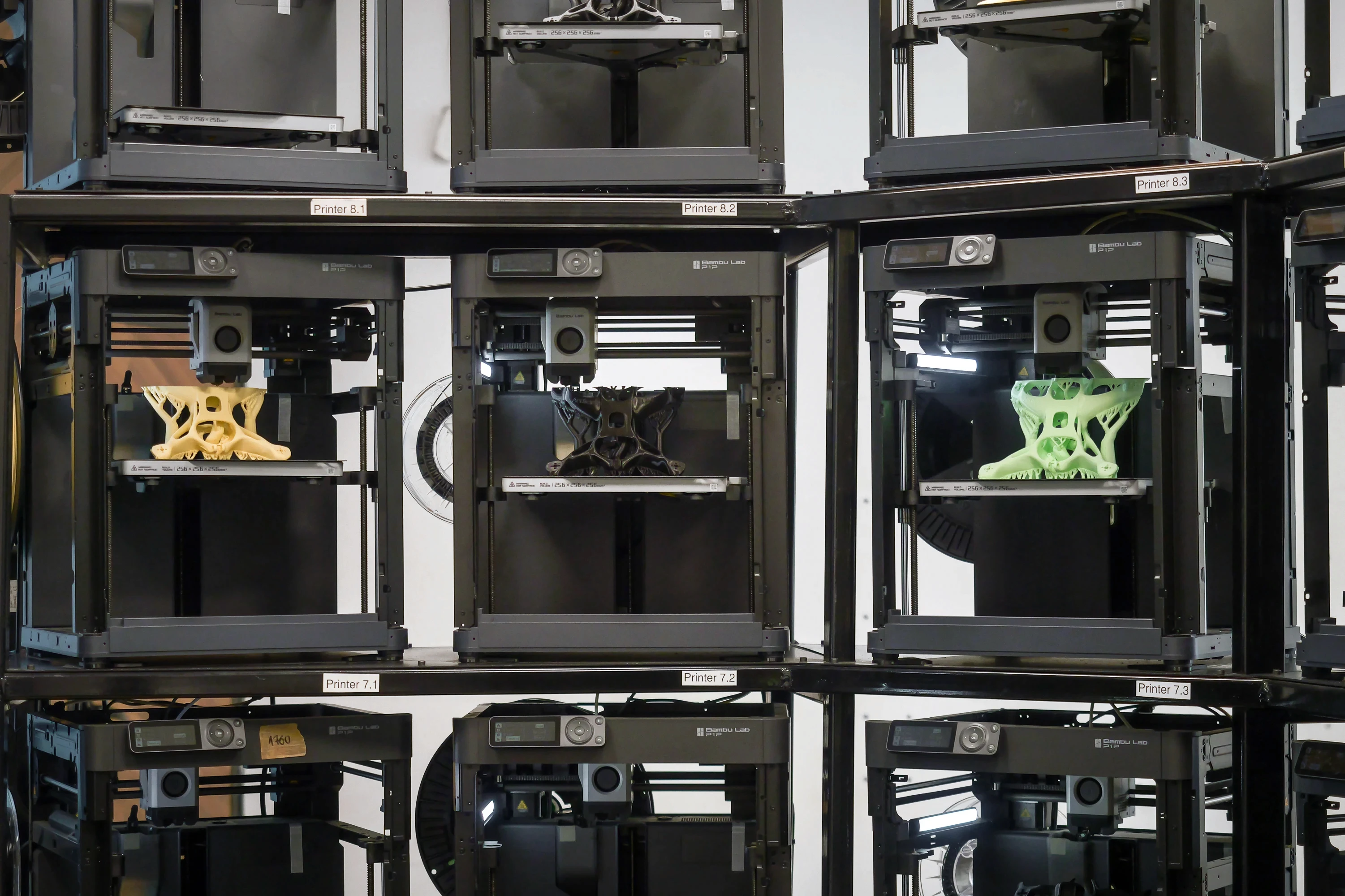
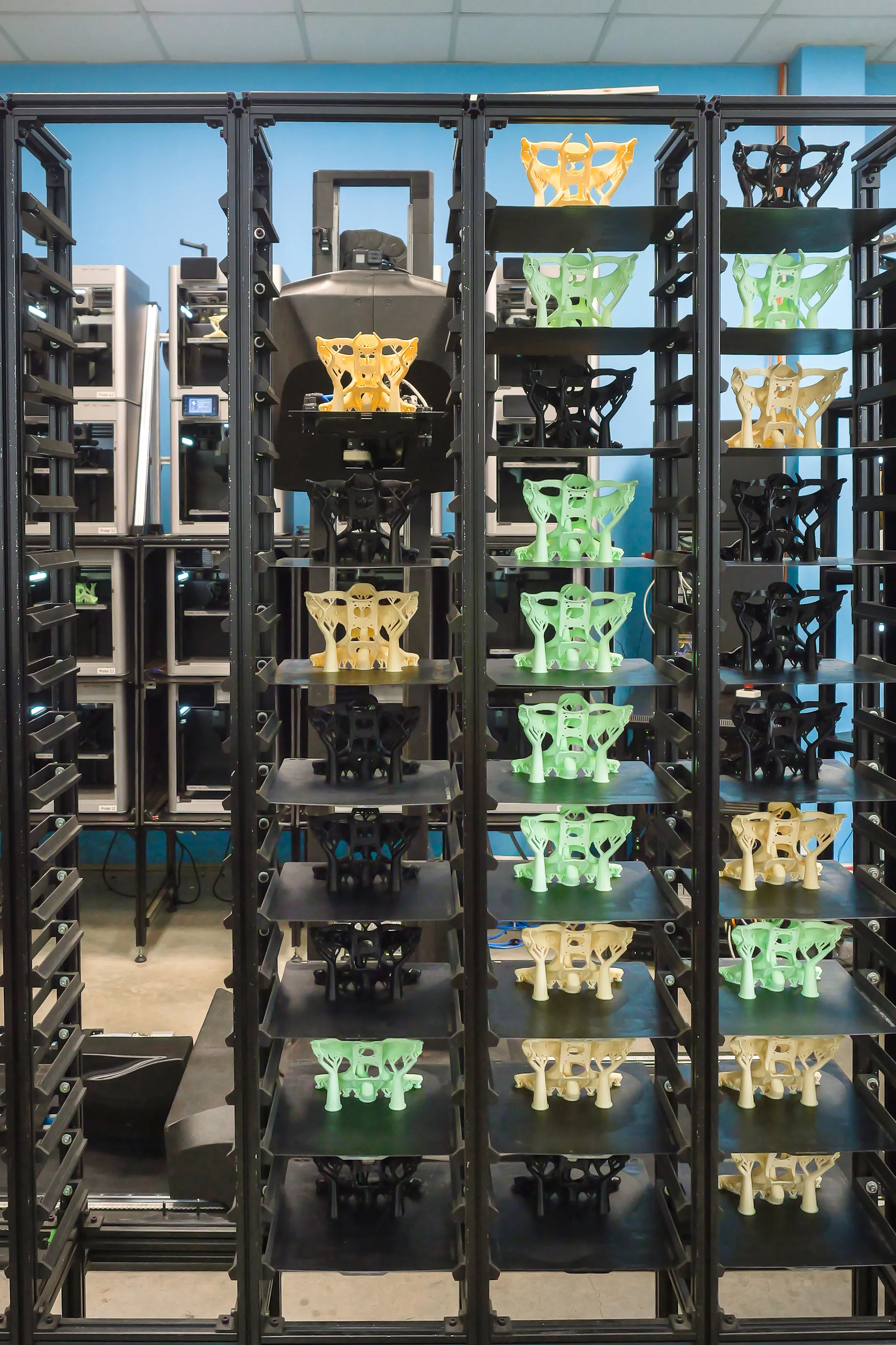
Running a drone airframe design across the farm with 44 FDM machines, DHR produced 120 drone bodies in under 24 hours - unattended, overnight, with zero operator interventions during the production run.
This is not a capability that requires a dedicated drone manufacturing facility. It is the output of an existing automated print farm applied to a new part geometry. The infrastructure, the software, the robot, and the process were already in place. Producing 120 drone bodies instead of 120 fixture brackets required just changing the files.
That is the core argument for automated additive manufacturing as a drone production strategy: the capability is general. Once you have built it, the marginal cost of applying it to a new part, including a drone airframe, is essentially zero.
What this means for the defense and commercial drone sectors
For defense customers, this system demonstrates that production at tactically meaningful volumes is achievable without bespoke manufacturing infrastructure. A unit or agency that needs 100 airframes per day does not need to build a factory. It needs to operate a print farm.
Moreover, FDM, SLS, metal powder and resin printers can operate side by side under the same robotic handling system and the same scheduling software. For drone manufacturing specifically, this matters because different airframe components may have different material requirements. A mixed fleet farm removes that constraint entirely.
The same infrastructure also supports dual-use production at the tactical edge. When drone demand is low, the same print farm can be retasked to produce medical supplies like splints, wound closure devices, tourniquet components, or custom prosthetics, without any change to the underlying hardware. A forward-deployed unit running this system is not just a drone factory, it is an on-demand manufacturing node that shifts output based on the mission's most pressing need. That flexibility may prove as strategically valuable as the airframe throughput itself.
For organizations that need to build this capability in-house, DHR's 3D printing automation services cover the full scope: custom robotic workcells, unified MES software, and integration across FDM, SLS, SLA, and MJF platforms - all running lights-out under a single system. Contact our team to discuss a custom automation roadmap for your specific manufacturing goals.
Frequently Asked Questions on Drone Manufacturing with 3D Printing
The Demand Signal: Why Conventional Drone Manufacturing Cannot Keep Up
The traditional path to drone manufacturing is slow, expensive, and geographically constrained. It depends on specialized tooling, centralized supply chains, and production timelines measured in months. When the threat environment changes overnight, or a forward operating unit needs a hundred airframes by morning, those systems fail completely.
The global market for 3D-printed drones was valued at approximately USD 707 million in 2024. It is forecast to reach USD 1.89 billion by 2029, growing at a compound annual rate of 21.8%.[^1] That trajectory is not driven by consumer gadgetry. It is driven by defense agencies, border security operations, and critical infrastructure operators who need UAVs in volumes and at unit costs that conventional manufacturing simply cannot deliver.
The FY2026 Pentagon budget allocated USD 3.3 billion to additive manufacturing projects - an 83% increase over the prior year.[^2] The DoD has separately committed USD 1 billion to domestic production of low-cost military drones, with 3D printing as the primary production technology.[^3] Defense Secretary Pete Hegseth described drones as "the biggest battlefield innovation in a generation" in a 2025 memorandum ordering the military to scale production and integrate UAV capabilities into training.[^4]
The evidence from active conflict makes this concrete. Facing Russian Shahed launches exceeding 5,000 per month,[^5] Ukrainian operators built decentralized print farm networks to produce interceptors at speed. Wild Hornets, a non-profit using consumer FDM printers, reached approximately 100 drones per day.[^6] The U.S. Army's 101st Airborne Division separately demonstrated the same model onshore, producing over 100 airframes using unit-level funding and in-house printing, bypassing procurement entirely.[^7]
This shift from field-expedient tactic to institutional strategy is now backed by major defense capital. In early 2025, the U.S. Air Force awarded Firestorm Labs a $100 million contract to scale the development of 3D-printed unmanned aerial systems.[^8] The premise of the deal represents a universal shift in aerospace manufacturing: instead of relying on massive, centralized factories and vulnerable supply chains, highly customizable drones can now be printed and assembled directly at the point of need.
USD 3.3B | 21.8% | 80% |
|---|---|---|
Pentagon FY2026 additive manufacturing budget, 3D Printing Industry, 2025 | CAGR of the 3D-printed drone market through 2029, Research and Markets, 2024 | Cost reduction per drone airframe when switching to on-site FDM printing, 3D Printing Industry, 2025 |
The challenge is not demand. It is production capacity and supply chain independence, and the answer is not more factories. It is smarter ones.
The Manufacturing Case: Why 3D Printing Wins for Drone Bodies
Drone airframes have specific requirements that make additive manufacturing particularly well-suited to producing them. Drone airframes need to be light, geometrically complex, rapidly iterable, and producible at varying volumes without the unit economics collapsing. Traditional manufacturing is structurally misaligned with all of those requirements.
Tooling costs kill low-volume viability. Injection molding requires molds and dies costing USD 10,000–50,000 or more before a single part is produced.[^9] 3D printing builds directly from a CAD file without upfront tooling, which means low-volume and one-off production are economically viable from unit one.
Lighter parts through geometry. Additive manufacturing enables topology optimization and internal lattice structures that reduce component mass by 25–70% while maintaining structural integrity. These geometries cannot be machined or molded. For drones, mass reduction directly translates to longer flight time and higher payload capacity.
Rapid design iteration in hours, not weeks. Ukrainian drone technology becomes outdated roughly every six weeks as adversaries adapt countermeasures.[^10] A manufacturing method that requires retooling for every design revision cannot operate at that tempo. 3D printing requires only a file update and the next print reflects the change.
The cost data is stark. The British Army ran a field exercise in Kenya in 2025 where a team used a portable FDM printer to produce drone airframes at roughly £400 per unit, compared to £2,000 for conventionally procured equivalents, an 80% cost reduction.[^11] U.S. Army field-printed FPV drones have come in at USD 400–500 per unit versus USD 5,000 for commercially sourced alternatives.
The drone that can be printed overnight, repaired in the field, and redesigned between missions is not a prototype. It is the new production standard.
The Automation Imperative: Why Lights-Out Print Farms Drone Manufacturing
3D printing changes the economics of drone manufacturing. Automated 3D printing changes the scale. These are different problems, and both matter.
A single printer producing drone airframes is useful for prototyping. A farm of 40 printers operated manually, where a person clears beds, restarts jobs, and monitors failures across every machine, does not scale. The throughput ceiling is the manual labor, not the hardware.
What automated print farm architecture looks like
An automated 3D print farm for drone manufacturing combines three integrated layers:
Robotic Handling: A robot identifies completed prints, removes the build plate, deposits it on output racking, loads a clean bed, and signals the software to begin the next job. The machine does not wait for a technician to walk over and swap the bed. It proceeds immediately. Across a farm of 40 or more machines, this eliminates the idle time that occurs between print completion and job restart in manual operations - the single largest source of lost production capacity in non-automated farms.[^12]
Centralized Scheduling Software: Jobs are assigned to available machines based on material requirements and queue status. The MES manages complex batch queues involving different materials, different file types, and different priority levels. The result is continuous production: machines running more than 95% of the time rather than the 40–60% utilization typical of manually operated farms.
Automated Material Management: Filament inventory is tracked across machines, ensuring continuous supply without manual cartridge changes. For high-volume drone body production using consistent materials across a standardized airframe design, this allows production runs of hundreds of units to complete entirely unattended.
Why the defense sector needs automated production
For drone manufacturing, the defense case for automation goes beyond throughput. Demand is episodic - a unit may need zero drones for a week, then need 80 overnight. An automated farm can idle or ramp immediately. Designs change constantly; automated farms running from digital files implement those changes with zero tooling lead time. And the model is location-independent: mobile containerized print farms can operate at forward bases or on naval vessels, taking production to where it is needed rather than shipping finished goods through vulnerable supply chains.[^13]
The U.S. Army's "transforming-in-contact" initiative formalizes this model. Soldiers provide real-time operational feedback, designers update files, and printers at the forward edge produce the updated airframes immediately. This creates a local, organic capability, not a dependency on distant industry.[^14]
In Practice: 120 Airframes, Under 24 Hours, Unattended
DHR's automated print farm was built as a universal manufacturing infrastructure - a high-throughput, lights-out production capability built to support DHR's own industrial automation work, churning out jigs, fixtures, brackets, and functional components for CNC and additive manufacturing systems. The capability also translates directly to drone body production.
Running a drone airframe design across the farm with 44 FDM machines, DHR produced 120 drone bodies in under 24 hours - unattended, overnight, with zero operator interventions during the production run.
This is not a capability that requires a dedicated drone manufacturing facility. It is the output of an existing automated print farm applied to a new part geometry. The infrastructure, the software, the robot, and the process were already in place. Producing 120 drone bodies instead of 120 fixture brackets required just changing the files.
That is the core argument for automated additive manufacturing as a drone production strategy: the capability is general. Once you have built it, the marginal cost of applying it to a new part, including a drone airframe, is essentially zero.
What this means for the defense and commercial drone sectors
For defense customers, this system demonstrates that production at tactically meaningful volumes is achievable without bespoke manufacturing infrastructure. A unit or agency that needs 100 airframes per day does not need to build a factory. It needs to operate a print farm.
Moreover, FDM, SLS, metal powder and resin printers can operate side by side under the same robotic handling system and the same scheduling software. For drone manufacturing specifically, this matters because different airframe components may have different material requirements. A mixed fleet farm removes that constraint entirely.
The same infrastructure also supports dual-use production at the tactical edge. When drone demand is low, the same print farm can be retasked to produce medical supplies like splints, wound closure devices, tourniquet components, or custom prosthetics, without any change to the underlying hardware. A forward-deployed unit running this system is not just a drone factory, it is an on-demand manufacturing node that shifts output based on the mission's most pressing need. That flexibility may prove as strategically valuable as the airframe throughput itself.
For organizations that need to build this capability in-house, DHR's 3D printing automation services cover the full scope: custom robotic workcells, unified MES software, and integration across FDM, SLS, SLA, and MJF platforms - all running lights-out under a single system. Contact our team to discuss a custom automation roadmap for your specific manufacturing goals.
Frequently Asked Questions on Drone Manufacturing with 3D Printing
References
[^1]: Research and Markets. 3D-Printed Drones Industry Research Report 2024–2029. GlobeNewswire, August 2024. globenewswire.com
[^2]: 3D Printing Industry. Analysis of U.S. Military Budget Shows Increased Commitment to Additive Manufacturing. July 9, 2025. 3dprintingindustry.com
[^3]: Creallo. Reshaping the Defense Landscape: How 3D Printing Is Transforming Military Drone Manufacturing. December 2025. creallo.com
[^4]: 3D Printing Industry. U.S. Army Builds 3D Printed Drones in the Field. August 7, 2025. 3dprintingindustry.com
[^5]: 3D Printing Industry. Ukraine Deploys 3D Printed Drones to Combat Russian Shahed Swarms. July 25, 2025. 3dprintingindustry.com
[^6]: Wild Hornets. Wikipedia. en.wikipedia.org
[^7]: Breaking Defense. Army Conducting 3D Printing Sprint for Small Drones, Eyeing Scaling Decision. April 2025. breakingdefense.com
[^8]: 3D Print. $100M U.S. Air Force contract awarded to Firestorm Labs for 3D-printed drone systems, January 2025. https://3dprint.com/
[^9]: Creallo. Reshaping the Defense Landscape. December 2025. creallo.com
[^10]: Military Times. These are Ukraine's $1,000 interceptor drones the Pentagon wants to buy. March 11, 2026. militarytimes.com
[^11]: 3D Printing Industry. New U.S. Army Course Trains Soldiers to 3D Print FPV Drones. August 26, 2025. 3dprintingindustry.com
[^12]: DHR Engineering. 3D Print Farm Automation. dhr.is
[^13]: Endeavor 3D. 3D Printing Mission-Critical Military Parts. August 2025. endeavor3d.com
[^14]: Defense.info. Additive Manufacturing and the Land Forces Supply Chain. December 2025.defense.info