June 25, 2026
How an Automated Print Farm Makes 3D Printed Fashion Viable at Scale
The same automated print farm that produced 120 drone airframes in a day printed the biodegradable lace for a designer's garment collection the next, with no retooling between them, just a different file. We worked with designer Danit Peleg, who featured the run at Figma Config 2026, to put flexible, on-demand fashion production through a test. The lesson is the one we keep proving across every industry: at scale, the success of additive manufacturing is determined by automation.
The same automated print farm that produced 120 drone airframes in a day printed the biodegradable lace for a designer's garment collection the next, with no retooling between them, just a different file. We worked with designer Danit Peleg, who featured the run at Figma Config 2026, to put flexible, on-demand fashion production through a test. The lesson is the one we keep proving across every industry: at scale, the success of additive manufacturing is determined by automation.
3D Printing
Automation
Textile Manufacturing
3D Printing
Textile Manufacturing
Automation
Table of Contents


Same Farm, Different File: Drone Frames One Day, Designer Lace the Next
A few weeks ago our print farm produced 120 drone airframes in under 24 hours, unattended. Shortly after, the same machines printed the biodegradable lace for a designer's garment collection, on demand, only as many pieces as the collection actually called for. Nothing on the farm was rebuilt, retooled, or reconfigured between those two runs. We only changed the files.
That is the whole argument for automated additive manufacturing, and it is easy to miss because the two products could not look more different. A quadcopter body and a lace garment share no supply chain, no material assumptions, and no traditional factory on earth. They have nothing in common, except the farm that printed both. At DHR we build the automation that lets a single fleet of printers run lights-out and switch from one product to the next on demand. We document what our farm can do by pointing it at things it was never built for. This time: fashion.
The garments from this run featured in Danit Peleg's "Prompts to Fashion" talk at Figma Config 2026, where she made the case that on-demand, zero-waste fashion is producible today.

DHR and Danit Peleg: a Collaboration Outside the Factory
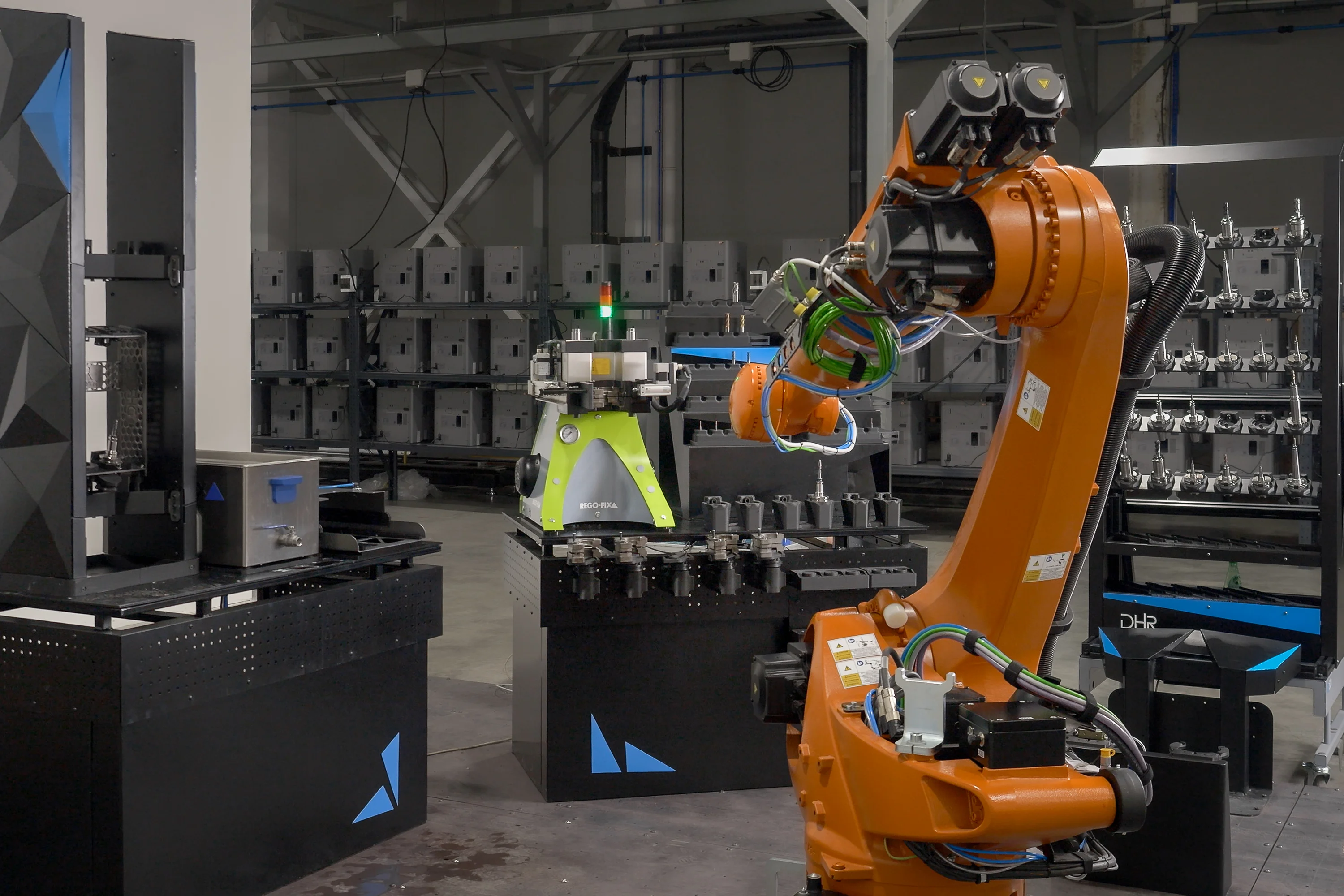
DHR Engineering builds automation for hardware startups. One line of work is automation for additive manufacturing: robotic tending for print farms, unified scheduling software, and integration across platforms like FDM, SLS, SLA, and MJF so a mixed fleet runs continuously without an operator on the floor. Our own automated print farm, 44 FDM machines under a custom robot and a centralized control system, exists as universal manufacturing infrastructure. It normally turns out jigs, fixtures, brackets, and functional parts for our automation projects, and it has produced footwear and drone airframes in continuous lights-out runs to prove out throughput.
The point of that farm is that it does not care what it makes. The robot loads and clears beds, the software schedules and re-routes jobs, regardless of whether the file on the queue describes a bracket or a shoe. To make that concrete in a domain as far from our usual work, we collaborated with fashion designer Danit Peleg. What came off the beds were not prototypes, but finished, wearable 3D printed fabric pieces ready to be assembled into garments.
Peleg is the founder of 3D Printed Fashion Lab and one of the most established figures in 3D printed clothing. In 2015 she produced the first full fashion collection made on desktop 3D printers, and she has since built software with AI that converts any conventional sewing pattern into wearable, 3D-printable files.[^3] The garment becomes code. She has also worked with a new plant-based, biodegradable material developed specifically for 3D printed clothing. That combination, a digital design pipeline feeding a sustainable printed material, is exactly the kind of product our farm is built to manufacture on demand. Her side supplies the files and the material science; ours supplies the production layer that makes hundreds of units as routine as one.
The Waste Behind Fashion Production and What Additive Fixes
Fashion is one of the most wasteful industries on the planet. The industry is not slow or unsophisticated. Modern fast fashion is extremely fast, with mature digital patternmaking and design-to-shelf cycles measured in days, and the leaders deliberately produce in small batches and reorder what sells. The waste comes from a different place: the sheer scale of variety the model generates, the volume of garments that never sell, and the pollution and labor cost baked into producing all of it.
120 million tonnes | Less than 1% | ~$150 billion |
|---|---|---|
Textiles discarded globally in 2024, about 80% landfilled or incinerated, Boston Consulting Group, 2024 | Share of textile waste recycled back into new fibers, Boston Consulting Group, 2024 | Raw-material value lost each year to unrecovered textile waste, Boston Consulting Group, 2024 |
The volume keeps climbing. Around 92 million tonnes of textile waste are generated every year, and on current trends that figure is heading toward 150 million tonnes annually by 2030.[^1] Producing textiles accounts for about 92% of the industry's greenhouse gas emissions, and the sector as a whole is responsible for close to 10% of global emissions, more than aviation and maritime shipping combined.[^2] The deeper driver is overassortment: brands release thousands of new styles, in some cases daily, and even small per-style batches add up to enormous volume across that many SKUs. Around 100 billion garments are produced each year, and an estimated 20 to 30% of them are never sold.[^6]
On-demand additive production changes fashion by shifting the logic of production itself. The same advantages we exploit when printing drone frames apply directly to garments:
Factor | Conventional fast fashion | Additive, on-demand |
|---|---|---|
Minimum order | Mill and factory minimums per style | One unit |
Production trigger | Made ahead of sale, in assortment | Made to order, after sale |
Inventory risk | Unsold stock, markdowns, dead stock | None, nothing made on spec |
Waste profile | Cut offcuts plus unsold volume | Prints to net shape, no offcuts |
Customization and size range | New samples or runs per variation | Change the file, near-zero cost |
End of life | Mostly landfill or incineration | Biodegradable, recyclable |
The material is what closes the loop
Peleg worked with Algenesis and ColorFabb to develop a plant-based TPU filament made from castor, hemp, and algae oils. It is bio-based, produces zero microplastics, and is recyclable. It also biodegrades on its own in a natural microorganism-rich environment, in soil or in water, rather than needing an industrial composter or special facility.[^4] Durability and biodegradation are separate properties here, so a garment stays strong and flexible in normal wear and breaks down only once it is deliberately returned to that environment at end of life.
Peleg's recent experiments push the same circular direction, including a process that shreds denim production scrap and blends it with recycled TPU into printable pellets.[^5] Combine that material with on-demand printing and a digital design pipeline and the waste profile of a garment changes at every stage: no offcuts in production, no dead stock from overproduction, and no persistent plastic at disposal.


In Practice: Why Short Prints Are an Automation Problem
A digital design pipeline and a biodegradable material only matter at scale if you can produce them without a person babysitting every machine. That is the layer we own, and this run is a clean example of why it is the hard part.
We printed Peleg's modular lace pieces on demand, exactly the pieces the collection needed and nothing more, which is the entire point of made-to-order production. The components came off the beds ready to be joined, and the assembled result is the garment shown in the video.
The capacity behind that run is what makes it more than a demonstration. Running continuously and unattended, the same farm can produce up to 2,000 lace pieces in a 24-hour window, enough to assemble roughly 200 skirts in a single day. That number is not a function of faster printers. It is a function of keeping every printer working through the night without a person in the room, which is exactly what a lace piece makes difficult.
A short print is the worst case for manual operation
Here is the counterintuitive part. A lace piece like this is only three to four layers tall, so each one is a short job. Short jobs are usually good news. In this case they are the problem.
The biodegradable TPU has to be printed very slowly, because the material will not tolerate the speeds a rigid filament would. But each piece is very shallow, under 1mm tall, so a bed still finishes every minute across a 44-machine fleet. Run that farm by hand and someone has to stand at the machines clearing finished plates and starting new jobs almost constantly, all day and all night, with a gap after every single piece. Miss a few minutes and that printer sits idle, producing nothing, while the operator is across the room at another machine.
That is where utilization disappears. The printers are not the bottleneck and the file is not the bottleneck. The bottleneck is the few minutes of dead time after every short job, multiplied across dozens of machines and a 24-hour day. Manual print rooms typically land at roughly 40 to 60% utilization for exactly this reason. The shorter the job, the worse it gets, because the changeover happens more often. Automation removes that dead time. The robot clears a finished plate and starts the next job in seconds, around the clock, and a short print stops being a liability and becomes throughput.
Why you cannot just push the part off the bed
Most print-farm automation handles part removal the cheap way. The machine finishes, then a scraper or the print head itself pushes the finished part off the build surface so the next job can start on the same plate. That works when the part is tall and rigid enough to take the shove.
A lace piece is the exact opposite. It is a few layers of flexible TPU fused flat across the whole plate, with a large footprint and almost no height. There is nothing rigid to push against, and trying to shove it would tear or deform it. The only reliable way to clear it is to swap the entire build plate, lifting the finished plate out with the part still on it and dropping a clean plate in its place. Our farm does that with robotic build-plate handling rather than part ejection, which is what lets it run flat, delicate, large-footprint geometry like this unattended. The same plate-swap approach is also what lets the farm move between completely different products without anyone reconfiguring the removal step.
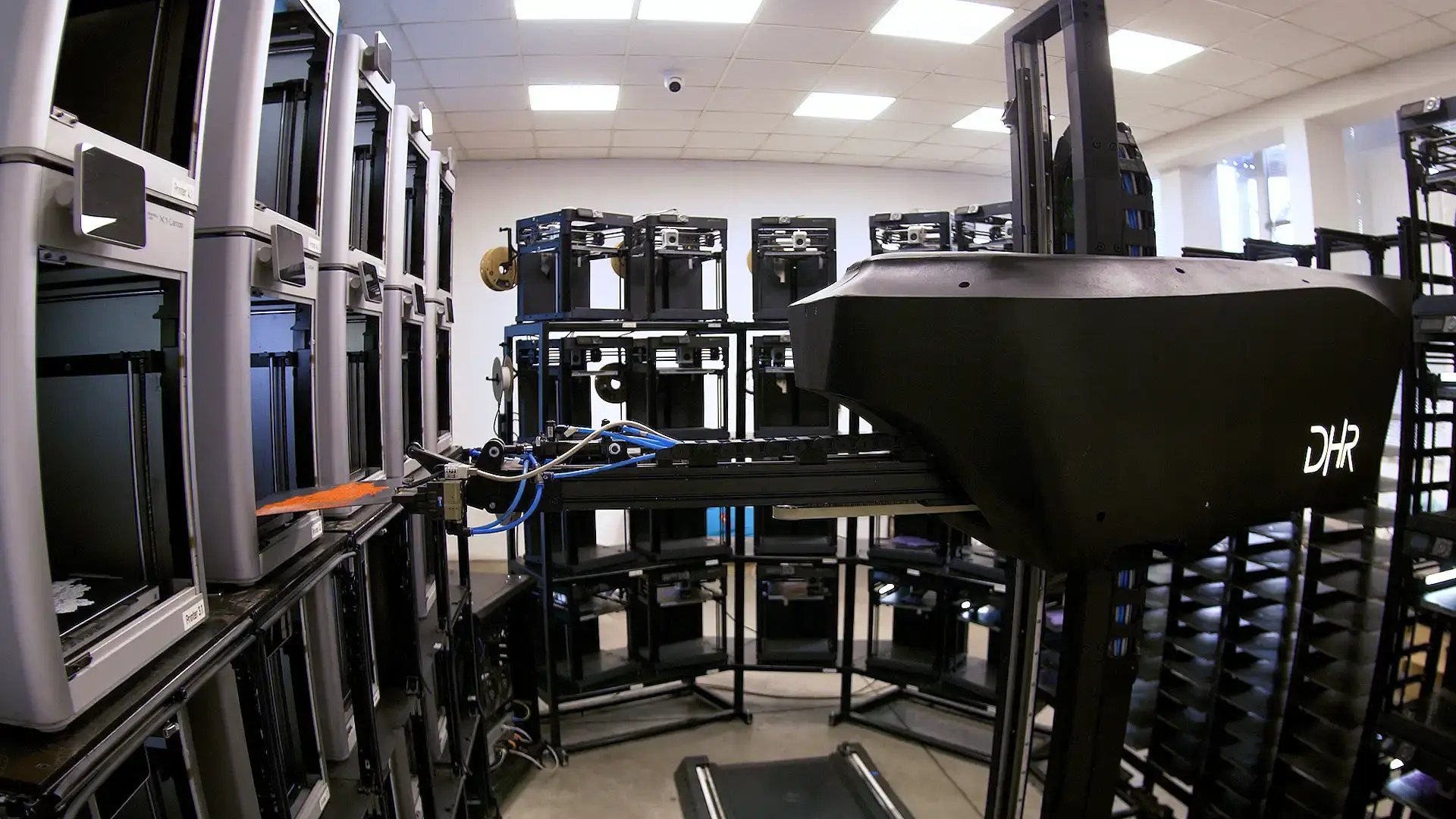
One unchanged farm, three unrelated products
What matters is what the run did not require. We did not build a garment line. We did not retool, re-fixture, or reconfigure the farm. The robot, the scheduling software, and the material handling that produce drone bodies produced lace the same way, because to the system a skirt panel is just another geometry in the queue. This is the same result we documented running 120 drone airframes in under 24 hours and a continuous 48-hour footwear cycle that modeled finished sneakers at roughly $15 a pair. Three products with nothing in common, one unchanged farm.
That generality is the entire commercial case. Once the automation exists, the marginal cost of pointing it at a new product is close to zero. A brand that wants made-to-order garments does not need a garment factory, and a defense unit that needs airframes does not need a drone factory. Both need a print farm that runs lights-out and switches output on demand. The bottleneck in every one of these runs was the same, and it was never the printer or the file. It was machine uptime: keeping a fleet productive overnight through robotic tending, build-plate handling, scheduling, and material logistics. That is precisely the problem we exist to solve.
We design and build that production layer from first principles for each client's environment, across FDM, SLA, SLS, and metal printing workflows, and we spend about half of every project on the client's floor, because lights-out reliability is earned at the machine. If your bottleneck is throughput and fleet utilization rather than machine capacity, let's talk.
Frequently Asked Questions on 3D Printed Fashion and Automation
Same Farm, Different File: Drone Frames One Day, Designer Lace the Next
A few weeks ago our print farm produced 120 drone airframes in under 24 hours, unattended. Shortly after, the same machines printed the biodegradable lace for a designer's garment collection, on demand, only as many pieces as the collection actually called for. Nothing on the farm was rebuilt, retooled, or reconfigured between those two runs. We only changed the files.
That is the whole argument for automated additive manufacturing, and it is easy to miss because the two products could not look more different. A quadcopter body and a lace garment share no supply chain, no material assumptions, and no traditional factory on earth. They have nothing in common, except the farm that printed both. At DHR we build the automation that lets a single fleet of printers run lights-out and switch from one product to the next on demand. We document what our farm can do by pointing it at things it was never built for. This time: fashion.
The garments from this run featured in Danit Peleg's "Prompts to Fashion" talk at Figma Config 2026, where she made the case that on-demand, zero-waste fashion is producible today.
DHR and Danit Peleg: a Collaboration Outside the Factory
DHR Engineering builds automation for hardware startups. One line of work is automation for additive manufacturing: robotic tending for print farms, unified scheduling software, and integration across platforms like FDM, SLS, SLA, and MJF so a mixed fleet runs continuously without an operator on the floor. Our own automated print farm, 44 FDM machines under a custom robot and a centralized control system, exists as universal manufacturing infrastructure. It normally turns out jigs, fixtures, brackets, and functional parts for our automation projects, and it has produced footwear and drone airframes in continuous lights-out runs to prove out throughput.
The point of that farm is that it does not care what it makes. The robot loads and clears beds, the software schedules and re-routes jobs, regardless of whether the file on the queue describes a bracket or a shoe. To make that concrete in a domain as far from our usual work, we collaborated with fashion designer Danit Peleg. What came off the beds were not prototypes, but finished, wearable 3D printed fabric pieces ready to be assembled into garments.
Peleg is the founder of 3D Printed Fashion Lab and one of the most established figures in 3D printed clothing. In 2015 she produced the first full fashion collection made on desktop 3D printers, and she has since built software with AI that converts any conventional sewing pattern into wearable, 3D-printable files.[^3] The garment becomes code. She has also worked with a new plant-based, biodegradable material developed specifically for 3D printed clothing. That combination, a digital design pipeline feeding a sustainable printed material, is exactly the kind of product our farm is built to manufacture on demand. Her side supplies the files and the material science; ours supplies the production layer that makes hundreds of units as routine as one.
The Waste Behind Fashion Production and What Additive Fixes
Fashion is one of the most wasteful industries on the planet. The industry is not slow or unsophisticated. Modern fast fashion is extremely fast, with mature digital patternmaking and design-to-shelf cycles measured in days, and the leaders deliberately produce in small batches and reorder what sells. The waste comes from a different place: the sheer scale of variety the model generates, the volume of garments that never sell, and the pollution and labor cost baked into producing all of it.
120 million tonnes | Less than 1% | ~$150 billion |
|---|---|---|
Textiles discarded globally in 2024, about 80% landfilled or incinerated, Boston Consulting Group, 2024 | Share of textile waste recycled back into new fibers, Boston Consulting Group, 2024 | Raw-material value lost each year to unrecovered textile waste, Boston Consulting Group, 2024 |
The volume keeps climbing. Around 92 million tonnes of textile waste are generated every year, and on current trends that figure is heading toward 150 million tonnes annually by 2030.[^1] Producing textiles accounts for about 92% of the industry's greenhouse gas emissions, and the sector as a whole is responsible for close to 10% of global emissions, more than aviation and maritime shipping combined.[^2] The deeper driver is overassortment: brands release thousands of new styles, in some cases daily, and even small per-style batches add up to enormous volume across that many SKUs. Around 100 billion garments are produced each year, and an estimated 20 to 30% of them are never sold.[^6]
On-demand additive production changes fashion by shifting the logic of production itself. The same advantages we exploit when printing drone frames apply directly to garments:
Factor | Conventional fast fashion | Additive, on-demand |
|---|---|---|
Minimum order | Mill and factory minimums per style | One unit |
Production trigger | Made ahead of sale, in assortment | Made to order, after sale |
Inventory risk | Unsold stock, markdowns, dead stock | None, nothing made on spec |
Waste profile | Cut offcuts plus unsold volume | Prints to net shape, no offcuts |
Customization and size range | New samples or runs per variation | Change the file, near-zero cost |
End of life | Mostly landfill or incineration | Biodegradable, recyclable |
The material is what closes the loop
Peleg worked with Algenesis and ColorFabb to develop a plant-based TPU filament made from castor, hemp, and algae oils. It is bio-based, produces zero microplastics, and is recyclable. It also biodegrades on its own in a natural microorganism-rich environment, in soil or in water, rather than needing an industrial composter or special facility.[^4] Durability and biodegradation are separate properties here, so a garment stays strong and flexible in normal wear and breaks down only once it is deliberately returned to that environment at end of life.
Peleg's recent experiments push the same circular direction, including a process that shreds denim production scrap and blends it with recycled TPU into printable pellets.[^5] Combine that material with on-demand printing and a digital design pipeline and the waste profile of a garment changes at every stage: no offcuts in production, no dead stock from overproduction, and no persistent plastic at disposal.
In Practice: Why Short Prints Are an Automation Problem
A digital design pipeline and a biodegradable material only matter at scale if you can produce them without a person babysitting every machine. That is the layer we own, and this run is a clean example of why it is the hard part.
We printed Peleg's modular lace pieces on demand, exactly the pieces the collection needed and nothing more, which is the entire point of made-to-order production. The components came off the beds ready to be joined, and the assembled result is the garment shown in the video.
The capacity behind that run is what makes it more than a demonstration. Running continuously and unattended, the same farm can produce up to 2,000 lace pieces in a 24-hour window, enough to assemble roughly 200 skirts in a single day. That number is not a function of faster printers. It is a function of keeping every printer working through the night without a person in the room, which is exactly what a lace piece makes difficult.
A short print is the worst case for manual operation
Here is the counterintuitive part. A lace piece like this is only three to four layers tall, so each one is a short job. Short jobs are usually good news. In this case they are the problem.
The biodegradable TPU has to be printed very slowly, because the material will not tolerate the speeds a rigid filament would. But each piece is very shallow, under 1mm tall, so a bed still finishes every minute across a 44-machine fleet. Run that farm by hand and someone has to stand at the machines clearing finished plates and starting new jobs almost constantly, all day and all night, with a gap after every single piece. Miss a few minutes and that printer sits idle, producing nothing, while the operator is across the room at another machine.
That is where utilization disappears. The printers are not the bottleneck and the file is not the bottleneck. The bottleneck is the few minutes of dead time after every short job, multiplied across dozens of machines and a 24-hour day. Manual print rooms typically land at roughly 40 to 60% utilization for exactly this reason. The shorter the job, the worse it gets, because the changeover happens more often. Automation removes that dead time. The robot clears a finished plate and starts the next job in seconds, around the clock, and a short print stops being a liability and becomes throughput.
Why you cannot just push the part off the bed
Most print-farm automation handles part removal the cheap way. The machine finishes, then a scraper or the print head itself pushes the finished part off the build surface so the next job can start on the same plate. That works when the part is tall and rigid enough to take the shove.
A lace piece is the exact opposite. It is a few layers of flexible TPU fused flat across the whole plate, with a large footprint and almost no height. There is nothing rigid to push against, and trying to shove it would tear or deform it. The only reliable way to clear it is to swap the entire build plate, lifting the finished plate out with the part still on it and dropping a clean plate in its place. Our farm does that with robotic build-plate handling rather than part ejection, which is what lets it run flat, delicate, large-footprint geometry like this unattended. The same plate-swap approach is also what lets the farm move between completely different products without anyone reconfiguring the removal step.
One unchanged farm, three unrelated products
What matters is what the run did not require. We did not build a garment line. We did not retool, re-fixture, or reconfigure the farm. The robot, the scheduling software, and the material handling that produce drone bodies produced lace the same way, because to the system a skirt panel is just another geometry in the queue. This is the same result we documented running 120 drone airframes in under 24 hours and a continuous 48-hour footwear cycle that modeled finished sneakers at roughly $15 a pair. Three products with nothing in common, one unchanged farm.
That generality is the entire commercial case. Once the automation exists, the marginal cost of pointing it at a new product is close to zero. A brand that wants made-to-order garments does not need a garment factory, and a defense unit that needs airframes does not need a drone factory. Both need a print farm that runs lights-out and switches output on demand. The bottleneck in every one of these runs was the same, and it was never the printer or the file. It was machine uptime: keeping a fleet productive overnight through robotic tending, build-plate handling, scheduling, and material logistics. That is precisely the problem we exist to solve.
We design and build that production layer from first principles for each client's environment, across FDM, SLA, SLS, and metal printing workflows, and we spend about half of every project on the client's floor, because lights-out reliability is earned at the machine. If your bottleneck is throughput and fleet utilization rather than machine capacity, let's talk.
Frequently Asked Questions on 3D Printed Fashion and Automation
References
[^1]: UNEP. Unsustainable Fashion and Textiles in Focus for International Day of Zero Waste 2025. 2025: unep.org
[^2]: U.S. Government Accountability Office. Report on Textile Waste and Fast Fashion's Environmental Toll. 2024. Reported via Fibershed: fibershed.org
[^3]: VoxelMatters. Designer Uses AI to Turn Clothing Patterns into 3D Printable Wearables. 2026: voxelmatters.com
[^4]: SpecialChem. Soleic TPU 1295A by Algenesis — Technical Datasheet. 2025: specialchem.com
[^5]: 3D Printing Industry. Danit Peleg Debuts Early Prototype for 3D Printed Denim Made From Recycled Waste. 2025: 3dprintingindustry.com
[^6]: ScienceDirect. Assessing Fast Fashion Overstock Through Time-to-Peak-Sales. 2025: sciencedirect.com